
To find the HSN code for your product, search it by name on the GST portal's free Search HSN/SAC page. Then confirm it by working down the tariff: Section, Chapter, 4-digit heading, 8-digit tariff item. Read the chapter notes at each step. Before you print a single invoice, match that code to the current CBIC rate notification, because rates moved again on 1 November 2026.
Wrong HSN code GST cost calculator
Works out the GST you should charge on an invoice, what you actually charged, and how big the gap becomes over a year if the HSN code or rate is wrong.
Correct GST per invoice —
CGST and SGST each (same-state sale) —
GST you charged per invoice —
Gap per invoice (positive means you under-charged) —
Gap over 12 months —
Rough interest on a 12-month shortfall at 18% a year (average 6-month delay) —
Same-state sales split GST equally into CGST and SGST; inter-state sales carry the full rate as IGST. Interest on short-paid tax is 18% a year under Section 50 of the CGST Act. Confirm your rate in the current CBIC Central Tax (Rate) notification.
Most guides on how to find HSN code stop at "type your product name in the search box". That works for a plain cotton towel. It fails for a lacquered wooden toy, a 60/40 cotton-poly T-shirt, a refurbished phone or a Diwali hamper, where two codes look right and carry different GST rates. This guide covers those cases.
Key facts
- HSN means Harmonized System of Nomenclature. The World Customs Organization maintains it, and India uses it at 8 digits for goods. Services use SAC codes, which start with 99.
- Structure: 2 digits = chapter, 4 = heading, 6 = sub-heading, 8 = tariff item. There are 21 sections and 97 chapters.
- How many digits you must show: under Notification 78/2020-Central Tax, in force since 1 April 2021, turnover above ₹5 crore means at least 6 digits. Up to ₹5 crore means at least 4 digits on B2B invoices.
- Official search: GST portal, Services > User Services > Search HSN Code. No login needed. You can also download the full directory in Excel.
- Rate changes to track: 22 September 2025 (the 12% and 28% slabs were merged into 5% and 18%, and a 40% slab was added), 1 February 2026, and 1 November 2026.
- Latest round: the 57th GST Council meeting (8 October 2026) led to Central Tax (Rate) Notifications 2/2026 to 10/2026. Tax-news coverage dates them 27 October 2026. They took effect on 1 November 2026.
- Classification clarifications: Circular 265/11/2026-GST (28 October 2026) covers toys under heading 9503, sublimation paper and seaweed bio-stimulants.
What changed on 1 November 2026, and why your old code needs a second look
The codes themselves did not change. The rate and tax treatment attached to some of them did. If your billing software still carries October's rate against your code, every invoice since 1 November is wrong.
Here is what tax-news sites (TaxGuru, TaxGst.in, Taxo) report from the new notifications. Confirm each row on the CBIC GST site before you change your item master.
| Item | HSN/SAC | Before | From 1 Nov 2026 |
|---|---|---|---|
| Retreaded tractor tyres | 4012 | 18% | 5% |
| Psyllium (isabgol) seeds | 1211 90 13 | 5% if dried or frozen | Nil |
| Delivery through an e-commerce operator | 9968 | 18% | 5%, no ITC |
| Hotels (up to ₹7,500 a day), restaurants, catering | 9963 | 5%, no ITC | 5% with same-line credit |
| Used cooking oil, plastic waste, tyre waste, e-waste | 1518, 3915, 4004, 8549 | Forward charge | Reverse charge, plus reported 2% GST TDS on scrap purchases |
Look at the scrap row. Whether the buyer or the seller pays the tax now depends entirely on the 4-digit heading. A kabadi dealer in your district who puts plastic waste under the wrong heading gets the tax payer wrong, not just the rate. Code galat, toh poora tax ka system galat.
How to find HSN code on the GST portal, step by step
This is the official route, from the GST portal's own tutorial. It takes five minutes.
- Go to services.gst.gov.in/services/searchhsnsac, or open the GST portal and click Services > User Services > Search HSN Code. You do not need to log in.
- Search by product name ("toy", "T-shirt", "corrugated") or by a code you already have.
- For the full list, click Download HSN Directory in Excel Format under "Search HSN Chapter by Code". Filter the Excel by your chapter. Reading 40 rows beats trusting one search result.
- Write down every code that looks right. Usually there are two or three. The rest of this guide is about picking between them.
- Check the GST rate for your final code in the current CBIC rate notification. Do not rely on a rate shown on a blog, including this one.
Want a faster first pass? Type your product into the KidharMilega HSN Code Finder to get candidate codes in seconds. Then run the checks below before you put any of them on an invoice.
If your item truly is not in the directory, you can raise a ticket on the GST self-service helpdesk at selfservice.gstsystem.in. Usually, though, the product is listed under a name you did not try.
Reading the code: what each pair of digits tells you
An HSN code works like a postal address. Each pair of digits narrows the search. Take a cotton T-shirt:
| Level | Digits | Example | What it says |
|---|---|---|---|
| Section | Roman numeral, not part of the code | Section XI | Textiles and textile articles |
| Chapter | 2 | 61 | Apparel, knitted or crocheted |
| Heading | 4 | 6109 | T-shirts, singlets and other vests, knitted |
| Sub-heading | 6 | 6109 10 | Of cotton |
| Tariff item | 8 | 6109 10 00 | India's national line, used for customs and exports |
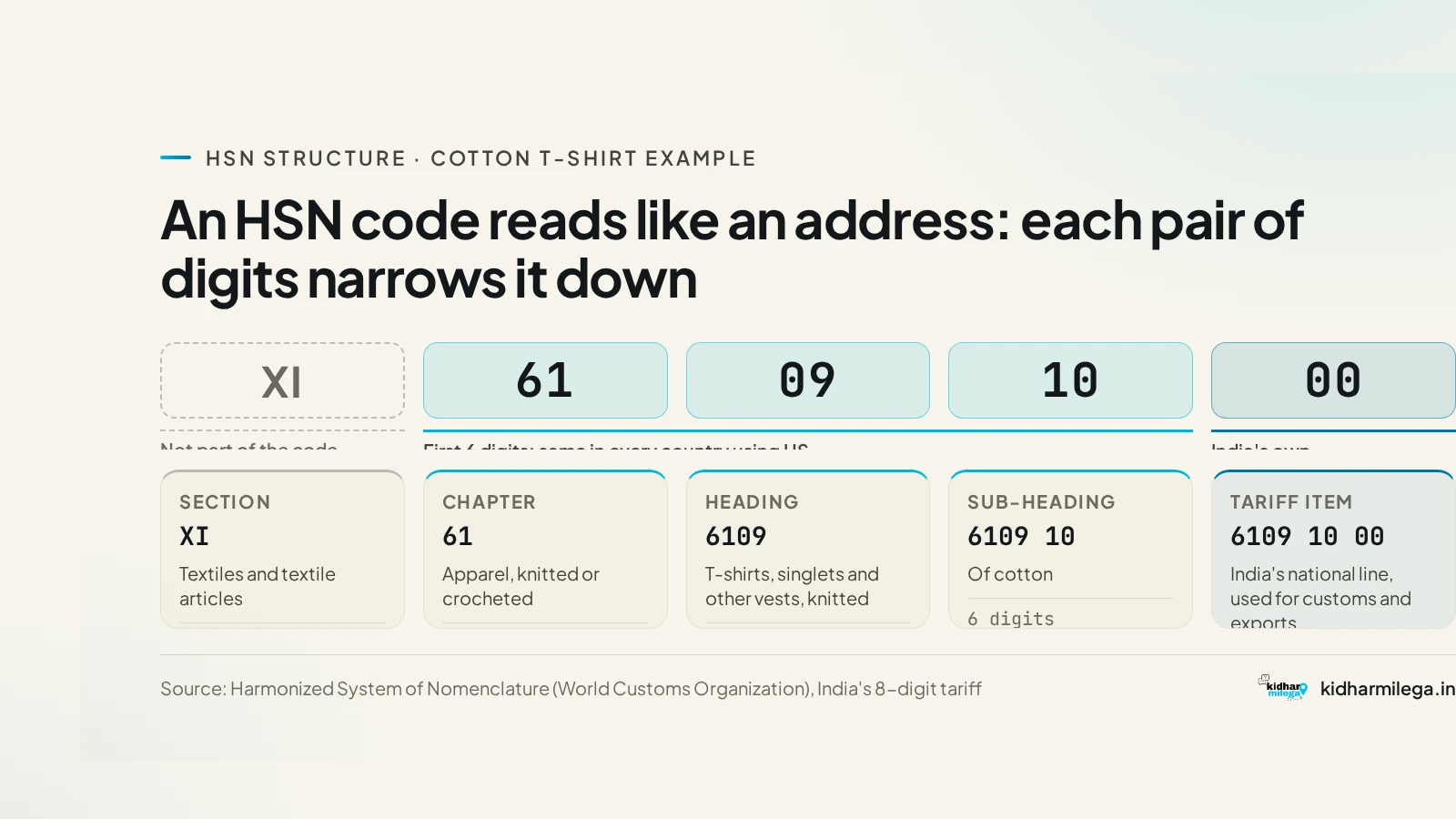
The first 6 digits are the same in every country that uses HS. Digits 7 and 8 are India's own. That matters when you export. Your buyer's customs office in Germany will read the first six exactly the way you do.
How many digits do you need on your invoice?
- Aggregate annual turnover up to ₹5 crore: at least 4 digits on B2B tax invoices.
- Above ₹5 crore: at least 6 digits on all tax invoices.
- E-invoices and e-way bills follow the same turnover logic. Where no valid 6-digit code exists, GSTN advises using the matching 8-digit code. The NIC e-invoice release notes set out the turnover rule.
- Exports: the shipping bill uses the full 8-digit ITC-HS code. No shortcut there.
Here is the honest advice. Even if the law lets you write 4 digits, work out all 8 once. The 4-digit heading 6109 does not tell you whether your T-shirt is "of cotton" or "of other textile materials". The 8-digit line does, and sometimes the rate depends on it.
The method finder tools skip: Section to Chapter to Heading to 8 digits
Classification has rules. They are called the General Rules for the Interpretation (GRI) of the Customs Tariff, and the GST rate notifications say the same rules, section notes and chapter notes apply to GST too. Six rules, in order. You only move to the next rule if the earlier one does not settle it.
| Rule | What it says, in plain words | When you use it |
|---|---|---|
| GRI 1 | Classify by the wording of the headings and the section and chapter notes. Section and chapter titles are only for reference. | Always first. It settles most products. |
| GRI 2(a) | An incomplete or unassembled article goes with the complete article if it already has the essential character of it. | CKD kits, a thresher shipped in parts, a phone missing its battery |
| GRI 2(b) | A mention of a material includes mixtures of that material. Then go to GRI 3. | Mixed-material goods |
| GRI 3(a) | The most specific description wins over a general one. | "Toy" beats "article of wood" |
| GRI 3(b) | Mixtures, composite goods and retail sets go by the component that gives them their essential character. | Gift sets, kits |
| GRI 3(c) | If still tied, take the heading that comes last in numerical order. | True 50/50 cases |
| GRI 4 | Goods that fit nowhere go with the goods they are most like. | New products |
| GRI 5 | Fitted cases and normal packing go with the goods they hold. | Camera case sold with camera, standard packaging |
| GRI 6 | Apply the same logic at sub-heading level, comparing only sub-headings at the same level. | Picking between 6-digit and 8-digit lines |
Now the real work. Here are four products that small founders actually sell, each classified from scratch.
Four tricky products, classified from scratch
1. Lacquered wooden toy from Etikoppaka: toy or wooden ornament?
Suppose you sell Etikoppaka lacquerware toys from Anakapalli. The search box shows two candidates: 9503 (toys) and 4420 (wooden statuettes and other ornaments). Both sound right.
- Section: wood products sit in Section IX (Chapter 44). Toys sit in Section XX, miscellaneous manufactured articles (Chapter 95).
- Chapter notes decide it (GRI 1): Chapter 44's notes exclude articles of Chapter 95, such as toys and games. So once the item is a toy, Chapter 44 is off the table, whatever it is made of.
- Heading: 9503 covers dolls, other toys, scale models and puzzles. Circular 265/11/2026-GST, as reported by tax-news sites, clarifies that all toys under 9503 are covered by the same rate entry, including dolls, puzzles and scale models.
- The real test: what is it designed for? A spinning top, rattle or toy cart made for children to play with goes to 9503. A lacquered elephant made to sit on a showcase, or a decorative box, goes to 4420 or another Chapter 44 heading.
Same kaarigar, same lathe, same lacquer, different code. Write the design intent into your catalogue description, because your invoice wording is the first thing an officer reads.
2. Cotton-poly T-shirt or jeans: which fibre wins?
Blends confuse almost every garment seller, from Tiruppur to the jeans units of Anantapur.
- Section XI (textiles, Chapters 50 to 63).
- Chapter: knitted or crocheted garments go to Chapter 61. Woven garments go to Chapter 62. Most T-shirts are knitted (61). Denim jeans are woven (62).
- Heading: T-shirts are 6109. Men's trousers, including jeans, are 6203. Women's are 6204.
- Sub-heading, the trap: Section XI's notes say a blended textile is classified as if it were made entirely of the fibre that is greatest by weight. A 60% cotton, 40% polyester T-shirt goes to 6109 10 (of cotton). A 35/65 cotton-poly T-shirt goes to 6109 90 (other textile materials). In a true 50/50 tie, the notes send you to the code that comes last in numerical order among those that equally apply.
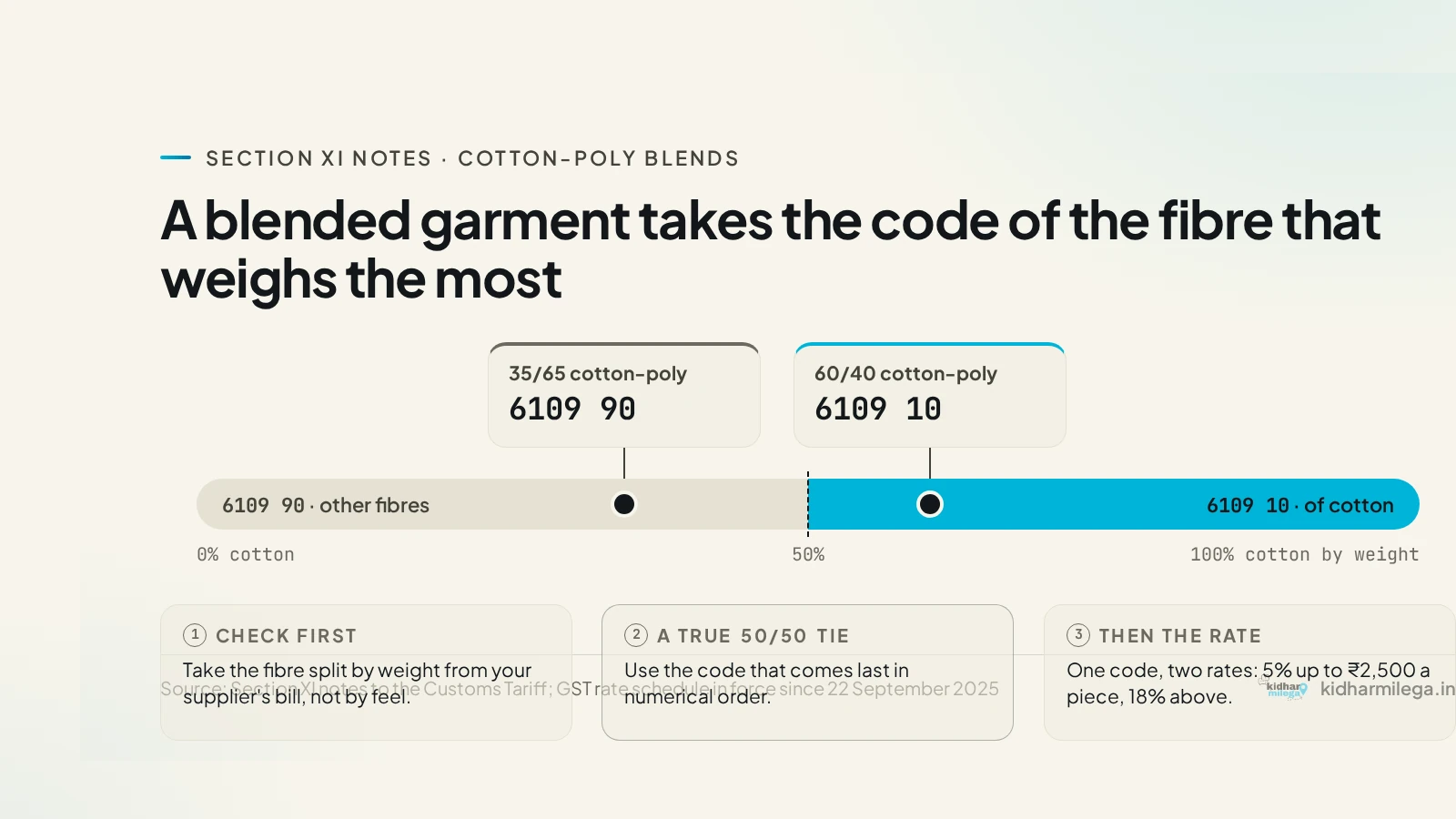
Check the fibre content on your fabric supplier's bill, by weight and not by "feel". Then check the rate. Under the schedule in force since 22 September 2025, readymade garments are taxed by sale value per piece: 5% up to ₹2,500 and 18% above it. One HSN code, two rates. Confirm that the February and November 2026 notifications have not touched your line.
3. Refurbished smartphone and its spare parts
- Section XVI (machinery and electrical equipment, Chapters 84 and 85).
- Chapter 85, heading 8517, sub-heading 8517 13: smartphones.
- "Refurbished" does not get its own code. Under GRI 1, the heading describes what the article is, not its history. A refurbished phone is still 8517 13.
- What changes is the value you tax. If you deal in second-hand goods and did not claim input tax credit on the purchase, Rule 32(5) of the CGST Rules lets you pay GST only on your margin (selling price minus purchase price). Buy at ₹8,000, sell at ₹10,000, and you pay GST on ₹2,000, not ₹10,000. If the margin is negative, it is ignored.
Spare parts are where repair shops go wrong. Section XVI's notes say that if a part is itself covered by a specific heading, it goes there and not under "parts of phones".
| Part | Where it goes | Why |
|---|---|---|
| Lithium-ion battery | 8507 60 | Accumulators have their own heading |
| Charger / adapter | 8504 40 | Static converters have their own heading |
| Display assembly, back panel | Parts of 8517 (8517 79) | No specific heading of their own, used solely with phones |
4. Diwali gift hamper: the GST rule that overrides "essential character"
Under customs logic, a hamper of dry fruits, chocolates and a decorative box is a "set put up for retail sale". GRI 3(b) says you classify it by the item that gives it its essential character, usually the dry fruits.
GST adds its own rule. Section 2(74) of the CGST Act defines a mixed supply, and its official illustration is almost word for word a Diwali hamper: canned foods, sweets, chocolates, cakes, dry fruits, aerated drinks and fruit juices sold for one price. Section 8 says a mixed supply is taxed at the highest rate among its items.
So one aerated drink at a higher rate in a ₹1,500 dry-fruit hamper can pull the whole hamper up to that rate. Practitioners usually show the HSN of the highest-rated item on that invoice line. Your two clean options: drop the high-rate item, or price each item separately on the invoice. Hamper ka rate, uske sabse mehnge item se tay hota hai.
Bonus: printed packaging, goods or printing service?
Box makers, like the corrugated box units of Sirmaur, often ask this. CBIC Circular 11/11/2017-GST answers it. Printed boxes, envelopes and cartons made from the printer's own paper, carrying the client's logo or design, are a supply of goods under Chapter 48 or 49. Corrugated cartons are 4819 10. Printing books or pamphlets where the client only supplies the content is a printing service (SAC 9989). Printing a logo on a corrugated box does not move it out of 4819.
Spare parts vs whole machines: the engineering seller's cheat sheet
If you make or trade parts, as many small units in Rajkot's engineering cluster do, these rules from the Section XV and XVI notes settle most disputes.
| What you sell | Goes to | Rule that decides |
|---|---|---|
| Bolts, nuts, screws, even if sold for a specific tractor | 7318 | "Parts of general use" stay in their own heading |
| Ball or roller bearings | 8482 | A specific Chapter 84 heading beats "parts of machine" |
| Impeller made only for a pump | 8413 91 (parts of pumps) | Parts used solely or principally with one machine go with it |
| Part made only for a lathe | 8466 | Machine-tool parts have their own heading |
| Complete thresher shipped unassembled | 8433, as the complete machine | GRI 2(a), unassembled article with essential character |
Now find the GST rate from the HSN code, the right way
A code without the current rate is half the job. Rates sit in the CBIC rate notifications, not in the HSN directory.
- Open cbic-gst.gov.in and go to the Central Tax (Rate) notifications.
- Find the rate schedule and match your code. Match the description too, not just the digits. Some entries are written at 8 digits (isabgol is 1211 90 13), and other lines under the same heading may carry a different rate.
- Read the conditions on the row. Watch for "pre-packaged and labelled" (common for cereals, flour and pulses, where loose and packaged versions of the same code are taxed differently), "sale value not exceeding ₹X per piece" for garments and footwear, and ITC conditions.
- Check the exemption notification separately. Nil-rated goods are listed there, not in the rate schedule.
- Check the later amending notifications: September 2025, February 2026 and the November 2026 set (2/2026 to 10/2026). The latest amendment wins.
- For scrap headings (1518, 3915, 4004, 8549), check the reverse-charge notification too.
Worked ₹ invoice: what a wrong HSN code actually costs
Take a ₹10,000 taxable sale. You picked a code at 5%, but the correct code for your product carries 18%.
| Line | Correct code (18%) | Wrong code (5%) |
|---|---|---|
| Taxable value | ₹10,000 | ₹10,000 |
| CGST (same state) | ₹900 | ₹250 |
| SGST (same state) | ₹900 | ₹250 |
| Or IGST (other state) | ₹1,800 | ₹500 |
| Invoice total | ₹11,800 | ₹10,500 |
Short-paid tax on this invoice: ₹1,300. That looks small. Now run it like a business:
- 40 such invoices a month = ₹4 lakh in monthly sales, or ₹48 lakh a year.
- Short tax over 12 months: ₹1,300 × 40 × 12 = ₹6,24,000.
- Interest under Section 50 of the CGST Act is 18% a year. If the shortfall built up evenly over the year, the average delay is about six months: ₹6,24,000 × 18% × 0.5 = roughly ₹56,000 in interest. Penalty can come on top.
- You cannot go back and collect the extra 13% from customers who have already paid. It comes out of your margin.
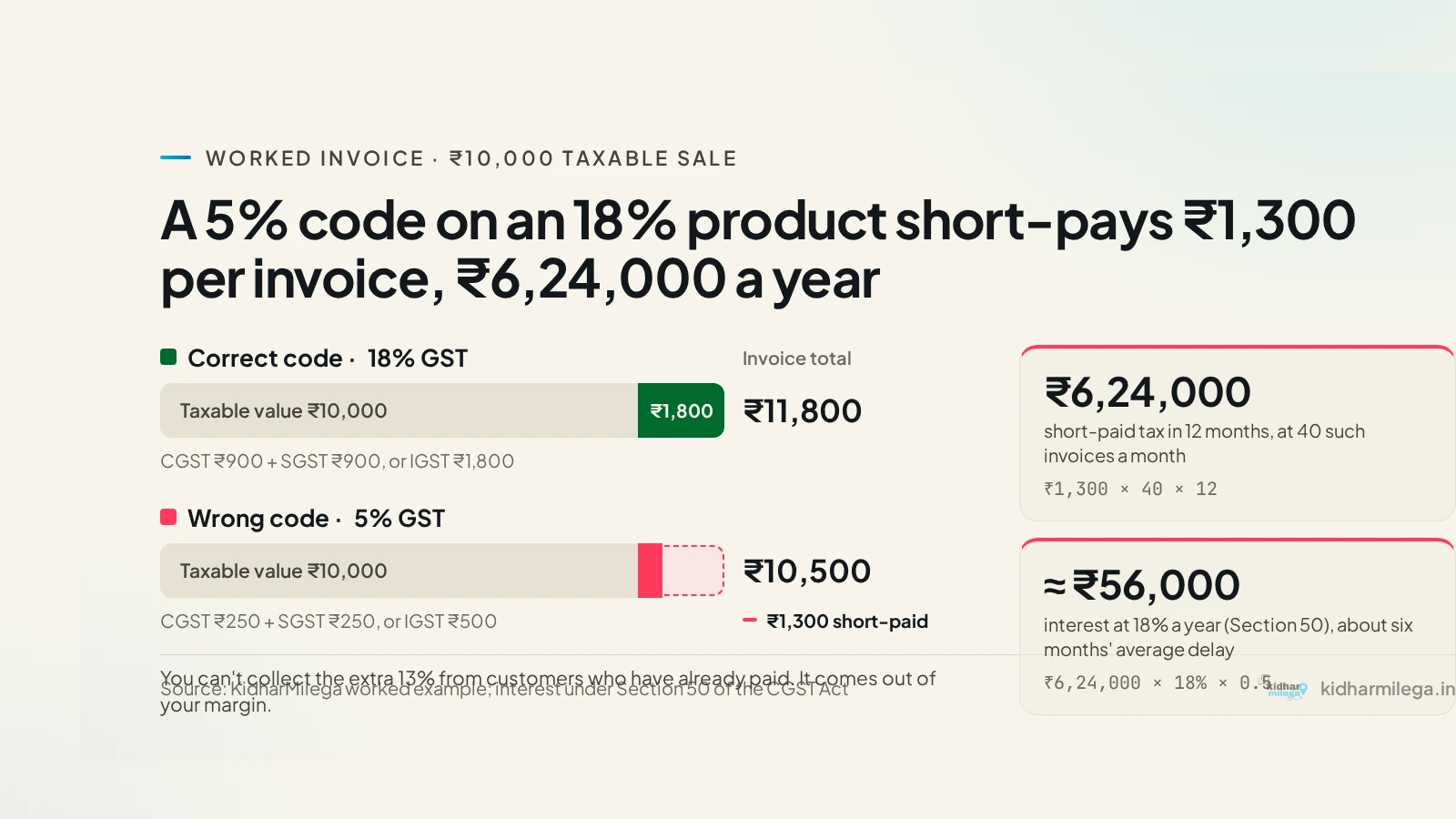
The opposite mistake hurts too. Say you sell retreaded tractor tyres and still bill at 18% after 1 November 2026, when tax-news reports put them at 5%. You collect ₹1,300 extra per ₹10,000. You must still deposit that with the government, because any amount collected as tax has to be paid in. Meanwhile your price looks 12% higher than a competitor billing correctly (₹11,800 against ₹10,500). B2B buyers can take the credit, but a farmer buying one tyre simply pays more and goes to the next dukaan.
Run your own numbers in the calculator on this page. Enter your invoice value, the correct rate, the rate you actually charged and your monthly invoice count.
Shortcuts that save time, and their limits
- Your supplier's purchase invoice or e-way bill. This is a good starting point if you resell the same item unchanged. If you transform it, the code changes. Cotton fabric bought under Chapter 52 becomes a shirt under Chapter 62 the moment you stitch it.
- Competitors' invoices and Amazon or GeM listings. Useful for spotting candidate codes. Not proof, because competitors get it wrong too. Different sources even disagree on common items like LED lights (8539 vs 9405).
- ICEGATE and the CBIC customs tariff. For imports and exports, this is where the 8-digit tariff lines and chapter notes live in full. Exporters should cross-check against the DGFT ITC-HS schedule, because the shipping bill needs those 8 digits.
- Advance ruling. When two codes carry different rates, the product is your main line, and the ₹ gap runs into lakhs, apply to your state's Authority for Advance Ruling in Form GST ARA-01. The fee is ₹5,000 under CGST plus ₹5,000 under SGST. The ruling binds only you and your tax officer, which is exactly the protection you need.
How to check an HSN code you already use
- Re-search it on the GST portal by code. If the description that comes back does not describe your product, you have a problem.
- Watch e-invoice and e-way bill errors. The e-invoice system checks codes against its master list. An invalid code is commonly reported to throw a validation error before an IRN is generated.
- Use GSTR-1 Table 12. Since the 2025 changes, HSN codes are picked from a dropdown instead of typed, and the table has separate B2B and B2C tabs, with the B2B tab mandatory. If your code is not in the dropdown, it is not a valid code. The older GSTN advisory on HSN in GSTR-1 explains the digit rules.
- Reconcile before the annual return. GSTR-9 and 9C for FY 2025-26 opened on 8 October 2026, and the annual return has its own HSN summary. Mismatches between your invoices, GSTR-1 and GSTR-9 are exactly what notices get built on.
- Check your buyer's side. If a B2B buyer complains that their input tax credit does not match, the HSN or rate on your invoice is the first thing to check.
Galat tareeka vs sahi tareeka
Galat tareeka: Google "HSN code for [product]", copy the first number from a blog, type it into Tally, and never look again.
Sahi tareeka: Get candidate codes from the portal or a finder. Narrow them down Section by Section using the chapter notes. Check the current rate notification. Write the reasoning in one line in your item master. Recheck every time the GST Council meets.
Checklist: classify your product in 10 minutes
Built from the GST portal tutorial, Notification 78/2020-Central Tax and the CBIC rate notifications. Print it and keep it next to your billing desk.
- Describe the product in one line: what it is, what it is made of (by weight), what it is for, and how it is sold (loose, packed, set).
- Search that description on the GST portal's Search HSN page. Note every plausible code.
- Find the Section and Chapter for each candidate. Read the chapter notes, especially the exclusions.
- Apply GRI 1. If the heading wording plus the notes settle it, stop here.
- If not: is it unassembled or incomplete (GRI 2)? A mix or a set (GRI 3, essential character)? A tie (last in numerical order)?
- For parts, ask whether the part has its own heading (bearings, bolts, batteries, chargers) before filing it under "parts of".
- Go to 6 digits, then 8, comparing only lines at the same level (GRI 6).
- Confirm how many digits your turnover requires: 4 (up to ₹5 crore, B2B) or 6 (above ₹5 crore). Keep all 8 on file anyway.
- Match the code and description to the latest CBIC rate notification. Check conditions (per-piece value, pre-packaged and labelled), the exemption list and reverse charge.
- For a mixed supply (hamper, combo), apply the highest rate, or split the items on the invoice.
- Write a one-line reason in your item master. Recheck after every GST Council meeting.
- If two codes still look right and the tax gap is large, apply for an advance ruling.
Bhaiya's take: who should do this themselves, and who should get help
If you sell 5 to 20 products, especially a single-material item like a handloom saree, a spice or a wooden toy, do this yourself. One focused evening with the Excel directory and the chapter notes is enough. Nobody knows your product's material and purpose better than you.
Get a CA or an advance ruling if you sell kits, combos, food in multiple pack formats, or anything electronic with parts. A rate difference of 13 percentage points on a ₹48 lakh business is ₹6 lakh. That justifies a ₹10,000 ruling fee many times over.
Code ek baar sahi baitha do. Phir har invoice apne aap sahi niklega.
Your next step
Pick your top-selling product this week and run it through the checklist above. If you plan to sell abroad, your 8-digit code is also how foreign buyers and importers search for suppliers. Put it into the Export Buyer Finder to see who buys that product overseas. Starting from scratch and not sure what to make yet? Begin at the KidharMilega home page and look at what your own district already produces.
Frequently asked questions
How do I find the HSN code for my product on the GST portal?
Open services.gst.gov.in/services/searchhsnsac, or go to Services, User Services, Search HSN Code on the GST portal. No login is needed. Search by product name or code, note every plausible result, and download the full HSN directory in Excel if you want to compare lines within a chapter. Then confirm the GST rate in the current CBIC rate notification.
How many digits of HSN code do I need on my invoice?
Under Notification 78/2020-Central Tax, in force since 1 April 2021, businesses with annual turnover up to Rs 5 crore must show at least 4 digits on B2B invoices. Above Rs 5 crore, at least 6 digits on all tax invoices. Exporters need the full 8-digit ITC-HS code on the shipping bill. Keep all 8 digits on file anyway.
What is the difference between HSN and SAC codes?
HSN codes classify goods. They come from the World Customs Organization's Harmonized System, and India uses them at 8 digits. SAC (Services Accounting Code) classifies services under GST, and every SAC starts with 99, for example 9963 for hotel and restaurant services or 9989 for printing services. If you supply both goods and services, you need both.
Did HSN codes or GST rates change on 1 November 2026?
The codes did not change, but the rates and tax treatment for some codes did, through Central Tax (Rate) Notifications 2/2026 to 10/2026 after the 57th GST Council meeting. Reported changes include retreaded tractor tyres (4012) moving from 18% to 5%, isabgol seeds becoming nil-rated, and several scrap items moving to reverse charge. Check your line on cbic-gst.gov.in.
What happens if I use the wrong HSN code?
If the wrong code carries a lower rate, you owe the short-paid tax plus interest at 18% a year under Section 50 of the CGST Act, and possibly a penalty. If it carries a higher rate, you still have to deposit the extra tax you collected, and your price looks costlier. Wrong codes also cause GSTR-1 errors and input tax credit mismatches for your buyers.
What should I do if my product is not in the HSN list?
First try other names and materials, and read the chapter notes, because most products are listed under a broader description. If nothing fits, the General Rules of Interpretation send you to the heading for the goods it is most like. You can raise a ticket on the GST self-service helpdesk, or apply for an advance ruling if the tax at stake is large.
Sources
- Search HSN/SAC Tax Rates: User Manual · GST Portal (GSTN)
- Advisory on mandatory HSN in GSTR-1 Table 12 · GSTN
- E-invoice release notes · National Informatics Centre
- GST changes from 1 November 2026: item-wise guide to notifications · TaxGuru
- GST rate changes from November 2026 · TaxGst.in
- CBIC GST rate clarifications: toys, used cars, sublimation paper, bio-stimulants · SAG Infotech