Kalamkari cloth material is cotton or silk coloured with natural dyes. In Srikalahasti it is drawn freehand with a bamboo kalam (pen). In Pedana and Machilipatnam the outlines are printed with hand-carved wooden blocks and the colours are filled in by hand. As of November 2026, genuine hand-block cotton sells for roughly ₹250 to ₹600 a metre and hand-painted cotton for ₹1,200 to ₹2,500 a metre. A lot of what's listed cheaper as "kalamkari print" is a screen or digital print of the design, made without the craft.
Kalamkari outfit cost calculator
Works out the kalamkari fabric to order, including a shrinkage buffer, and the total cost of your finished outfit.
Kalamkari metres to order (with 5% shrinkage buffer) —
Kalamkari fabric cost —
Total outfit cost —
Uses a 5% buffer for cotton shrinkage (a common 3 to 5% rule of thumb). Price bands for genuine work: hand-block cotton about ₹250 to ₹600/m, hand-painted cotton ₹1,200 to ₹2,500/m (2026 seller data).
This page is for buyers, boutique owners and resellers. It covers the checklist, the price floors, the metres you need for each garment, a worked ₹ cost from fabric to finished outfit, and how to buy from the source.
Key facts
- Two GI-registered Andhra styles: Srikalahasthi Kalamkari (GI Application No. 28, certificate No. 29, dated 12 January 2006, valid to 15 March 2035) and Machilipatnam Kalamkari, sold as Pedana Kalamkari (GI Application No. 90, certificate No. 71, dated 10 July 2008, valid to 15 April 2027), according to the GI Registry public search.
- Pedana GI year: many websites say 2013. The registry shows the certificate was issued in 2008.
- GI area for Pedana work: Pedana town plus Machilipatnam, Polavaram and Kappaladoddi (Guduru mandal), Krishna district. Pedana is about 13 km from Machilipatnam.
- Third style: Karuppur Kalamkari from Tamil Nadu, mostly temple cloths. Its GI was reported on 12 October 2021, with Poompuhar as the applicant.
- Price bands (seller data, 2026): basic block print ₹250 to ₹600/m, premium block ₹600 to ₹1,200/m, hand-painted cotton ₹1,200 to ₹2,500/m, silk ₹2,000 to ₹5,000+/m.
- Typical cotton base: about 100 GSM, which works for kurtas and dress material.
- Official state emporium: Lepakshi Handicrafts (AP Handicrafts Development Corporation), head office at Gandhi Nagar, Vijayawada 520003.
Pedana, Srikalahasti, Karuppur: three different things to buy
Most shop listings put all three under "kalamkari". When you're buying, treat them as different products. They differ in technique, price and use.
| Style | Where | How it's made | Look | Best buy for |
|---|---|---|---|---|
| Pedana / Machilipatnam Kalamkari | Krishna district, AP | Hand-carved wooden blocks print the outlines, then colours are filled by hand. Natural dyes. | Floral, paisley and Persian-influenced motifs in repeating patterns | Dress material by the metre, bedsheets, dupattas, cushion covers, cotton sarees |
| Srikalahasti Kalamkari | Tirupati district (earlier Chittoor), AP | Drawn and painted freehand with a bamboo kalam pen | Temple and mythological scenes, narrative panels | Statement sarees, kurta panels, blouse pieces, wall hangings |
| Karuppur Kalamkari | Around Karuppur (Udayarpalayam taluk, Ariyalur) and villages near Kumbakonam, Thanjavur, TN | Dye-painted temple cloths | Yazhi, peacocks, deities | Canopies, hangings, temple umbrella and chariot covers. Not everyday dress material. |
Here's what that means for you. If you want 50 metres of dress material for your boutique, you want Pedana. If you want one saree that people stop and ask about, you want Srikalahasti pen work. If someone is selling "Karuppur kalamkari dress material" at ₹300 a metre, ask a lot of questions, because Karuppur's registered craft is temple cloth.
We have district pages for both Andhra clusters: Machilipatnam Kalamkari in Krishna district and Srikalahasthi Kalamkari fabrics and handicrafts in Tirupati. Each covers the cluster, setup costs and the business angle.
Kalamkari cloth material price per metre, and the floor where you should start asking
The price bands below come from the House of Kawaii price guide (February 2026) and listings on iTokri. iTokri's printed cotton has sat around ₹290 to ₹390 a metre, and its pen-work silk listings go above ₹3,000 a metre. These are retail prices, so check them again before you buy in bulk.
| What you're buying | Typical retail | Be suspicious below |
|---|---|---|
| Basic hand-block cotton (Pedana type) | ₹250 to ₹600 per metre | ₹250 per metre |
| Premium hand-block cotton | ₹600 to ₹1,200 per metre | n/a |
| Hand-painted (pen) cotton | ₹1,200 to ₹2,500 per metre | ₹1,200 per metre |
| Kalamkari on silk | ₹2,000 to ₹5,000+ per metre | ₹2,000 per metre |
| Cotton saree | ₹1,500 to ₹4,000 | ₹1,500 |
| Premium cotton saree | ₹4,000 to ₹8,000 | n/a |
| Silk saree | ₹5,000 to ₹15,000+ | ₹5,000 |
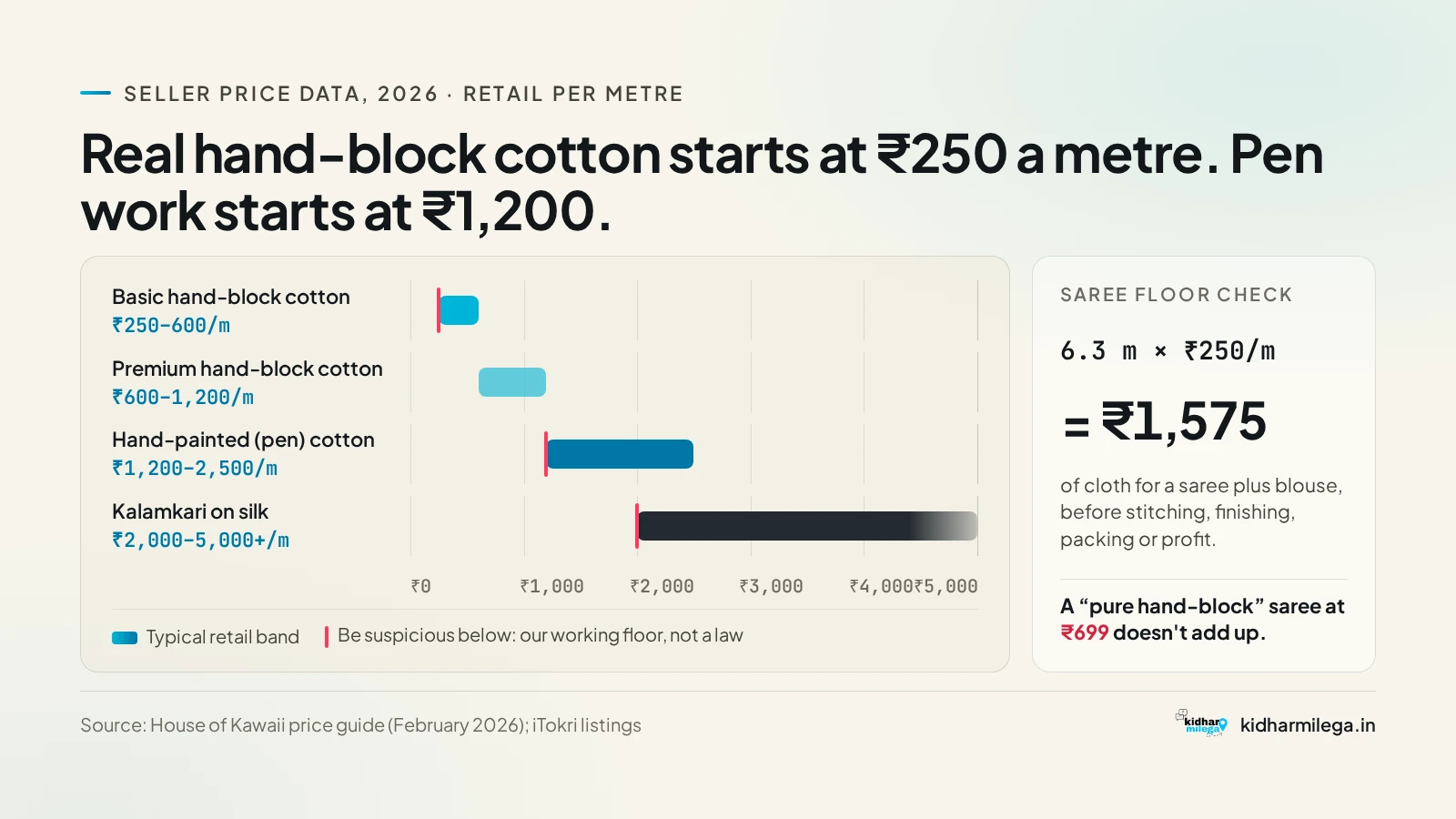
The "be suspicious below" column is our working floor, taken from the bottom of each retail band. It is not a law. A Pedana workshop may sell you an end-of-thaan piece for less. A dishonest seller can also charge ₹800 for a screen print. Price tells you which question to ask. It doesn't prove anything on its own.
Run the saree floor as a check. A saree plus blouse uses about 6.3 metres. At the lowest hand-block price of ₹250 a metre, that's ₹1,575 of cloth before anyone has stitched, finished, packed or made a profit. So a "pure hand-block natural-dye kalamkari saree" at ₹699 doesn't add up. Sasta kalamkari aur asli kalamkari, dono ek saath nahi milte.
How much of the market is fake? One March 2026 feature on thetalentedindian.com claims only 5 to 10% of what's sold as Pedana Kalamkari is authentic. That comes from a single source and can't be confirmed. Still, the direction matches what you'll see if you compare prices online.
Checklist: is this real kalamkari or just a kalamkari print?
Do all nine checks. None of them works alone. Retailer guides from MeMeraki, Fabric by Singhanias and Yuvani all start from the first four.
- Flip it over. Natural dye soaks into the fibre, so the colour shows clearly on the back. A screen print sits on the surface and the back looks pale. Thin cotton can let some screen print through, so use this check alongside the others.
- Find the block joins. Hand-block work has small misalignments where one block impression meets the next. You'll see a slight overlap or gap, and the repeat won't be perfectly even. Pen work has lines that get thicker and thinner along their length.
- Check the edges. Perfectly crisp, identical edges on every motif point to a machine. Zoom in with your phone camera. If you see a dot or pixel pattern, it's a digital print.
- Read the colours. Natural kalamkari uses a narrow, earthy palette. Iron gives black, alum with madder gives red, and indigo gives blue, along with mustard and rust tones. If you see neon pink, fluorescent green or a bright optical-white background, it's a print.
- Touch the surface. Pigment screen prints leave a slightly stiff, rubbery layer on top of the cloth. Natural dye doesn't change how the fabric feels.
- Smell it, without expecting too much. Real pieces often smell mildly earthy. Some sellers talk about a "milky" smell. That's folklore, not a test.
- Ask the exact question. "Is this hand-painted, hand-block printed with natural dyes, or a printed kalamkari design?" Ask for the answer on the invoice. Honest sellers say "printed design" without any fuss.
- Ask where it was made. For Machilipatnam GI work, the answer should be Pedana, Machilipatnam, Polavaram or Kappaladoddi. For pen work, it should be Srikalahasti. "Andhra" or "Jaipur" is not an answer.
- Compare against the price floor. Use the table above. If the price is below the floor and the seller claims "hand-made natural dye", the claim is probably wrong.
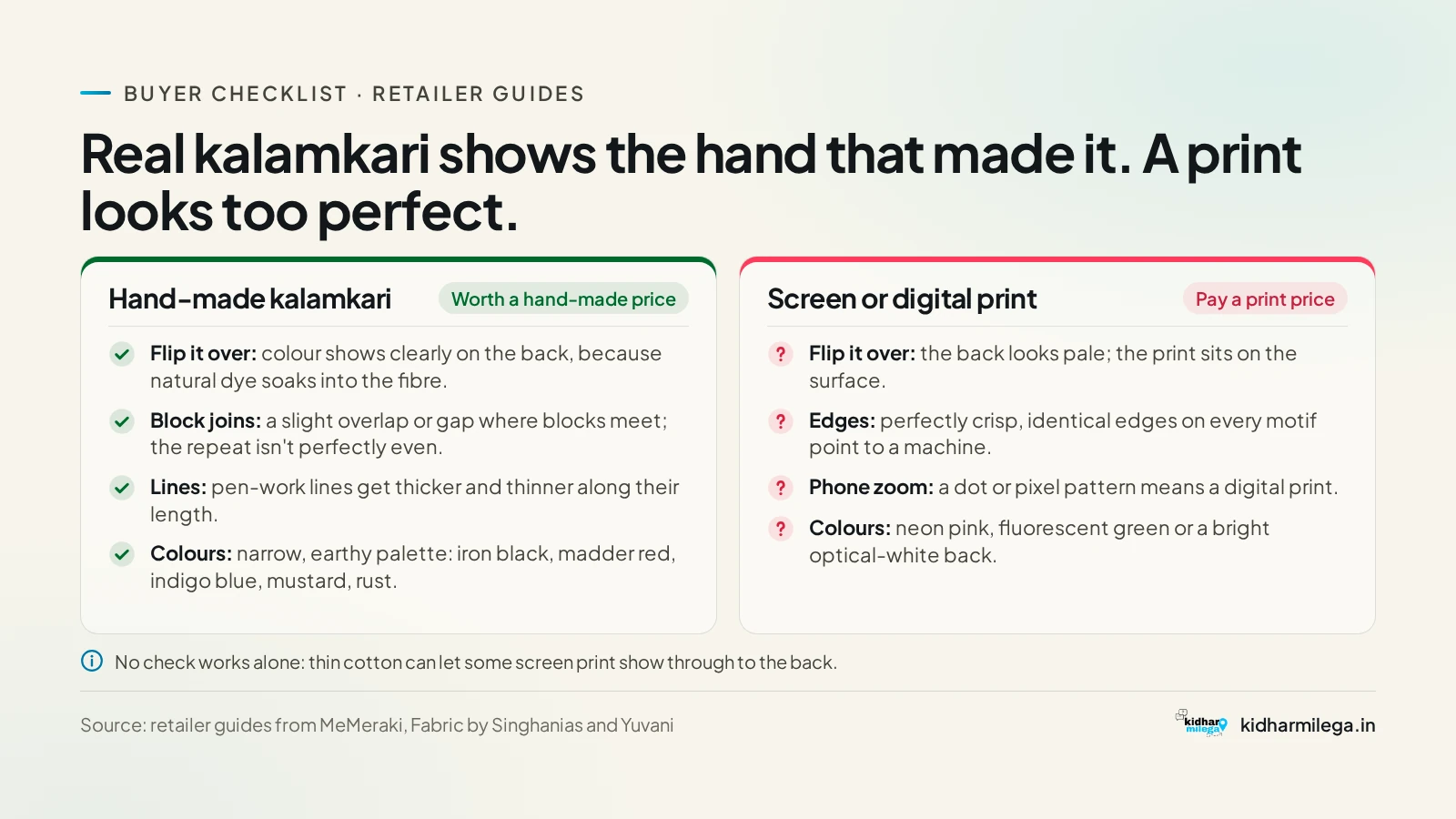
"Kalamkari prints" is the phrase to watch. It often means the design, not the craft. Design kalamkari ka hai, kapda kalamkari nahi. That's fine if you know it and pay a print price for it.
Wrong way vs right way to buy your first lot
Wrong way: you see a good reel, message the seller, and order 100 metres of one design because the per-metre price drops at that quantity. It arrives, the first wash turns your sink red, and the cloth shrinks a size.
Right way: order 1 metre from each of three sources. Cut a 10 cm square from each, measure it, and wash it in cold water with mild soap. Dry it in the shade and measure again. You'll learn three things in one afternoon:
- How much it bleeds. Natural dye bleeds a little in the first wash and then settles. A print bleeds very little, or the pigment starts cracking.
- How much it shrinks, so you know how much extra to order.
- How it feels after washing, which is the version your customer will actually live with.
Three samples cost you about ₹1,000 to ₹1,500. A bad 100-metre lot can cost ₹25,000 or more. Pehle sample, phir thaan.
Which base fabric suits which use and season
Kalamkari is mostly done on cotton (cambric, Mangalagiri handloom), and also on silk, Chanderi and blends. The base decides drape, comfort and whether you'll need lining.
| Base fabric | Feel and weight | Good for | Watch out for |
|---|---|---|---|
| Cotton cambric | Medium, about 100 GSM, crisp | Kurtas, dress material, shirts, cushion covers. Wearable all year in the south and in a north Indian summer. | Holds its shape rather than draping. Shrinks if you don't pre-wash it. |
| Cotton mul (mulmul) | Lighter and softer than cambric | Dupattas, summer kurtis, stoles | Can be see-through in light grounds, so line kurtas. Tears more easily at seams. |
| Mangalagiri / handloom cotton | Slightly coarser and textured | Sarees, half saree sets, structured kurtas | Shrinks more than mill cambric. Always do a sample wash. |
| Chanderi (silk-cotton) | Light, slightly sheer, with sheen | Festive kurtas, dupattas, pen-work panels | Needs lining. Gentle hand wash or dry clean only. |
| Silk (including Bangalore silk) | Fluid, rich colour | Original kalamkari sarees, half sarees, blouses for weddings | Dry clean first. The most expensive option to make mistakes on. |
| Rayon | Very drapey, cool | Flowy kurtas, palazzos | Almost every rayon "kalamkari" on the market is digitally or screen printed. Treat it as a print unless the seller can prove otherwise. |
Is kalamkari good for summer? On cotton cambric or mul, yes. It's breathable, and natural dye doesn't put a plastic layer over the fibre. On Chanderi and silk it works best for evenings and festive wear.
How many metres of kalamkari cloth material to buy for each garment
Kalamkari dress material usually comes in two widths: about 36 inches for handloom and older stock, and about 44 inches for most mill cotton. The figures below are a tailor's rule of thumb for an average adult size, up to about a 38-inch bust. Add 10 to 15% for larger sizes, big prints you want to match, or long sleeves.
| Garment | 36" width | 44" width | Note |
|---|---|---|---|
| Knee-length kurta with sleeves | 2.75 to 3 m | 2.25 to 2.5 m | Add 0.25 m if you want a border on the hem |
| Short kurti / top | 2 to 2.25 m | 1.5 to 1.75 m | |
| Blouse | 1 m | 0.8 to 1 m | Puff or long sleeves need 1.25 m |
| Salwar / palazzo / pants | 2.75 to 3 m | 2.25 to 2.5 m | Often made in a plain matching colour |
| Dupatta | 2.25 to 2.5 m | 2.25 to 2.5 m | Length matters here, not width |
| Lehenga / half saree langa (skirt) | 4 to 5 m | 3 to 4 m | More kalis means more cloth |
| Half saree voni (drape) | 2.25 to 2.5 m | 2.25 to 2.5 m | |
| Saree yoke, border or patch panel | 0.5 m | 0.5 m | The cheapest way to wear pen work |
| Cushion cover, 16" x 16" (front and back) | 0.5 m | 0.5 m | Two squares fit across either width |
Shrinkage buffer: unwashed cotton commonly shrinks around 3 to 5%. On a 2.5-metre kurta cut, that's an extra 10 to 15 cm. Ask for it, or do your sample wash first.
Worked ₹ example: a kurta set in Pedana cotton vs Chanderi pen kalamkari
This is the math most shop pages skip. The fabric prices sit inside the 2026 bands above. The plain fabric, lining and tailoring rates are typical for a Tier 2 town and are our assumptions, so your own tailor will differ.
| Line item | A: Pedana hand-block cotton (44") | B: Chanderi pen kalamkari |
|---|---|---|
| Kurta fabric, 2.5 m | ₹400/m = ₹1,000 | ₹1,800/m = ₹4,500 |
| Bottom, 2.5 m plain solid | ₹150/m = ₹375 | ₹250/m = ₹625 |
| Dupatta | 2.5 m block cotton at ₹400/m = ₹1,000 | Hand-painted Chanderi dupatta = ₹2,500 |
| Lining, 2.5 m | Not needed = ₹0 | ₹100/m = ₹250 |
| Tailoring, kurta | ₹700 | ₹1,000 (lined) |
| Tailoring, bottom | ₹350 | ₹350 |
| Dupatta edge finishing | ₹100 | ₹150 |
| Shrinkage buffer, 0.15 m extra kurta fabric | ₹60 | ₹270 |
| Total | ₹3,585 | ₹9,645 |
Two things stand out.
- In option A, the kalamkari fabric is ₹2,060 of the ₹3,585 total. If a readymade "hand-block kalamkari" kurta set sells for less than ₹2,000, the numbers don't support the claim.
- In option B, the pen work is about 70% of the cost. To get the look for less, use a 0.5 m hand-painted yoke panel (₹600 to ₹900 at pen-work rates) on a plain Chanderi kurta. Your total drops by roughly ₹3,500.
Use the calculator on this page to plug in your own metres, per-metre price and your tailor's rates.
Original kalamkari saree, half sarees, bedsheets and shawls: what to check
Original kalamkari saree
Real cotton kalamkari sarees start at about ₹1,500. Real silk ones start at around ₹5,000, and hand-painted Srikalahasti silk goes well beyond ₹15,000. Look at the pallu. On pen work, no two figures are identical, and you can see where the kalam paused. Ask whether the blouse piece is attached and whether it's in the same technique. Sometimes the saree is block-printed and the blouse is a screen print.
Kalamkari half sarees
A half saree set needs a langa (3 to 4 m at 44"), a voni (2.25 to 2.5 m) and a blouse (1 m). That's 6.25 to 7.5 metres in total. Even at the lowest hand-block price, the cloth alone comes to about ₹1,560 to ₹1,875. Wedding-season sets often pair a kalamkari langa with a plain silk voni. That's a good way to control the budget, as long as the label says so honestly.
Kalamkari bedsheets
Pedana is well known for bedsheets. A 90" x 100" double bedsheet uses about 5.8 square metres of cloth, which is roughly 5.2 running metres at 44" width. At ₹250 a running metre, that's about ₹1,300 of fabric value before stitching and pillow covers. A "hand-block natural-dye double bedsheet with two pillow covers" at ₹499 is a print. Also look at the block repeats across the full width. On wide hand-block sheets you'll see small registration shifts where the printer moved along the table.
Kalamkari shawl
Natural-dye kalamkari is a cotton and silk tradition. On cotton or silk stoles, a kalamkari shawl can be the real thing. On acrylic or polyester blends, it's a printed design, whatever the listing says. For winter, a cotton kalamkari stole layered over a plain wool shawl gives you real craft without paying for a fibre the craft wasn't built for.
"Kailash kalamkari"
There's no GI-registered producer or society by this name. The name most often linked to it is M. Kailasam, a Srikalahasti kalamkari artist whose work is in the NIFT collection on Google Arts & Culture. If you're buying from a shop or Instagram seller using a similar name, run the same nine-point checklist. A name is not a certificate.
Why real kalamkari costs three to ten times a print
The Krishna district administration's Pedana Kalamkari page describes the process. It explains the price better than any seller can.
- The grey cloth is boiled in an alkaline solution for 2 to 3 hours.
- It's soaked in myrobalan for 30 to 45 minutes and dried in the sun.
- Black outlines are block-printed, and alum paste is printed wherever red will go. Iron gives the black and alum gives the red.
- The cloth is washed in running water, then mordanted and dyed again for each further colour. Other dyes used include indigo, madder and pomegranate rind.
Then look at output. MeMeraki reports one Pedana team of about 20 artisans printing roughly 30 metres per artisan per day. Another workshop says labour shortages hold it to 1,000 to 1,500 metres a month. Hand-painted Srikalahasti pieces can take 30 to 40 days each with 20 or more washes, according to an anecdotal July 2026 account. A screen-printing unit turns out thousands of metres a day. That difference in output is the price gap you see online.
Buying from the source vs online: Pedana, Srikalahasti, emporia and wholesale
Your four routes, honestly compared
| Route | Best for | The catch |
|---|---|---|
| Visit Pedana / Srikalahasti workshops directly | Resellers, boutiques and tailors buying 50 m or more | Travel cost. You have to sort the genuine workshops from traders reselling Surat or Jaipur prints in the same lanes. |
| State emporium (Lepakshi, Poompuhar) | Gifts, first-time buyers, one saree | Smaller range, and retail prices |
| Curated craft platforms (iTokri and similar) | By-the-metre buyers anywhere in India | Retail margin is built in. Read whether each listing says block, painted or printed. |
| Marketplace listings | Price shopping | Most "kalamkari dress material" at the lowest prices is a print |
Official places to verify and buy
- GI records: Machilipatnam Kalamkari, Application 90 (applicant: Vegetable Hand-block Kalamkari Printers Association) and Srikalahasthi Kalamkari, Application 28 (applicant: KARUNA society). The Machilipatnam registration is listed as valid to 15 April 2027 and comes up for renewal. The registry page itself was last updated in 2016, so its status may lag. When you buy from a GI-area maker, ask whether they're a registered authorised user.
- Krishna district ODOP: Pedana Kalamkari is the district's One District One Product item. See the Krishna district ODOP page.
- Lepakshi Handicrafts: the AP government emporium, with a Kalamkari section. Head office: Gandhi Nagar, Vijayawada 520003. Email: info@lepakshihandicrafts.gov.in.
- Poompuhar: Tamil Nadu Handicrafts Development Corporation, the applicant for the Karuppur Kalamkari GI. See its GI page.
Wholesale: MOQ and the napkin math
Minimum order quantities differ from workshop to workshop. Some sell by the thaan, others set a minimum per design. Ask three things on the first call: the MOQ per design, the lead time at their current monthly output, and whether they'll send a 1-metre sample of the exact lot. Given the 1,000 to 1,500 metres a month that some workshops manage, don't promise a client 500 metres of one design next week.
Here's a reseller example. The quote is an assumed one, used only to show the math:
- 100 m at an assumed workshop quote of ₹260/m = ₹26,000
- Courier from Pedana to your town (assumed) = ₹1,200
- Wash-test and defect loss, 3 m, leaves 97 sellable metres
- Cost per sellable metre = ₹27,200 ÷ 97 = about ₹280
- Sell 38 kurta cuts of 2.5 m at ₹1,100 each (₹440/m) = ₹41,800
- Platform fees, payment charges and packaging at an assumed 15% = ₹6,270
- Left before GST and your own time: ₹41,800 − ₹6,270 − ₹27,200 = ₹8,330
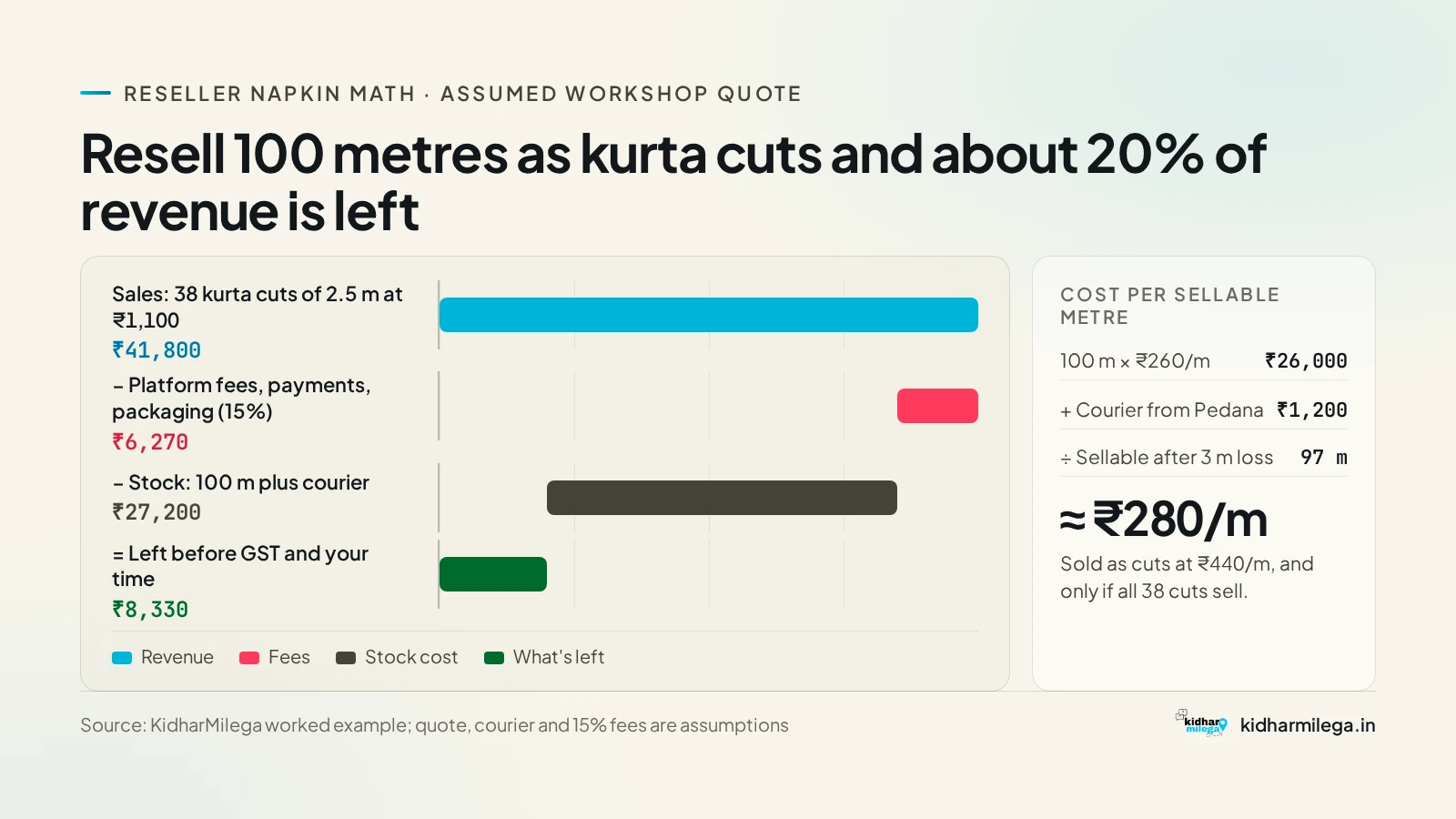
That's about 20% of revenue, and only if all 38 cuts sell. Reselling plain thaans is thin money. The margin is in finished pieces (stitched kurta sets, cushion covers, half saree sets) and in being the source your customers trust. GST depends on the product's HSN code, so check the current rate on the CBIC GST rates page. Most printed cotton woven fabric falls under heading 5208, and our HSN code finder will give you the exact 8-digit code for your invoice in seconds.
Washing natural-dye kalamkari without ruining it
- First wash alone. Expect some colour in the water, especially from red and black. That's normal for natural dye and it settles after a wash or two.
- Cold water, mild soap. Use a neutral liquid detergent or reetha. No bleach, and no strong detergent powder.
- Don't soak. Wash quickly, rinse, and squeeze gently. Never wring or twist.
- Dry inside out, in the shade. Sun fades natural dyes faster than washing does.
- Iron on the reverse at medium heat for cotton and low heat for silk.
- Pre-wash cotton before cutting so the 3 to 5% shrinkage happens before stitching, not after.
- Silk and Chanderi: dry clean for the first few cleans, then gentle hand wash in cold water if you're confident.
Real kalamkari does fade, slowly and evenly, into a softer version of itself. A screen print tends to crack or peel at the folds instead. Ageing like that is part of what you're paying for.
Toh kharidna chahiye, aur kisko?
Buy genuine Pedana or Srikalahasti kalamkari if: you're a boutique owner or tailor whose customers ask "asli hai?", you want an original kalamkari saree or half saree for a wedding, or you have roots in Krishna or Tirupati district and can visit the workshops yourself. Visiting in person is your biggest advantage over every online reseller.
Skip it, and buy an honest print instead, if: you want bright neon colours, you need 1,000 metres of one design every month at a fixed low price, or your customer only cares about the look. Buying a print is fine. Paying a hand-made price for one isn't.
Find kalamkari suppliers near you
Before you take the train to Pedana, shortlist the makers. The KidharMilega supplier finder lists verified suppliers and manufacturers for free. Filter by product and district, then call three of them with the MOQ, lead-time and sample questions above.
Your first step before any bulk order: order three 1-metre samples, do the 10 cm wash test, and read the Krishna and Tirupati district pages linked above. If your own district has a craft like this, start from the KidharMilega homepage and look at what's already made close to home. Bheed ka hissa nahi, kissa bano.
Frequently asked questions
Does real kalamkari fabric fade?
Yes, slowly and evenly. Natural dyes bleed a little in the first one or two washes, then settle. Over many washes the colours soften into a muted version of the original. Sunlight fades them faster than washing does, so dry inside out in the shade. Screen-printed copies behave differently: the colour sits on top and tends to crack or peel at folds rather than fade gently.
Is kalamkari cloth material good for summer?
On cotton cambric (about 100 GSM) or mulmul, yes. Both are breathable, and natural dye doesn't put a plastic layer on the fibre the way pigment prints do. Mul can be see-through in light colours, so line kurtas. Chanderi and silk kalamkari suit evenings and festive wear more than hot afternoons.
Why is the price gap between kalamkari listings so big?
Because the listings are different products. Hand-block Pedana cotton involves boiling, myrobalan treatment, block printing, mordanting and repeated washing in running water, and some workshops manage only 1,000 to 1,500 metres a month. Hand-painted Srikalahasti work can take weeks per piece. Screen and digital prints of the same design are made in thousands of metres a day, so they cost far less.
Can rayon be real kalamkari?
Treat rayon kalamkari as a print unless the seller can prove otherwise. Traditional kalamkari is a cotton and silk craft, and almost all rayon sold under the name is digitally or screen printed with the design. If you want drape plus real craft, choose Chanderi or silk with block or pen work, or use a real kalamkari panel on a plain rayon garment.
Which is better, Pedana or Srikalahasti kalamkari?
They do different jobs. Pedana (Machilipatnam) is hand-block printed with floral and paisley repeats, so it suits dress material, bedsheets and dupattas at about ₹250 to ₹1,200 a metre. Srikalahasti is freehand pen work with mythological scenes, so it suits statement sarees, panels and hangings at ₹1,200 a metre and above. Buy Pedana for volume and Srikalahasti for a one-of-a-kind piece.
What is Karuppur kalamkari?
Karuppur Kalamkari is a dye-painted temple cloth tradition from around Karuppur in Ariyalur district and villages near Kumbakonam in Thanjavur, Tamil Nadu. Pieces include canopies, hangings, and umbrella and chariot covers, with motifs like yazhi, peacocks and deities. Its GI tag was reported on 12 October 2021, with Poompuhar as the applicant. It is not usually sold as everyday dress material.
Sources
- Machilipatnam Kalamkari, GI Application 90 · GI Registry, IP India
- Srikalahasthi Kalamkari, GI Application 28 · GI Registry, IP India
- Pedana Kalamkari · Krishna District, Government of Andhra Pradesh
- One District One Product · Krishna District, Government of Andhra Pradesh
- Kalamkari Prints · Lepakshi Handicrafts (APHDC)
- Geographical Indications · Poompuhar (TNHDC)
- Kalamkari origin and price guide · House of Kawaii
- Kalamkari Fabrics · iTokri