
ODOP Rajasthan is the state's One District One Product Policy 2024. It has been in force since 9 December 2024. It names one product for each district and pays micro and small units that make that product. New micro units can get margin money of 25% of project cost, up to ₹15 lakh. Small units can get 15%, up to ₹20 lakh. Since a May 2026 amendment, existing units that expand can get margin money too. There are also refunds for certification, trade fair stalls, e-commerce fees and websites. You register your unit on the Rajasthan SSO portal, and since March 2026 the General Manager of your District Industries & Commerce Centre (DICC) approves it directly.
Rajasthan ODOP margin money and stall refund calculator
Works out your likely ODOP margin money as a micro or small unit, the minimum loan the bank must disburse first, and your fair stall refund.
Margin money if micro unit (25%, cap ₹15 lakh, ₹20 lakh with extra) —
Margin money if small unit (15%, cap ₹20 lakh, ₹25 lakh with extra) —
Minimum bank loan to be disbursed first (micro) —
Rest of project you fund with own money plus loan (micro) —
Fair stall refund (75%, up to ₹2 lakh) —
Uses the Rajasthan ODOP Policy 2024 figures as widely reported: 25% up to ₹15 lakh (micro), 15% up to ₹20 lakh (small), with the extra ₹5 lakh treated as a higher ceiling. Confirm against the official policy notification and with your DICC.
Key facts: Rajasthan ODOP at a glance
- Policy: Rajasthan One District One Product (ODOP) Policy 2024, in force from 9 December 2024. It was launched around the Rising Rajasthan summit. Some sources say it runs until 31 March 2029.
- Budget: about ₹100 crore a year, according to Business Standard.
- Districts: the policy set products for 50 districts at launch. Rajasthan now has 41, after the district cuts of December 2024.
- Margin money: 25% up to ₹15 lakh (micro), 15% up to ₹20 lakh (small). Up to ₹5 lakh more is reported for SC/ST entrepreneurs, people with disabilities and entrepreneurs under 35.
- Expansion units (May 2026 amendment): existing units that expand now qualify for margin money as well, reported as up to ₹20 lakh for micro and ₹15 lakh for small, with ₹15 crore of extra budget, according to Patrika. These reported caps run the opposite way to the new-unit caps, so confirm them at your DICC.
- Where to apply: sso.rajasthan.gov.in. The application moved online in April 2025.
- Who approves: the DICC General Manager. District task-force committees were scrapped in March 2026.
- Uptake: about 497 ODOP enterprises had received marketing help by September 2026. There were 72 applications between 1 February and early March 2026.
- Official text: Rajasthan ODOP Policy 2024 PDF (iStart Rajasthan).
Why ODOP Rajasthan matters in November 2026
The India International Trade Fair (IITF) 2026 runs from 14 to 27 November 2026 at Bharat Mandapam, New Delhi, under the theme "Vikas aur Virasat". Rajasthan is a partner state, along with Bihar, Maharashtra and Uttar Pradesh. The fair has an ODOP pavilion with 21 states. Business days are 14 to 18 November and public days are 19 to 27 November.
This matters for your wallet because the state ODOP policy pays back 75% of your stall rent at fairs like IITF. A month earlier, from 7 to 11 October 2026, 38 Rajasthan ODOP units exhibited at the Bharat ODOP Sangam run by DPIIT. Stall bookings for these fairs happen months ahead. If you plan to exhibit in 2027, get registered now.
Rajasthan ODOP district list: what each district makes
Here is the honest situation first. The official policy PDF is a scanned document, and different published lists disagree on some districts. The table below lists the products that the Economic Survey 2025-26 list (cited by Rajasthan Current Affairs) and the 2026 state infrastructure approvals agree on. Where sources conflict, the table says so. Before you spend a rupee, confirm your district's product at your DICC.
| District | ODOP product | Status |
|---|---|---|
| Jaipur | Gems and jewellery | Economic Survey 2025-26 list |
| Kota | Kota Doria (handloom) | Economic Survey 2025-26 list |
| Bikaner | Bikaneri namkeen | Economic Survey 2025-26 list |
| Pratapgarh | Thewa jewellery | Economic Survey 2025-26 list |
| Sri Ganganagar | Mustard oil | Economic Survey 2025-26 list |
| Baran | Garlic | Economic Survey list; also in a Lok Sabha answer |
| Phalodi | Sonamukhi (senna) | Economic Survey list; senna warehouse approved May 2026 |
| Barmer | Embroidery | Economic Survey 2025-26 list |
| Alwar | Auto parts | Economic Survey 2025-26 list |
| Khairthal-Tijara | Auto parts | Economic Survey 2025-26 list |
| Kotputli-Behror | Auto parts | Economic Survey 2025-26 list |
| Jodhpur | Wooden furniture | Economic Survey 2025-26 list |
| Sikar | Wooden furniture | Economic Survey 2025-26 list |
| Udaipur | Marble and granite | Economic Survey 2025-26 list |
| Rajsamand | Marble and granite | Economic Survey 2025-26 list |
| Ajmer | Marble and granite | Economic Survey 2025-26 list |
| Dausa | Stone (per state list) | Conflict: some sources say durries or jute carpets. Stone tech centre approved May 2026 |
| Jhalawar | Kota stone (per one state list) | Conflict: the central list and a parliamentary answer say orange |
| Churu | Wood-based products | A wood testing lab was approved here in May 2026; confirm the exact product |
| Balotra | Textile printing | A textile printing facility was approved in May 2026; confirm the exact product |
| Didwana-Kuchaman | Stone (Makrana marble belt) | A CNC stone centre was approved in May 2026; confirm the exact product |
Districts to confirm at the DICC: Banswara, Beawar, Bharatpur, Bhilwara, Bundi, Chittorgarh, Deeg, Dholpur, Dungarpur, Hanumangarh, Jaisalmer, Jalore, Jhunjhunu, Karauli, Nagaur, Pali, Salumbar, Sawai Madhopur, Sirohi and Tonk. Each of these has a product in the policy annexure. We are not printing them until we can match them against the official text, because one wrong product on this page could cost you a rejected application.
Some older lists still show Dudu with blue pottery. Dudu was one of the districts abolished in December 2024, so check what your area falls under now. The central DPIIT list is a separate list. In January 2021 it picked items such as Jaipur Blue Pottery and Makrana marble, and it does not always match the state policy.
Want to see what is already being made around you, beyond the single ODOP pick? Browse the district product directory, which maps all 787 districts. If you are in the marble belt, compare yourself with the neighbouring cluster in Gujarat on the Banaskantha granite and marble blocks page. Auto parts makers in Alwar and Khairthal-Tijara should look at how the Faridabad auto components cluster sells to the same OEM buyers.
What the Rajasthan ODOP Policy 2024 actually pays
Mera ek dost bolta hai, "ODOP mein sarkar ₹25 lakh deti hai, bas form bharo." The money is real. But it comes in pieces, each piece has a cap, and most of them are refunds of money you spend first. These are the figures that sources agree on most often:
| Support | Rate | Cap | When you get it |
|---|---|---|---|
| Margin money, new micro unit | 25% of project cost | ₹15 lakh | After the bank disburses a loan at least equal to the grant |
| Margin money, new small unit | 15% of project cost | ₹20 lakh | Same condition |
| Margin money, existing unit expanding (May 2026 amendment) | Check the notification | Reported as ₹20 lakh (micro) and ₹15 lakh (small) | Confirm the conditions at your DICC |
| Extra for SC/ST, people with disabilities, under 35 | Additional | Up to ₹5 lakh (reported by Udaipur Times) | With the margin money |
| Technology or software upgrade (government or, since May 2026, private institutions) | 50% | ₹5 lakh | Refund after purchase |
| Quality certification and IPR (GI, trademark, patents, etc.) | 75% | ₹3 lakh | Refund after certification |
| Exhibitions and fairs | 75% of stall rent, plus travel for 2 people | ₹50,000 to ₹2 lakh per event, depending on the fair | Refund after the event |
| E-commerce platform fees | 75% | ₹1 lakh a year, for 2 years | Refund on fees paid |
| Catalogue and website | 60%, one-time | ₹75,000 | Refund after delivery |
Two changes came in through a notification on 21 May 2026, following the Budget 2026-27 announcement. First, existing units that expand now get margin money, backed by ₹15 crore of extra budget. Second, technology upgrades done through private institutions now count for the ₹5 lakh support. Before, only government institutions did. Both were reported by Patrika.
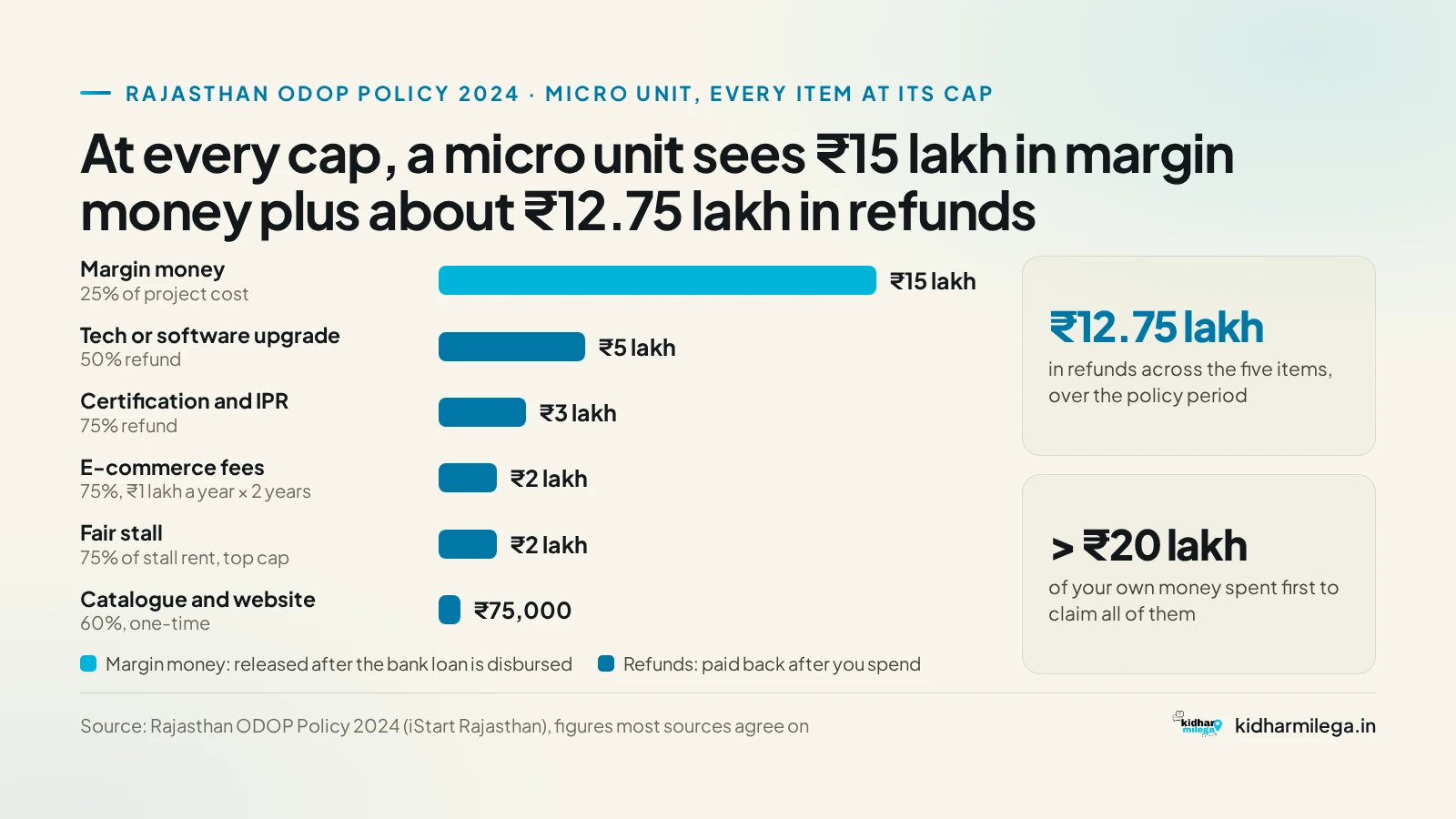
If you take every item at its cap, a micro unit could see ₹15 lakh in margin money plus about ₹12.75 lakh in refunds over the policy period. That assumes ₹5 lakh tech, ₹3 lakh certification, ₹2 lakh e-commerce over two years, ₹75,000 catalogue and a ₹2 lakh fair stall. To get all of that, you would first have to spend more than ₹20 lakh of your own money on those items. Announcement hai, cheque nahi, until you have the bills.
₹15 lakh, ₹20 lakh or ₹25 lakh? The margin money confusion explained
Read three pages on ODOP Rajasthan and you will see three different numbers. Here is where each one comes from.
- "25%, up to ₹15 lakh (micro) and 15%, up to ₹20 lakh (small)." This split appears in most detailed explainers, and it is the one this page uses for new units.
- "25%, maximum ₹25 lakh." ANI reported this in April 2026. One possible reading is that it adds the ₹20 lakh small-unit cap to the ₹5 lakh extra for special categories. That is our reading, not an official clarification.
- "Micro up to ₹20 lakh, small up to ₹15 lakh." This is how several outlets report the May 2026 expansion caps. It applies to existing units that expand, not to new units.
- "Maximum ₹1 lakh." One exam-prep site lists this. It matches the yearly cap on e-commerce fee refunds, not the margin money.
- "30% extra capital subsidy." One site says this. We found no other source that supports it.
Another open question is whether the extra ₹5 lakh is added on top of whatever you get, or simply raises your ceiling. The calculator on this page takes the cautious reading: it raises the ceiling. So micro units in these categories can get up to ₹20 lakh and small units up to ₹25 lakh, but only if 25% or 15% of your project actually reaches that figure. The official word is in the policy PDF on iStart, with a copy on Rising Rajasthan. Both are scanned images, so read the incentive annexure yourself and get the DICC to confirm your figure in writing.
Worked example: a ₹40 lakh Bikaneri namkeen unit
Say you are setting up a new namkeen unit in Bikaner, where Bikaneri namkeen is the ODOP product. The total project cost is ₹40 lakh: machinery, shed work, packaging line and working capital. Under the revised Udyam limits (investment up to ₹2.5 crore, turnover up to ₹10 crore), that is a micro unit.
| Line | Amount |
|---|---|
| Project cost | ₹40,00,000 |
| Margin money at 25% | ₹10,00,000 (under the ₹15 lakh cap) |
| Your own contribution (assume 10%) | ₹4,00,000 |
| Bank term loan | ₹36,00,000 |
| Loan the bank must disburse before the grant is released | At least ₹10,00,000 |
| EMI on ₹36 lakh, illustrative 10% over 7 years | About ₹59,800 a month |
| EMI if the ₹10 lakh is adjusted against the loan (₹26 lakh left) | About ₹43,200 a month |
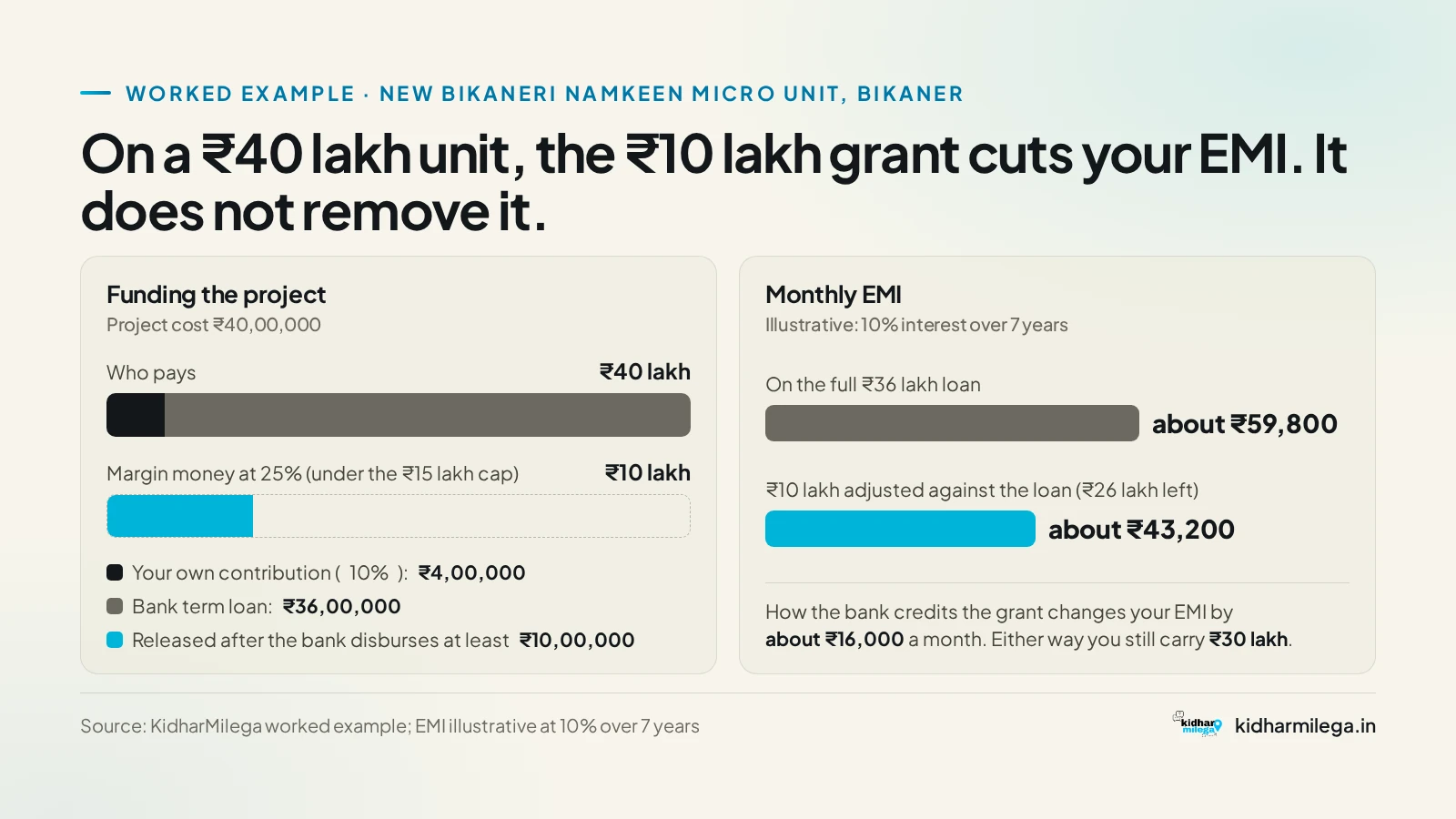
Look at the last two rows. You still carry ₹30 lakh, between your own money and the loan. The grant cuts your EMI. It does not remove it. Ask your bank and the DICC exactly how the margin money is credited, because that changes your monthly number by about ₹16,000.
Now say you are under 35. On this ₹40 lakh project, the extra ₹5 lakh does nothing under the ceiling reading, because 25% is ₹10 lakh and already sits below ₹15 lakh. The extra only starts to matter once 25% of your project crosses ₹15 lakh, which means projects above ₹60 lakh.
Second example: an ₹80 lakh micro unit
- 25% of ₹80 lakh = ₹20 lakh, so a general-category owner is capped at ₹15 lakh.
- An SC/ST owner, an owner with a disability or an owner under 35 gets the higher ceiling: ₹20 lakh.
- For a small unit at 15%, the ₹20 lakh cap only bites once the project crosses about ₹1.33 crore.
Third example: a stall at IITF
Say your stall rent at a Delhi fair is ₹1,60,000. A 75% refund is ₹1,20,000, which is under the ₹2 lakh cap, so you pay ₹40,000 net, plus travel for two people if that clause applies. The refund comes after the event, so you still need the full ₹1.6 lakh in your account when you book. Go to a fair for data and buyer contacts, not for counter sales. Your stall pays off from the orders that come in over the next three months.
Use the calculator on this page with your own project cost and stall rent to see your numbers.
How to apply for ODOP Rajasthan on the SSO portal
Since April 2025, ODOP unit registration happens online on the Rajasthan SSO portal, under the Business Reform Action Plan 2024. Since March 2026, the DICC General Manager checks and approves applications directly, without a district committee. Commissioner Suresh Kumar Ola announced the change, as Business Standard reported.
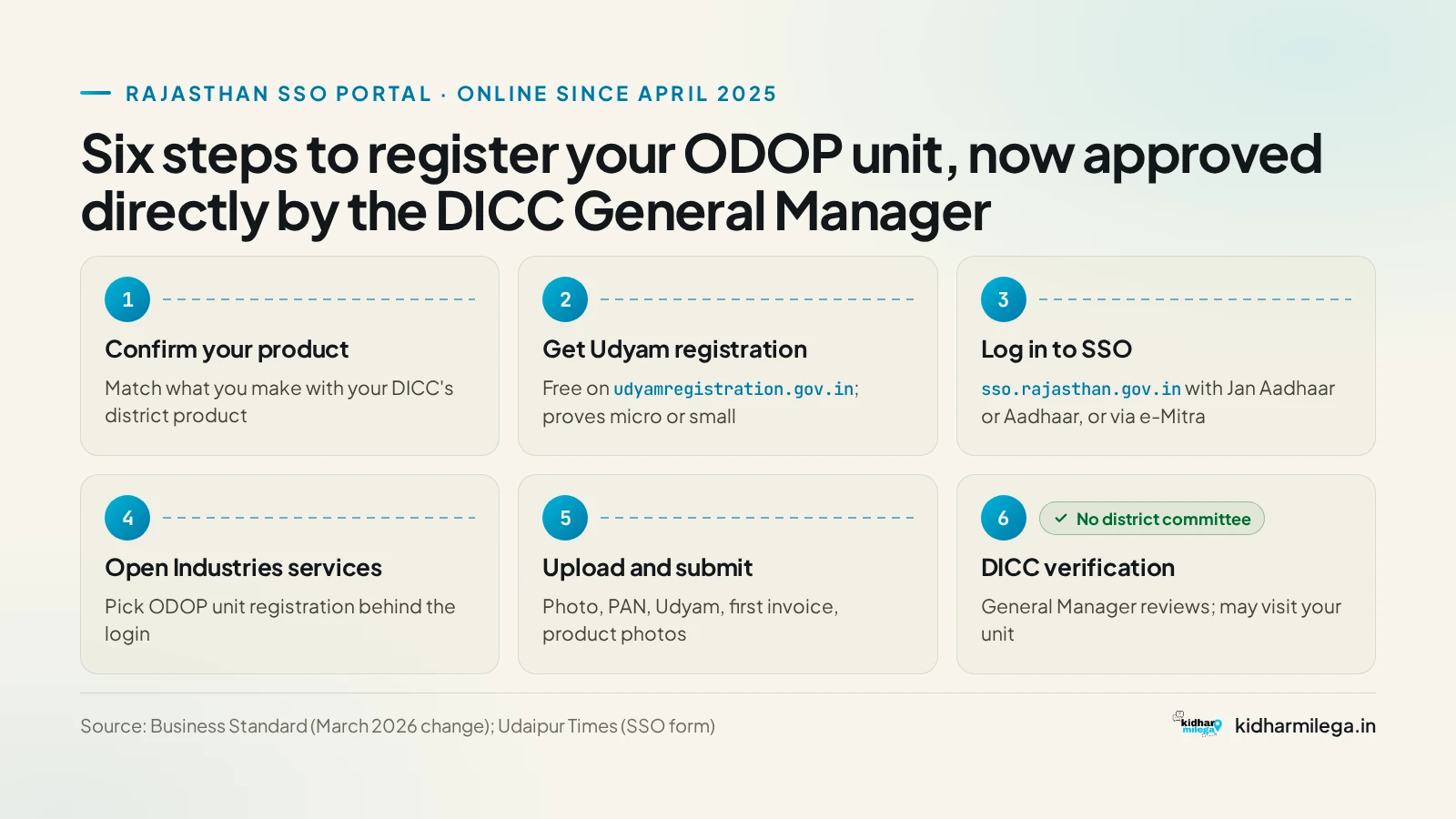
- Confirm your product. Visit the DICC in your district headquarters and check that what you make, or supply to, matches the district's ODOP product. Upstream and downstream supply chain units also count, but get that confirmed.
- Get Udyam registration. It is free on udyamregistration.gov.in. Your Udyam certificate is what proves you are micro or small.
- Create or log in to your SSO ID at sso.rajasthan.gov.in using your Jan Aadhaar or Aadhaar. If you are not comfortable doing it yourself, any e-Mitra kiosk works on the same portal.
- Open the ODOP application. The form is at swcs.rajasthan.gov.in/ODOP, which takes you to the SSO login first. After you log in, pick the ODOP unit registration or application.
- Upload your documents (see the checklist below) and submit.
- DICC verification. The General Manager reviews the application and may visit the unit. Keep your phone on and the unit ready.
- Claim each incentive separately. For margin money, the bank disbursement comes first. For refunds, you submit bills after spending. Keep every invoice in the unit's name, paid from the unit's bank account.
The policy does not publish a fixed processing time. Ask the DICC for a timeline when you submit, and follow up in writing after 30 days.
Documents required for Rajasthan ODOP: checklist
The SSO registration form asks for the following, as reported by Udaipur Times when the form went online:
- Applicant photograph
- Caste certificate (if you claim a category benefit)
- PAN of the unit
- Date production started
- First or current sale invoice
- Udyam registration certificate
- Photographs of the product
For a margin money claim, also keep these ready. Banks and DICCs routinely ask for them:
- Detailed project report with cost breakup
- Bank loan sanction letter and disbursement proof
- GST registration, if your turnover requires it (GST portal)
- Disability certificate or age proof, if you claim the extra ₹5 lakh
- Land or shed ownership or rent agreement
- FSSAI licence for food products such as namkeen or mustard oil (FoSCoS)
- Paid invoices for every refund claim (certification, stall, e-commerce fees, website)
State ODOP vs central ODOP vs PMFME
Three different things carry the ODOP name, and people mix them up all the time.
| Rajasthan ODOP Policy 2024 | Central ODOP (DPIIT) | PMFME (food processing) | |
|---|---|---|---|
| Run by | Industries & Commerce Dept, Rajasthan | DPIIT, Government of India | Ministry of Food Processing Industries |
| Product list | State's own list, 41 districts | Separate national list (for example Jaipur Blue Pottery, Makrana marble) | Its own food-focused ODOP picks |
| Main benefit | Margin money (₹15 lakh or ₹20 lakh caps) plus refunds | Branding, ODOP pavilions, events like the Bharat ODOP Sangam | 35% credit-linked capital subsidy, up to ₹10 lakh per unit |
| Who it suits | Any micro or small unit making the district product | Units that want national visibility | Micro food processors: namkeen, oil, spice, garlic products |
| Apply at | SSO portal | Invest India ODOP | pmfme.mofpi.gov.in |
A Bikaner namkeen maker or a Sri Ganganagar mustard oil unit could, in principle, use the state policy and PMFME together. The rule to watch is double-claiming: most state policies do not let you claim subsidy twice on the same cost. Ask the DICC in writing whether PMFME money reduces your ODOP margin money. Units in Rajasthan can also look at the MSME Policy 2024, RIPS 2024 and the Export Promotion Policy. To see which central and state schemes you might qualify for in one go, run your details through the scheme finder.
The catch nobody puts in the reel
- Margin money is loan-linked. No bank disbursement, no grant. If the bank says no, the policy cannot help you.
- Most of the support is a refund. You pay for the stall, the certification and the website first, and wait for the money back.
- Product lists are disputed. Dausa and Jhalawar have different products in different sources. If your product does not match the official annexure, you are not eligible.
- Expansion caps are reported, not confirmed. Outlets report the May 2026 expansion caps with micro higher than small, the reverse of the new-unit caps. Do not size an expansion on a news figure; get the notification from your DICC.
- Uptake is still small. 72 applications in about five weeks of early 2026, across 41 districts, is fewer than two per district. That means less competition for you, but also DICC staff who may be handling their first few files.
- The budget is shared. ₹100 crore a year also funds infrastructure. The ₹18.19 crore approved in May 2026 for five projects (Dausa, Churu, Balotra, Didwana-Kuchaman, Phalodi) comes from the same pool, and only ₹10.76 crore of it had been released.
Galat tareeka vs sahi tareeka
Galat tareeka: you hear "₹15 lakh grant", book machinery worth ₹50 lakh, take a loan, and only then go looking for buyers.
Sahi tareeka: talk to 10 buyers first. For namkeen that means distributors in Jaipur and Delhi. For marble it means contractors and architects. For Kota Doria it means boutiques. Get two or three trial orders done on job-work or rented capacity. Then size the project to the demand you have proven, and let the grant lower your cost, not decide your plan.
Exam quick facts on the Rajasthan ODOP Policy
If you are revising Rajasthan GS for a state exam such as RAS Prelims (reportedly moved to 6 December 2026; check rpsc.rajasthan.gov.in), these are the lines to remember:
- Effective date: 9 December 2024, linked to Rising Rajasthan.
- Budget: about ₹100 crore a year.
- Districts covered: products set for 50 districts at launch; Rajasthan has 41 districts after the December 2024 cuts.
- Online registration on SSO from April 2025; DICC General Managers approve from March 2026.
- May 2026: the Panch Gaurav state committee approved ₹18.19 crore for 5 ODOP infrastructure projects.
- 21 May 2026: two amendments notified. Expanding units get margin money (₹15 crore extra budget), and tech upgrades through private institutions now qualify for up to ₹5 lakh.
- 27 June 2026 (MSME Day): CM Bhajan Lal Sharma released an ODOP coffee table book.
- 7 to 11 October 2026: 38 Rajasthan ODOP units at the Bharat ODOP Sangam, New Delhi.
- IITF 2026: Rajasthan is a partner state, 14 to 27 November 2026.
Bhaiya's take: who should apply, who should skip
Apply if: you already make, or are about to make, your district's ODOP product. You also need a bank willing to lend and a project between ₹20 lakh and ₹60 lakh, where 25% margin money covers a real share of the cost. Existing units planning an expansion should look again too, because since May 2026 expansion projects can claim margin money. Existing units that only want the refunds for certification, e-commerce and fairs should register as well. Those refunds are small, but almost free to claim once you are on SSO.
Skip for now if: you have no buyer yet, your product is not on your district's list, or the plan only works if the grant arrives. Under ₹5 lakh, start with one stall, one wholesale buyer or one online listing. Grant ke bharose business mat banao; business banao, grant bonus hai.
Your next step: three questions for your DICC
Work out your margin money and stall refund with the calculator on this page. Then visit your DICC with your Udyam certificate and ask three questions: what exactly is our district's ODOP product, how is margin money credited against the loan, and can PMFME be claimed alongside it. Write the answers down. If you are still deciding what to build in your district, start on KidharMilega and look at what is already being made 20 km from your house.
Frequently asked questions
What is ODOP Rajasthan?
ODOP Rajasthan is the state's One District One Product Policy 2024, in force since 9 December 2024. It names one product for each district; Rajasthan now has 41. Micro and small units making that product get margin money of up to ₹15 lakh or ₹20 lakh, plus refunds for certification, fairs, e-commerce fees and websites. The budget is about ₹100 crore a year.
How much margin money can I get under the Rajasthan ODOP Policy 2024?
New micro units can get 25% of project cost, up to ₹15 lakh, and new small units 15%, up to ₹20 lakh. Up to ₹5 lakh more is reported for SC/ST, disabled and under-35 entrepreneurs. Since May 2026, expanding units also qualify, with reported caps of ₹20 lakh (micro) and ₹15 lakh (small). The grant follows bank loan disbursement. Confirm your figure with the DICC.
How do I apply for ODOP Rajasthan online?
Get Udyam registration first. Then go to swcs.rajasthan.gov.in/ODOP, log in with your SSO ID from sso.rajasthan.gov.in and fill in the ODOP unit application. You upload your photo, unit PAN, Udyam certificate, sale invoice, production start date, product photos and, if needed, your caste certificate. The DICC General Manager then verifies and approves it.
Can I use Rajasthan ODOP and PMFME together?
Food units such as namkeen, mustard oil or garlic processors may be able to use both. PMFME gives a 35% credit-linked subsidy up to ₹10 lakh. Most state policies do not allow two subsidies on the same cost, though. Ask the DICC in writing whether a PMFME subsidy reduces your ODOP margin money before you plan around both.
Does Rajasthan ODOP pay for a stall at IITF 2026?
The policy refunds 75% of stall rent at exhibitions and fairs, with caps reported from ₹50,000 up to ₹2 lakh per event, plus travel for two people. You pay the full rent upfront and claim the refund after the event with paid invoices. IITF 2026 runs from 14 to 27 November 2026, and Rajasthan is a partner state.
Sources
- Rajasthan One District One Product (ODOP) Policy 2024 · Government of Rajasthan (Rising Rajasthan)
- Rajasthan govt streamlines ODOP, MSME approvals to ease doing business · Business Standard
- Rajasthan to spend Rs 100 cr annually on One District One Product policy · Business Standard
- Rajasthan ODOP enterprises selected for Bharat ODOP Sangam · Udaipur Times
- ODOP application form on SSO portal · Udaipur Times
- Existing ODOP units get margin money · Visit Jaipur / Times of India
- Rajasthan's ODOP Policy 2024 to take local products to global stage · Asianet Newsable