
Under the Companies Act, 2013, general plant and machinery has a useful life of 15 years in Schedule II. That works out to a depreciation rate of 6.33% on the straight-line method (SLM) or 18.10% on the written-down value method (WDV), with residual value capped at 5% of cost. Continuous process plant gets 25 years (3.80% SLM, 11.29% WDV). Special industries such as pharma, telecom, power and construction have their own lives. Income tax uses a separate rate of 15% WDV on the machinery block, so your books and your tax return will never show the same depreciation figure.
Take a ₹10 lakh machine as an example. In year 1 it loses ₹63,333 in the company's books and ₹1,50,000 in the tax return. It's the same machine in the same year, with two different numbers, and both are correct. This page works through that one machine in every case a small manufacturer runs into.
Key facts
- Law: Companies Act, 2013, Section 123 read with Schedule II, Part C (full text on India Code).
- General plant and machinery: 15-year life, which gives 6.33% SLM or 18.10% WDV.
- Continuous process plant: 25-year life (3.80% SLM, 11.29% WDV). The old 8-year figure was replaced by GSR 237(E) dated 31 March 2014.
- Residual value: 5% of original cost at most.
- Extra shifts: depreciation goes up 50% for the period of double-shift use and 100% for triple shift. Assets marked NESD ("no extra shift depreciation") get nothing extra.
- Mid-year purchase: book depreciation is pro-rata by date. The Companies Act has no 180-day rule.
- Income tax: general machinery and plant is 15% WDV on the block. You get half the rate if the machine is used for less than 180 days in the year. New P&M used for manufacturing can get 20% additional depreciation. From 1 April 2026 this sits under Section 33 of the Income-tax Act, 2025, with rates in Appendix I of the Income-tax Rules, 2026.
- Changes in 2026: no amendment to the Schedule II useful lives. The tax law was renumbered, and published summaries say the general machinery rate stays at 15%.
- Dates: CBDT extended the ITR due date for audit cases (AY 2026-27) to 21 November 2026, and that date has now passed. Transfer pricing cases file by 30 November 2026. Under MCA General Circular 05/2026, companies file FY 2025-26 financial statements (AOC-4) by 31 December 2026 without extra fees.
The plant and machinery depreciation rate as per Companies Act comes from a useful life
Schedule II doesn't give you a percentage. Part C gives a useful life for each class of asset. Every "6.33%" or "18.10%" you see online, including on this page, is worked out from that life using a residual value of 5%.
Here are the two formulas, which you can do on paper:
- SLM rate = (100% minus residual %) ÷ useful life. For general P&M: 95% ÷ 15 = 6.33% of original cost, every year.
- WDV rate = 1 minus (residual value ÷ cost) raised to the power 1 ÷ life. For general P&M: 1 minus 0.05^(1/15) = 18.10% of the opening book value each year.
Both methods take the machine down to the same 5% after 15 years. They just get there at different speeds. SLM charges the same amount every year. WDV charges a lot in the early years and a little later on.
One thing reels skip: Schedule II only binds companies. If you run a proprietorship or a partnership firm, you aren't under Schedule II, and many small firms simply use income tax rates in their books. LLPs are governed by the LLP Act, not the Companies Act. Ask your CA which basis your entity follows before you copy a company's rate.
Every plant and machinery class in Schedule II, in one table
Most rate charts list the whole Act: buildings, furniture, vehicles, computers. This table covers only plant and machinery. The lives come from Part C. The SLM and WDV rates are calculated from those lives with a 5% residual value.
| Plant and machinery class | Useful life (years) | SLM rate | WDV rate |
|---|---|---|---|
| General P&M (not continuous process, not a special industry) | 15 | 6.33% | 18.10% |
| Continuous process plant (no special rate) | 25 | 3.80% | 11.29% |
| Medical: X-ray, CT, ultrasound, ECG, electrical equipment | 13 | 7.31% | 20.58% |
| Medical: other equipment | 15 | 6.33% | 18.10% |
| Cinema: projection and production equipment | 13 | 7.31% | 20.58% |
| Telecom: towers, cables, satellites | 18 | 5.28% | 15.33% |
| Telecom: switching and transmission | 13 | 7.31% | 20.58% |
| Pharma and chemicals: reactors, distillation columns and similar | 20 | 4.75% | 13.91% |
| Steel: sinter plant, blast furnace, coke oven, rolling mill | 20 | 4.75% | 13.91% |
| Power plants (thermal, hydro, nuclear), transmission lines | 40 | 2.38% | 7.22% |
| Wind power plant | 22 | 4.32% | 12.73% |
| Electric distribution plant | 35 | 2.71% | 8.20% |
| Refineries, petrochemical plant, rigs | 25 | 3.80% | 11.29% |
| Pipelines (petroleum), gas and water distribution | 30 | 3.17% | 9.50% |
| Construction: concreting, crushing, piling, road-making | 12 | 7.92% | 22.09% |
| Construction: earth-moving equipment | 9 | 10.56% | 28.31% |
| Cranes over 100 tonnes | 20 | 4.75% | 13.91% |
| Cranes up to 100 tonnes | 15 | 6.33% | 18.10% |
| Mines: earth-moving machinery (NESD) | 8 | 11.88% | 31.23% |
| Glass manufacturing: moulds (NESD) | 8 | 11.88% | 31.23% |
| Electrical installations and equipment (NESD) | 10 | 9.50% | 25.89% |
Most first-time manufacturers land in the first row. Say you're setting up a CNC, lathe or press unit in a cluster like Rajkot's engineering goods or Rohtak's fasteners and machine tools. Nearly every machine you buy is general P&M with a 15-year life. The special rows only matter if your industry is named in them.
Continuous process plant: 25 years, not 8
Pages ranking for this query don't agree. Some say 8 years, some say 25. The current figure is 25 years, which gives 3.80% SLM or 11.29% WDV.
The 8-year figure (11.88% SLM, 31.23% WDV) comes from the first version of Schedule II. GSR 237(E), notified on 31 March 2014, changed it to 25 years before most companies had even applied it. Blogs that still show 8 years copied the original text and never updated it.
Schedule II defines a continuous process plant as one that is required and designed to run 24 hours a day. "We run it round the clock in season" doesn't qualify. The design has to require it. Because the 25-year life already assumes non-stop running, don't plan for extra shift depreciation on top of it. Check the NESD marking against the Schedule II text on India Code.
A tile kiln in Morbi's ceramic cluster is the kind of plant where this question comes up. Get the classification in writing from your chartered accountant or a technical expert, and keep it on file.
One ₹10 lakh machine, worked through every case
Here is the setup for every example below. A private limited company buys a general-purpose machine for ₹10,00,000 (cost including freight and installation, with GST input credit excluded). Residual value is 5%, so ₹50,000. The useful life is 15 years. The depreciable amount is ₹9,50,000.
Full-year schedule: SLM vs WDV down to the 5% residual value
Assume the machine is ready for use on 1 April, so year 1 is a full year.
| Year | SLM depreciation (₹) | SLM closing value (₹) | WDV depreciation at 18.10% (₹) | WDV closing value (₹) |
|---|---|---|---|---|
| 1 | 63,333 | 9,36,667 | 1,81,000 | 8,19,000 |
| 2 | 63,333 | 8,73,333 | 1,48,239 | 6,70,761 |
| 3 | 63,333 | 8,10,000 | 1,21,408 | 5,49,353 |
| 4 | 63,333 | 7,46,667 | 99,433 | 4,49,920 |
| 5 | 63,333 | 6,83,333 | 81,436 | 3,68,484 |
| 6 | 63,333 | 6,20,000 | 66,696 | 3,01,788 |
| 7 | 63,333 | 5,56,667 | 54,624 | 2,47,164 |
| 8 | 63,333 | 4,93,333 | 44,737 | 2,02,427 |
| 9 | 63,333 | 4,30,000 | 36,639 | 1,65,788 |
| 10 | 63,333 | 3,66,667 | 30,008 | 1,35,780 |
| 11 | 63,333 | 3,03,333 | 24,576 | 1,11,204 |
| 12 | 63,333 | 2,40,000 | 20,128 | 91,076 |
| 13 | 63,333 | 1,76,667 | 16,485 | 74,591 |
| 14 | 63,333 | 1,13,333 | 13,501 | 61,090 |
| 15 | 63,333 | 50,000 | 11,090* | 50,000 |
SLM is ₹63,333.33 a year, so the paise add up to a rupee here and there over the years. *In year 15 the WDV charge is adjusted by ₹33 so that the closing value lands exactly on ₹50,000. Rounding 18.1036% down to 18.10% would otherwise leave ₹50,033.
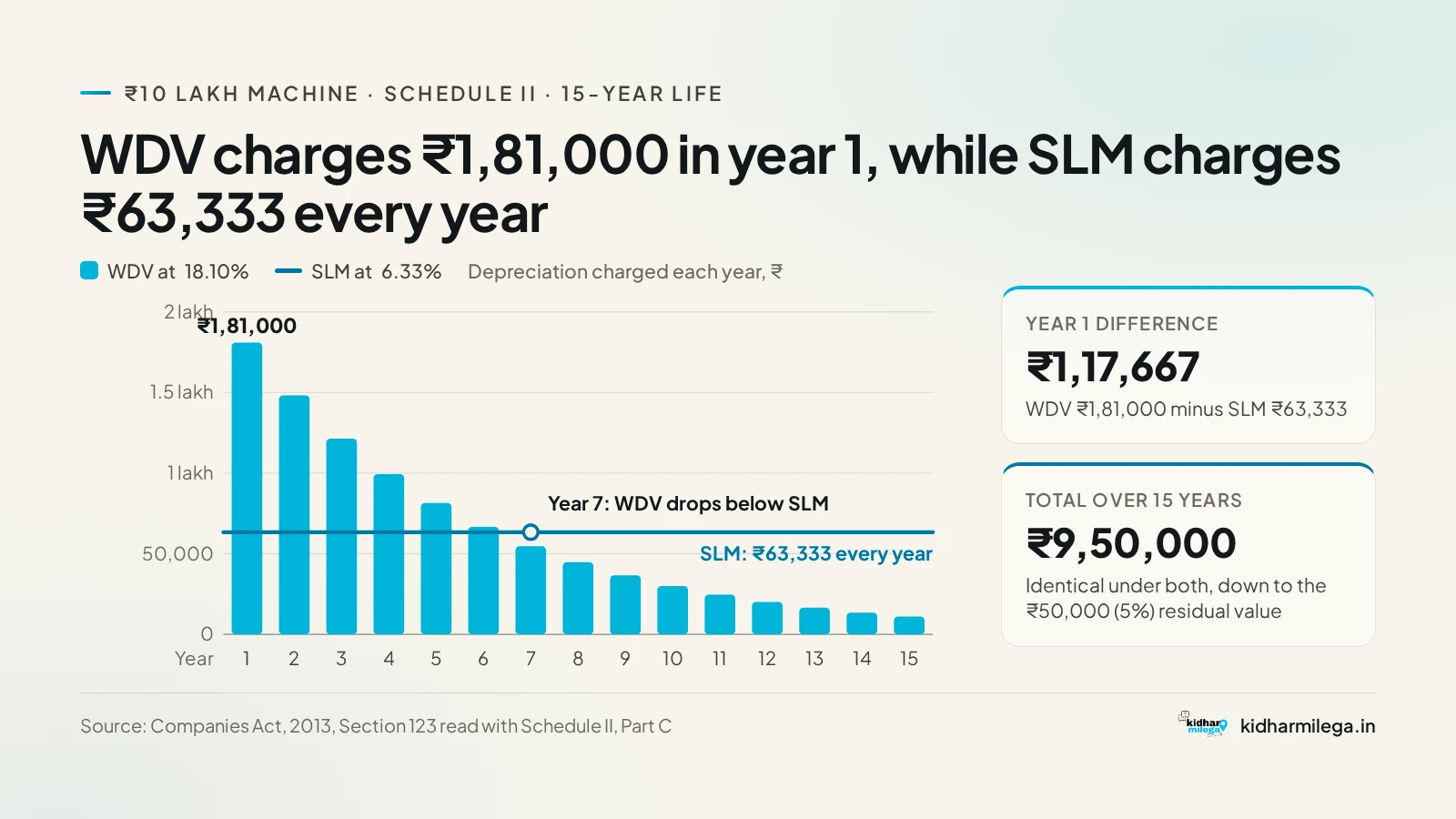
Look at year 1. WDV charges ₹1,81,000 and SLM charges ₹63,333, a difference of ₹1,17,667 in the first year alone. By year 7 the two lines cross, and WDV charges less than SLM every year after that. The total over 15 years is identical: ₹9,50,000.
Bought in October: pro-rata depreciation by date
Machines rarely arrive on 1 April. Say yours is installed and ready for use on 15 October 2026. From 15 October 2026 to 31 March 2027 is 168 days.
- SLM, FY 2026-27: ₹63,333 × 168 ÷ 365 = ₹29,151
- WDV, FY 2026-27: ₹1,81,000 × 168 ÷ 365 = ₹83,310
Under the Companies Act that's all there is: actual days, nothing else. You'll hear "half rate if less than 180 days" from the CA's office. That rule belongs to income tax, not Schedule II. Two more details matter. The date that counts is the date the machine is ready for use, not the invoice date. And FY 2027-28 has 366 days because 2028 is a leap year.
Under WDV, year 2 starts from ₹10,00,000 minus ₹83,310, which is ₹9,16,690. Year 2 depreciation is then ₹9,16,690 × 18.10% = ₹1,65,921.
Double and triple shift: +50% and +100% for the days you run them
The 15-year life assumes a single shift. If the machine runs a double shift, depreciation goes up by 50% for that period. For a triple shift it goes up by 100%. If you run a double shift for the full year on SLM, you charge ₹95,000 (9.50%). A full year of triple shift is ₹1,26,667 (12.67%).
Most small units don't run extra shifts all year. They run them when orders peak. So apportion by days. Say that in FY 2027-28 your festive and export orders mean:
| Period | Days | Extra charge (SLM) | ₹ |
|---|---|---|---|
| Single shift | 185 | Base charge for full year | 63,333 |
| Double shift | 120 | ₹63,333 × 50% × 120 ÷ 365 | 10,411 |
| Triple shift | 60 | ₹63,333 × 100% × 60 ÷ 365 | 10,411 |
| Total for the year | 365 | 84,155 |
Leaving the extra shifts out understates depreciation by ₹20,822 on this one machine. The same arithmetic works on WDV: ₹1,81,000 × 50% × 120 ÷ 365 = ₹29,753 extra for the double-shift days. Here's the catch. You need a shift log (attendance, production or electricity records) to back up the number. Without records it's just a claim. Assets marked NESD in Part C never get the extra charge.
Component accounting: when one part wears out faster
From financial years starting 1 April 2015, a significant part of an asset with a different useful life has to be depreciated separately. Take a made-up split of the same ₹10 lakh machine: a ₹8.5 lakh frame lasting 15 years and a ₹1.5 lakh tooling or die set lasting 5 years.
- Frame: ₹8,50,000 × 95% ÷ 15 = ₹53,833 a year
- Tooling: ₹1,50,000 × 95% ÷ 5 = ₹28,500 a year
- Total: ₹82,333 a year, against ₹63,333 if you treat the machine as one asset
When the tooling is replaced in year 6, the new set is capitalised as a fresh component. Don't expense it as a repair. This is for large machines with parts that clearly wear out faster, not for every bolt.
Companies Act vs Income Tax: machinery depreciation rate side by side
Book depreciation follows the Companies Act. Tax depreciation follows the Income-tax Act. They are two separate calculations, and the law expects them to differ.
| Point | Companies Act, 2013 (Schedule II) | Income-tax Act, 2025 (Section 33, Appendix I) |
|---|---|---|
| What the law gives | Useful life (15 years for general P&M) | A rate on a block of assets |
| General P&M rate | 6.33% SLM or 18.10% WDV | 15% WDV |
| Method | SLM or WDV, your choice | WDV on the block only |
| Mid-year purchase | Pro-rata by actual days | Half rate if used under 180 days, full rate otherwise |
| Extra shifts | +50% double, +100% triple, for the period | No shift loading |
| Residual value | Up to 5% | None; the block keeps reducing |
| Additional depreciation | None | 20% on new P&M for manufacturing or power generation (not under concessional regimes) |
| Year 1, ₹10 lakh machine, full year | ₹63,333 (SLM) or ₹1,81,000 (WDV) | ₹1,50,000 (₹3,50,000 with additional depreciation) |
| Year 1, ready for use 15 October 2026 | ₹29,151 (SLM) or ₹83,310 (WDV) | ₹75,000 (₹1,75,000 with additional depreciation) |
A note on the tax column. The 15% general rate is the same as under the 1961 Act. Published summaries of Appendix I under the 2026 Rules say it is unchanged, but confirm it against the official Appendix I page before you file. Returns for FY 2025-26 (AY 2026-27), including transfer pricing cases due by 30 November 2026, are still under Section 32 of the 1961 Act. Section 33 of the 2025 Act applies to machines in tax year 2026-27 onwards.
The 180-day rule and the ₹75,000 that two weeks can cost you
Put the same machine to use on 1 October 2026 instead of 15 October. That gives 182 days of use, which crosses 180, so you get the full 15% and ₹1,50,000 of tax depreciation in FY 2026-27. Install it on 15 October and you get 168 days and only ₹75,000.
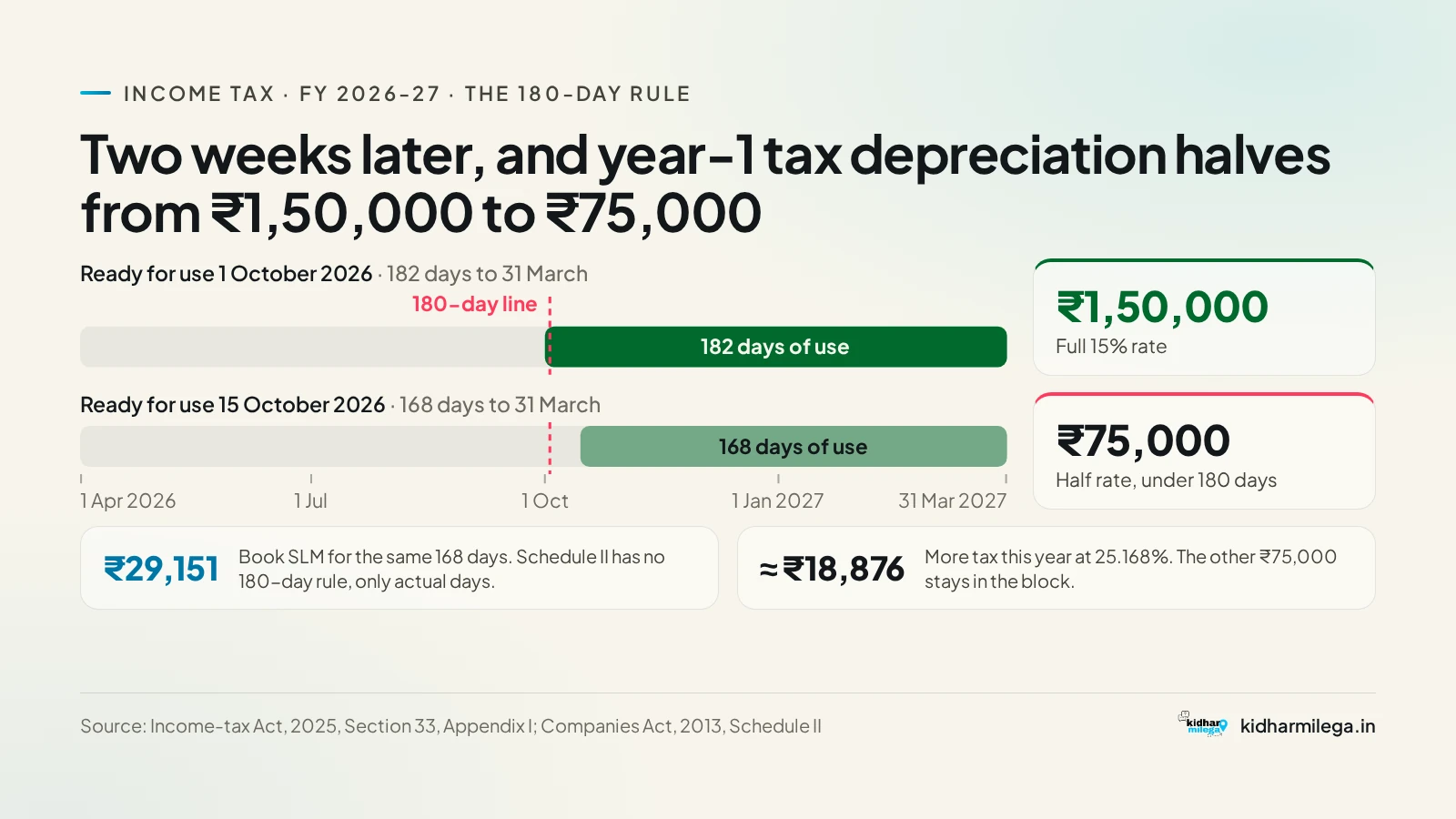
The other ₹75,000 isn't lost. It stays in the block and comes back in later years. But at a 25.168% tax rate you pay about ₹18,876 more tax this year. Machine ka installation date, tax ka cash flow. Plan the commissioning date with your CA, not with the supplier's dispatch calendar.
Additional depreciation: big number, small print
New plant and machinery used in manufacturing or power generation can get an extra 20% in the first year. If the machine is used for less than 180 days, you get half of that (10%) in the first year. Under the 1961 Act the balance half was allowed in the next year. Check with your CA that the same carry-over applies to your tax year under Section 33.
Here's the catch. Additional depreciation isn't available if you've opted for a concessional tax regime. Most small private companies choose the 22% company option, and many proprietors are on the new regime by default. It's also meant for new machinery. A second-hand machine from a dealer or expo auction doesn't qualify. Run the comparison before you count this money in your project report.
The book-vs-tax gap and the deferred tax it creates
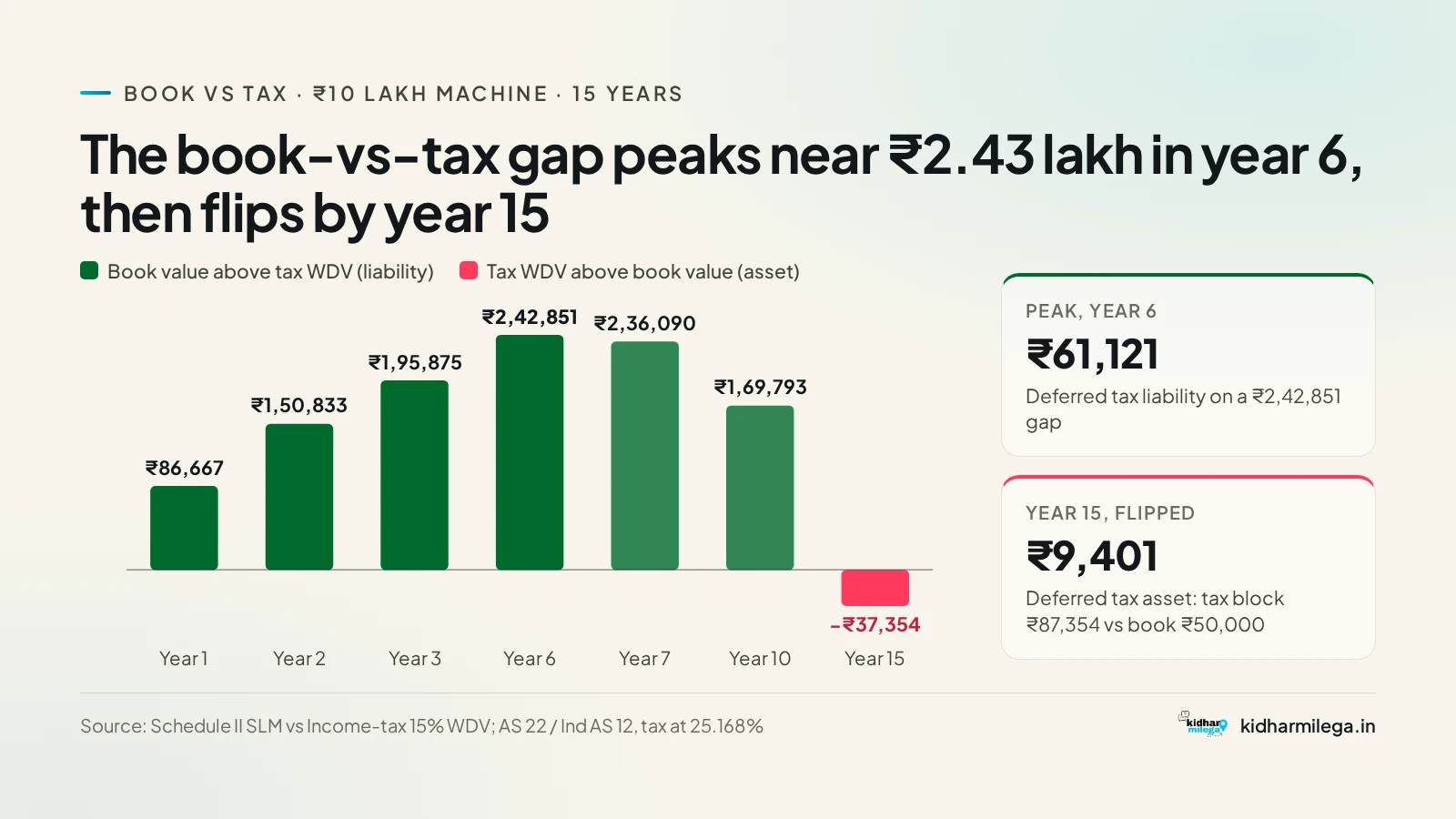
Your books (SLM) charge ₹63,333 in year 1. Your tax return charges ₹1,50,000. That ₹86,667 gap means you pay less tax now and more later. Companies record that future tax as a deferred tax liability (under AS 22, or Ind AS 12 if Ind AS applies).
The table assumes a full first year, no additional depreciation, and an effective tax rate of 25.168% (the 22% company option with 10% surcharge and 4% cess). Use your own rate.
| Year | Book SLM dep (₹) | Tax dep at 15% WDV (₹) | Book value at year-end (₹) | Tax WDV at year-end (₹) | Gap (₹) | Deferred tax, cumulative (₹) |
|---|---|---|---|---|---|---|
| 1 | 63,333 | 1,50,000 | 9,36,667 | 8,50,000 | 86,667 | 21,812 liability |
| 2 | 63,333 | 1,27,500 | 8,73,333 | 7,22,500 | 1,50,833 | 37,962 liability |
| 3 | 63,333 | 1,08,375 | 8,10,000 | 6,14,125 | 1,95,875 | 49,298 liability |
| 6 | 63,333 | 66,556 | 6,20,000 | 3,77,149 | 2,42,851 | 61,121 liability |
| 7 | 63,333 | 56,572 | 5,56,667 | 3,20,577 | 2,36,090 | 59,419 liability |
| 10 | 63,333 | 34,742 | 3,66,667 | 1,96,874 | 1,69,793 | 42,734 liability |
| 15 | 63,333 | 15,416 | 50,000 | 87,354 | (37,354) | 9,401 asset |
The gap grows for six years and peaks around ₹2.43 lakh. In year 7 tax depreciation falls below the ₹63,333 book charge, and the gap starts to unwind. By year 15 it has flipped: the tax block (₹87,354) is worth more than the book value (₹50,000), because the block never stops at a residual value. Book ka number alag, tax ka number alag. Dono sahi hain, bas register mein dono dikhne chahiye.
What this means for your tax bill and your EMI
Depreciation is not cash. Nobody hands the money to anyone. It still decides how much tax you pay, and banks look at it when they check whether you can repay a loan.
Assume the machine helps the unit earn ₹3,00,000 before depreciation and tax in a full year. To keep it simple, there's no interest and no other costs.
| Line | ₹ |
|---|---|
| Earnings before depreciation and tax | 3,00,000 |
| Tax depreciation (15% WDV) | 1,50,000 |
| Taxable income | 1,50,000 |
| Tax actually paid at 25.168% | 37,752 |
| Tax you would pay with no depreciation | 75,504 |
| Cash saved by tax depreciation in year 1 | 37,752 |
| Book profit before tax (after ₹63,333 SLM) | 2,36,667 |
| Book tax expense (₹37,752 current + ₹21,812 deferred) | 59,564 |
| Book profit after tax | 1,77,103 |
| Cash accrual (PAT + depreciation + deferred tax) | 2,62,248 |
The ₹2,62,248 is what your bank actually looks at. Compare it with your annual EMI. If the EMI is bigger, the machine isn't paying for itself in year 1, whatever the brochure says.
Paise kaise aayenge? Paise aate hain cash accrual se, depreciation se nahi. And if a government scheme covers part of the machine cost, it usually reduces the cost you depreciate, both in the books and for tax. Ask your CA how your specific grant is treated before you put it in the project report.
Work out your own machine's depreciation
Enter your machine's cost, its Schedule II life and the WDV rate from the table above, the days it was in use this year, and any double- or triple-shift days. The calculator gives your book depreciation (SLM and WDV), your year-1 income tax depreciation with the 180-day rule, and the deferred tax on the gap. The defaults are the ₹10 lakh machine put to use on 15 October 2026.
When you can use a different life or residual value
Schedule II isn't a fixed rule for every company:
- Ind AS and other prescribed companies can use a different useful life or residual value. They have to back it with a technical evaluation and disclose the difference, with the reason, in the notes to accounts.
- Other companies, which covers most small private limited companies, can't use a life longer than Part C or a residual value above 5%. A shorter life needs a documented technical reason.
- Sector regulators: where a regulator has notified useful lives for its sector, those lives take precedence.
- Second-hand machines: depreciate over the remaining useful life you estimate when you buy, not a fresh 15 years. Write down how you arrived at it.
"Technical evaluation" means a written report from a chartered engineer or the manufacturer's data. A line in the board minutes saying "we think 10 years" doesn't count.
Galat tareeka vs sahi tareeka
| Galat tareeka | Sahi tareeka |
|---|---|
| Using 15% income tax WDV in the company's books | Books on Schedule II (6.33% or 18.10%), tax return on 15%, with deferred tax for the gap |
| Starting depreciation from the invoice date | Starting from the date the machine is ready for use, pro-rata by days |
| Applying the 180-day half-rate rule in the books | 180-day rule for tax only; actual days for the books |
| Copying an 8-year life for continuous process plant from an old blog | 25 years since GSR 237(E), 31 March 2014 |
| Claiming double-shift depreciation for the full year because "we ran extra in Diwali" | Extra charge only for the double-shift days, backed by a shift log |
| Counting 20% additional depreciation in the project report | Checking your tax regime first; concessional regimes and used machines don't get it |
Checklist: setting up a machine in your fixed asset register
These items are what Schedule II and the income tax block rules ask of each asset. Fill them in the week the machine arrives, not at audit time.
- Asset ID and description: make, model, serial number, location in the shed.
- Supplier invoice: number, date, amount. Keep the GST input credit you claim out of cost.
- Cost build-up: base price, freight, non-refundable duties, installation and trial-run costs that are needed to bring the machine to working condition.
- Date ready for use: from the installation or commissioning report. This drives both book pro-rata and the tax 180-day test.
- Schedule II class: general P&M, continuous process plant, or a named special industry from Part C. Note whether it is NESD.
- Useful life and residual value: Part C life (or the remaining life for a used machine) and residual value of 5% or less, with the technical report if you depart from these.
- Method: SLM or WDV, applied consistently to the class.
- Components: any significant part with a different life, recorded as a separate line.
- Shift record: a monthly log of single, double and triple-shift days.
- Tax block: the Appendix I block (15% general machinery), days used in the year, and whether the machine is eligible for additional depreciation (new, used in manufacturing, regime allows it).
- Grants: any subsidy received against the machine and how it is treated.
- Disposal: date sold or scrapped, sale value, and the pro-rata depreciation up to that date.
Toh SLM lein ya WDV?
If you're a first-time manufacturer planning a bank loan, use SLM in the books. It shows a steadier, higher profit in the early years, and your project report and term-loan appraisal will read better. Your tax return gets the 15% WDV anyway, so you don't lose any tax benefit by choosing SLM in the books.
Choose WDV in the books only if your machines lose value fast in the real world. Fast-changing technology is the usual reason, and in that case writing them down quickly is the honest picture.
If you're a proprietor or partnership firm, Schedule II doesn't bind you. Most firms like that keep one set of numbers on income tax rates and get on with selling. Don't build a two-register system you don't need.
Your next step
Before you lock the machine budget, get three quotes and check the seller. The free supplier finder lists verified machinery suppliers and manufacturers near you. If you're funding part of the machine through PMEGP (apply on the KVIC e-portal) or another scheme, run the scheme finder first so you know which subsidy you actually qualify for. If you're still deciding what to make, start from your own district's ODOP product on the district product directory or the KidharMilega homepage. Then put the real cost and the real commissioning date into the calculator above, before the machine is on the truck.
Frequently asked questions
What is the depreciation rate of plant and machinery as per Companies Act 2013?
Schedule II gives general plant and machinery a useful life of 15 years with residual value capped at 5%. That works out to 6.33% a year on the straight-line method or 18.10% on the written-down value method. Continuous process plant has a 25-year life (3.80% SLM, 11.29% WDV), and special industries such as pharma, telecom and power have their own lives in Part C.
Is continuous process plant depreciated over 8 years or 25 years?
25 years. The first version of Schedule II showed 8 years (11.88% SLM, 31.23% WDV), but GSR 237(E) dated 31 March 2014 changed it to 25 years, which gives 3.80% SLM and 11.29% WDV. A continuous process plant is one that is required and designed to run 24 hours a day, not one you simply run round the clock in season.
Is there a 180-day rule for depreciation under the Companies Act?
No. Under the Companies Act, a machine bought partway through the year is depreciated pro-rata from the date it is ready for use. A machine ready on 15 October 2026 gets 168 days of depreciation in FY 2026-27. The half-rate rule for assets used under 180 days applies only under income tax, where the same machine would get 7.5% instead of 15%.
Why is the income tax depreciation rate on machinery different from the Companies Act rate?
The two laws do different jobs. Schedule II sets a useful life to show a fair book value in the accounts, while income tax gives a fixed 15% WDV rate on the machinery block to calculate taxable income. On a ₹10 lakh machine, year 1 book SLM depreciation is ₹63,333 against ₹1,50,000 for tax. Companies record the resulting gap as deferred tax.
Did plant and machinery depreciation rates change in 2026?
Schedule II of the Companies Act was not amended in 2026, so the useful lives are the same. On the tax side, the Income-tax Act, 2025 replaced the 1961 Act from 1 April 2026. Depreciation now sits in Section 33, with rates in Appendix I of the Income-tax Rules, 2026. Published summaries show general machinery still at 15%; confirm against the official Appendix I.
How does double shift depreciation work under Schedule II?
Schedule II lives assume a single shift. For the period a machine runs a double shift, depreciation goes up by 50%; for triple shift, it goes up by 100%. On a ₹10 lakh machine with ₹63,333 annual SLM, 120 double-shift days add about ₹10,411. Assets marked NESD get no extra charge, and you need shift records to support the claim.
Sources
- Companies Act, 2013 (including Schedule II) · India Code, Government of India
- Section 33, Income-tax Act, 2025 · Income Tax Department
- Appendix I: Depreciation rates · Income Tax Department
- Notification No. 22/2026, G.S.R. 198(E): Income-tax Rules, 2026 · Income Tax Department
- Ministry of Corporate Affairs · Ministry of Corporate Affairs
- MCA extends FY 2025-26 AOC-4 and MGT-7 filing deadlines · India Briefing
- Depreciation under the Income-tax Act 2025: rates, block of assets, additional depreciation · CSM & Co LLP
- Schedule II useful life table · Coraa