
The SBI MSME loan in 59 minutes does not put money in your account in 59 minutes. In that time you get an in-principle approval on the government's common portal, psbloansin59minutes.com, where SBI is one of several public sector lenders. After that, the SBI branch checks everything again before it sanctions and pays out, which third-party guides put at about 7 to 10 working days. You also need GST registration, ITRs and six months of bank statements before you can start, so most first-time founders can't use it.
MSME working capital loan cost calculator
Works out the first-year cost of a working capital (cash credit) loan: interest on what you actually draw, plus the processing and portal fees.
Average amount drawn —
Interest for one year —
Interest per month (approx.) —
Processing fee incl. 18% GST —
Portal fee incl. 18% GST (reported ₹1,000 + GST) —
Total first-year cost —
Cash credit interest is charged only on the amount drawn. SBI's MSME pages list rates from 7.50% a year, effective 15 October 2026; your actual rate and processing fee are in your sanction letter. The ₹1,000 + GST portal fee is reported by third-party guides and is not confirmed on an official page. CGTMSE guarantee fees, if charged, are not included.
Key facts (as of 18 November 2026)
- What it is: a common online loan marketplace run with SIDBI and the public sector banks (PSBs). It is not an SBI-only product; SBI is one lender on it.
- Launched: September 2018 for MSME loans up to ₹1 crore. The Prime Minister announced it on 2 November 2018 as part of the MSME Support and Outreach package (PIB release).
- Loan range: about ₹1 lakh to ₹5 crore for business loans. The in-principle limit was reportedly raised to ₹5 crore in July 2019.
- Speed: in-principle approval in 59 minutes. Sanction and disbursal happen at the bank after verification.
- Portal fee: third-party guides report ₹1,000 + GST to download the in-principle letter. No official page lists this fee.
- Usage: 28,56,270 MSME loans worth ₹6,59,170 crore sanctioned through the portal as of 30 September 2026, according to the Department of Financial Services.
- SBI rates: SBI's MSME loan pages list rates starting at 7.50% a year, effective 15 October 2026.
- SBI's own route: SBI's SME Digital Business Loans, launched in June 2024, can sanction in about 45 minutes. Up to ₹50 lakh, no financial statements are needed.
What "SBI MSME loan in 59 minutes" actually means
You've probably seen the reel by now: "59 minute mein ₹1 crore ka loan, sarkari scheme." It sounds believable, and there's a reason. The portal is real, the government launched it, and SBI is on it. The fine print is where it changes.
The 59 minutes covers only the first step. The portal pulls your GST data, reads your ITR and bank statements, scores you, and shows which banks are willing to consider you and for roughly how much. That letter tells you the bank is interested. It doesn't promise to lend.
Announcement hai, cheque nahi. Until the SBI branch issues a sanction letter and sets up your limit, you haven't been given a single rupee.
Now look at what it's built for. Divide the DFS figure, ₹6,59,170 crore across 28,56,270 MSME loans, and the average works out to about ₹23 lakh per loan. That's a loan for running businesses with a paper trail. It isn't a ₹2 lakh starter loan for someone who still has only an idea.
From 59 minutes to money in your account: the real timeline
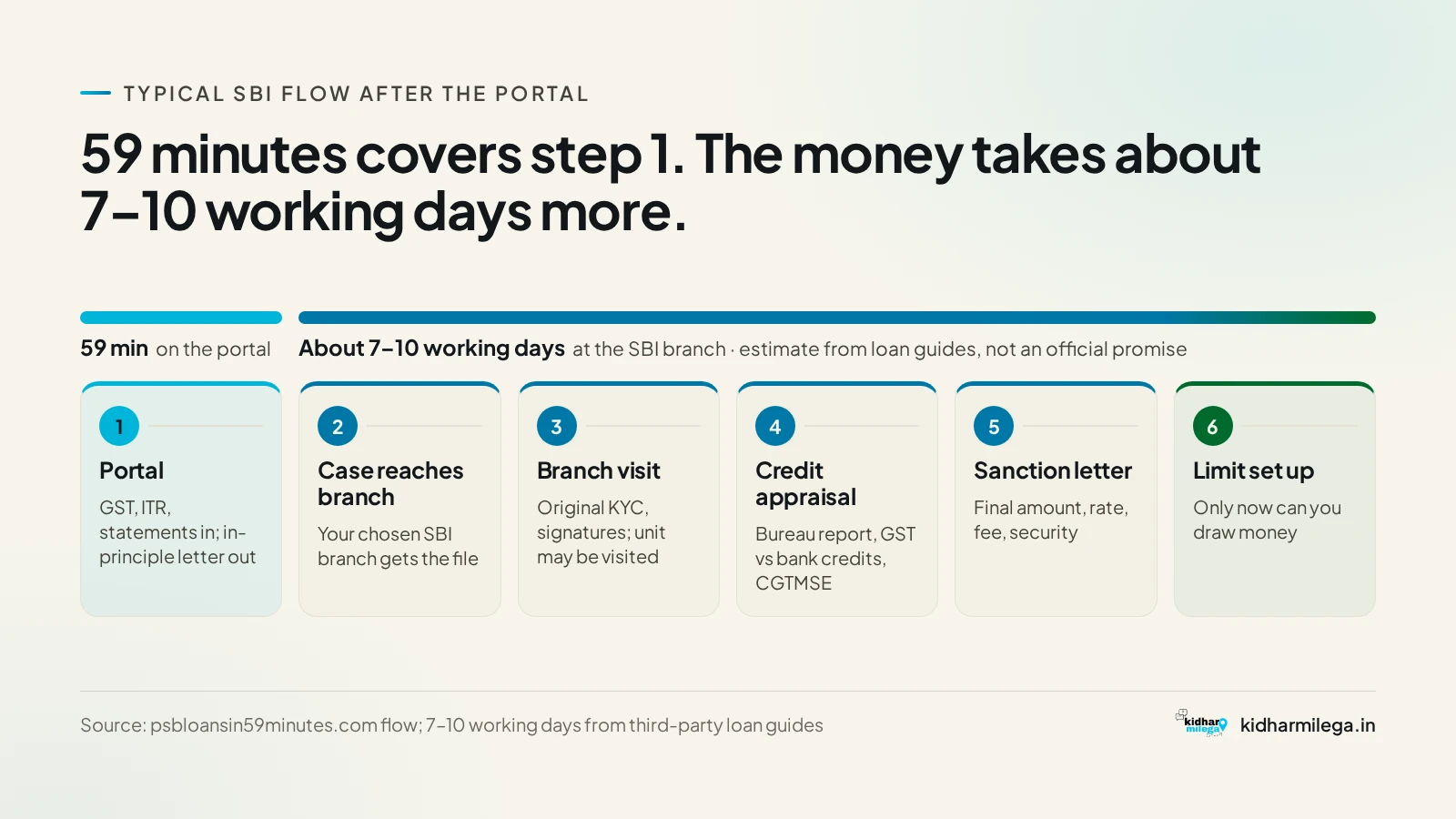
This is what usually happens after you pick SBI on the portal. Banks don't publish one fixed timeline, so treat the 7 to 10 working days figure as a rough estimate from loan guides, not an official promise.
- Minutes 0 to 59, on the portal. You sign up, connect your GSTIN, upload ITRs in XML format and six months of bank statements as PDFs, then fill in owner and business details. You pick SBI and a branch. You pay the reported ₹1,000 + GST and download the in-principle letter.
- The case reaches the branch. The SBI branch you picked gets your file. Someone from the branch calls you, or you can walk in with the letter.
- Branch visit. You bring original KYC, registration papers and signatures. The branch may also visit your unit, shop or godown.
- Credit appraisal. The bank pulls your credit bureau report, checks your existing loans, compares GST turnover with bank credits, and decides whether you need collateral or can get cover under CGTMSE (the government's credit guarantee scheme for MSME loans).
- Sanction letter. This sets out the final amount, interest rate, processing fee, security and conditions. Read every line, because it can differ from the in-principle letter.
- Documentation and disbursal. You sign the loan agreement and hypothecation papers. For a working capital loan the cash credit limit is set up; for a term loan the money is released, often straight to your machine supplier.
Steps 2 to 6 are where most of the time goes. When people say "59 minutes", they mean step 1.
Who qualifies, honestly?
The portal only works with data it can read. If your business has no GST, ITR or bank trail, there's nothing for it to score.
| Requirement | What the portal expects | Who this leaves out |
|---|---|---|
| GST registration | An active GSTIN; most guides say it is effectively required | Small traders and makers under the GST threshold who never registered |
| Income tax returns | Last 3 years in XML format (1 year for working capital) | Businesses less than a year old, or owners who never showed business income |
| Bank statements | Last 6 months, as PDF | Businesses where sales come in as cash or through a personal savings account |
| Udyam registration | A valid Udyam number | Nobody, really; it is free and online at udyamregistration.gov.in |
| Credit history | The bank checks your bureau report | Owners with overdue EMIs, settled loans or card defaults |
| KYC | PAN, Aadhaar and personal details of owners or directors | Firms where names and addresses don't match across PAN, GST and Udyam |
Who can't use it: idea-stage founders, businesses without GST, businesses with less than one ITR, and anyone whose sales mostly bypass the bank. For a first-time founder with ₹5 lakh in savings and a plan, this portal is the wrong door. Better options for you come further down.
MSME loan documents required: the checklist
This is what the portal asks for at sign-up, based on how the portal flow and the participating banks describe it. The live site loads the exact list when you log in, so check it there before you start.
Uploaded on psbloansin59minutes.com
- GSTIN (the portal reads your GST return data from it)
- ITR for the last 3 years in XML format (1 year if you want working capital)
- Bank statements for the last 6 months, in PDF
- Udyam registration number
- KYC and personal details of all owners, partners or directors
Usually asked for at the SBI branch
- Originals of KYC and business registration for verification
- Partnership deed or MOA/AOA if you are not a sole proprietor
- Machinery quotations, if it is a term loan for equipment
- Property papers, if the branch asks for collateral
- Details of every existing loan, including personal and gold loans
Download the bank statement PDF straight from net banking (for SBI, from the account statement section of internet banking). Scanned printouts can fail the portal's reading step.
How to apply on psbloansin59minutes.com and choose SBI
- Go to psbloansin59minutes.com and sign up with your mobile number and email. Third-party guides list the sign-up page as /signup and the login page as /login.
- Choose the MSME business loan option, not retail or personal.
- Enter your GSTIN and let the portal fetch your GST data.
- Upload your ITR XML files and bank statement PDFs.
- Fill in owner details, existing loans and the amount you need.
- From the banks shown, choose SBI and the branch nearest your business premises.
- Pay the platform fee (reported as ₹1,000 + GST, about ₹1,180) and download the in-principle letter.
- Log in again later to track status, and follow up with the branch directly.
Third-party guides list the support contacts as support@psbloansin59minutes.com and 079-41055999. These don't appear on an official page, so use them only for portal problems and never pay anyone who calls you from them.
One warning: a site at sbiloansin59minutes.com shows up in search results. Neither SBI nor any government page links to it, and it does not say clearly who runs it. Use only psbloansin59minutes.com or SBI's own website.
The math: what a ₹25 lakh SBI working capital loan really costs
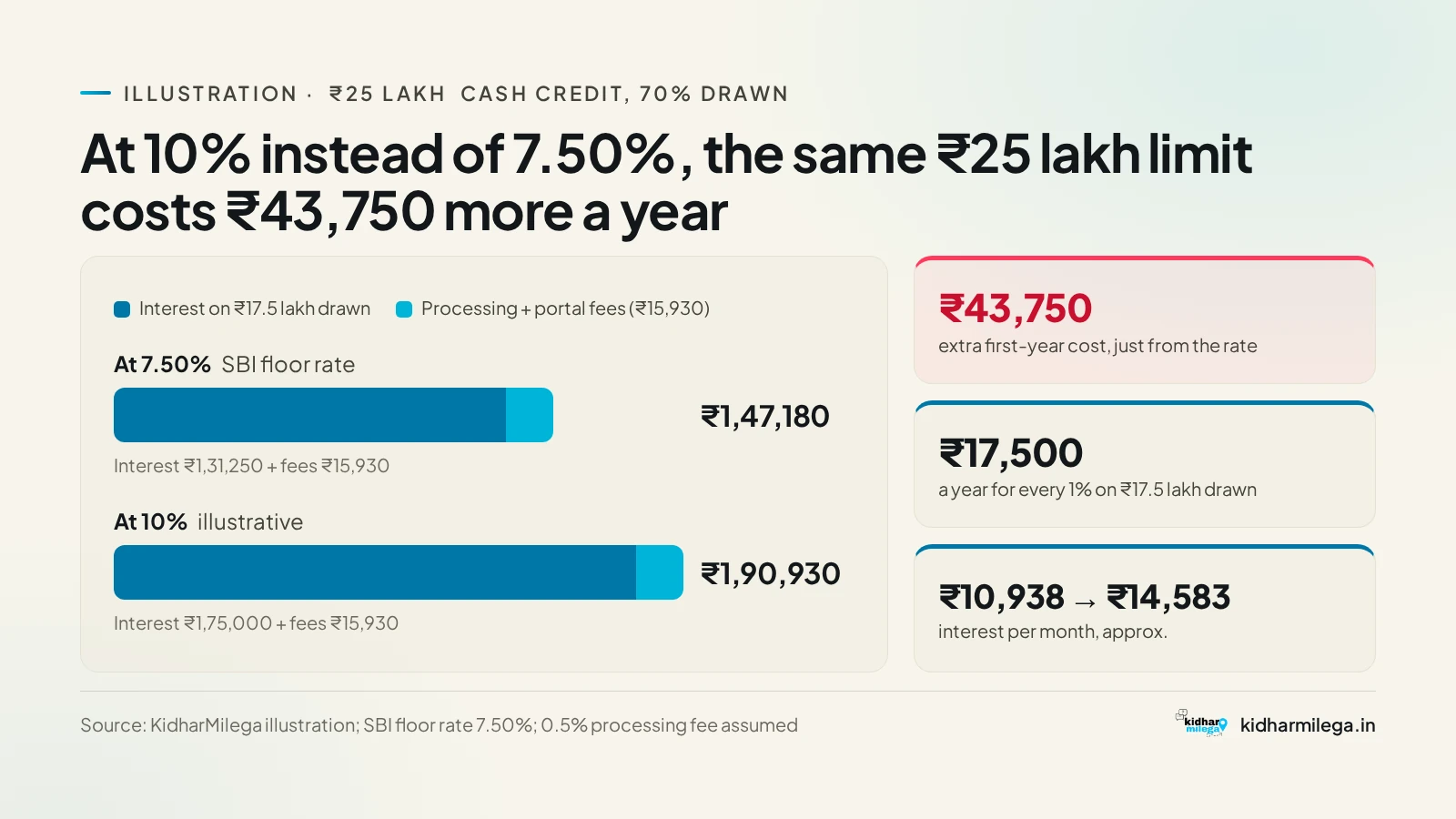
Take a makhana processor in Saharsa, or a chilli trader in Guntur. Both buy stock in season and sell it over the following months, which is a working capital problem. Say SBI sanctions a ₹25 lakh cash credit limit and, on average, you use 70% of it (₹17.5 lakh).
On cash credit you pay interest only on the amount you actually draw. SBI's floor rate is 7.50%, but your rate depends on your credit score, collateral and the bank's assessment, so the table also shows 10% for comparison. The 0.5% processing fee is an assumption for illustration only; your sanction letter will give the real figure.
| Line item | At 7.50% (SBI floor) | At 10% (illustrative) |
|---|---|---|
| Average amount drawn | ₹17,50,000 | ₹17,50,000 |
| Interest for one year | ₹1,31,250 | ₹1,75,000 |
| Interest per month (approx.) | ₹10,938 | ₹14,583 |
| Processing fee, assumed 0.5% of ₹25 lakh, + 18% GST | ₹14,750 | ₹14,750 |
| Portal fee, reported ₹1,000 + 18% GST | ₹1,180 | ₹1,180 |
| Total first-year cost | ₹1,47,180 | ₹1,90,930 |
The gap between those two columns is ₹43,750 a year, just from the rate. Every 1% on ₹17.5 lakh drawn costs you ₹17,500 a year. Your margin on stock has to cover that before you earn anything. If you have a guarantee fee under CGTMSE, add that too.
Taking a term loan for a machine instead? A ₹10 lakh loan at 9% over 5 years means an EMI of about ₹20,758 and roughly ₹2,45,480 in total interest. Agar business ka monthly cash flow ₹21,000 ki EMI nahi jhel sakta, toh loan bada hai, business chhota.
Why in-principle approvals fail at the SBI branch
An in-principle letter is not a sanction, and the branch can still say no. These are the usual reasons, and what you can do about each one before you apply.
| What goes wrong | What to do about it |
|---|---|
| GST turnover and bank credits don't match | Route all sales through one current account for at least 6 months before you apply |
| Bad credit report: overdue card, settled loan, errors | Pull your own credit report first, pay off overdues and raise disputes for errors |
| Existing EMIs already use up your repayment capacity | Declare every loan honestly and ask for a smaller amount you can actually repay |
| Branch asks for collateral you didn't expect | Ask in writing whether the loan can be covered under CGTMSE instead |
| Name or address mismatch across PAN, GST, Udyam and bank | Fix the records on the GST portal and Udyam before applying |
| Branch is far from your unit | Choose the SBI branch closest to where the business actually runs |
| You never followed up | Visit the branch within a few days of getting the letter, with your originals |
Portal vs SBI's own digital loans: which route makes sense in 2026
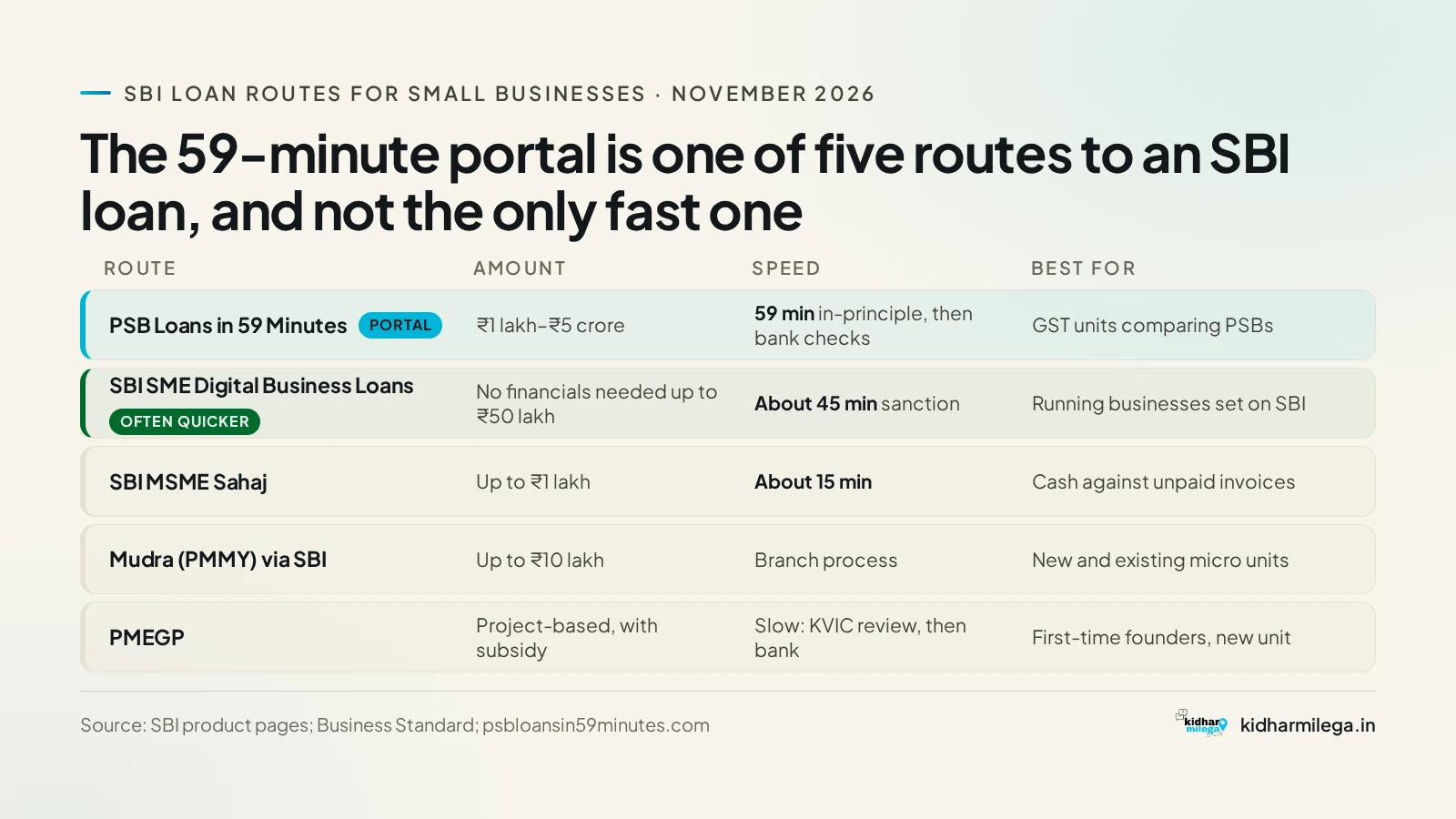
All the pages still ranking for this topic were written in 2018. Since then SBI has built its own fast lanes. SBI reported in August 2026 that it used AI to underwrite about ₹1 lakh crore of MSME loans in FY26 (Business Standard). If you already know you want SBI, its own route can be quicker than the common portal.
| Route | Amount | Speed | What it needs | Best for |
|---|---|---|---|---|
| PSB Loans in 59 Minutes (SBI is one lender) | About ₹1 lakh to ₹5 crore | In-principle in 59 min, then bank verification | GST, ITR, 6 months' bank statements, Udyam | GST-registered units that want to compare PSBs |
| SBI SME Digital Business Loans | No financial statements needed up to ₹50 lakh | Sanction in about 45 min, per SBI at launch | GST, ITR and bank data | Running businesses that are set on SBI |
| SBI MSME Sahaj | Up to ₹1 lakh | About 15 min | GST invoices | Short-term cash against unpaid invoices |
| Mudra (PMMY) via SBI | Up to ₹10 lakh, per SBI's page | Branch process | Business plan, KYC | New and existing micro units |
| PMEGP | Project-based, with subsidy | Slow: KVIC review, then bank | Project report, own contribution of 5 to 10% | First-time founders setting up a new unit |
SBI's digital business loans had about 2.25 lakh accounts and ₹74,434 crore in loans as of August 2025, according to Business Standard. For loans above ₹10 lakh and up to ₹50 lakh, SBI also has SME Smart Score. Banks change rates and product terms, so check both SBI's site and the portal on the day you apply.
"PM MSME loan scheme": what people actually mean, and the fake letters
There is no official scheme called the "PM MSME loan". When people search for it, they usually mean one of three things:
- The 59-minute portal, because the Prime Minister announced it in November 2018.
- Mudra (PMMY), which offers collateral-free loans to micro businesses through banks.
- PMEGP, which gives a subsidy of 15 to 35% on the project cost for new units. The bank still has to approve your loan first, and you put in 5 to 10% yourself.
Scammers use this confusion. In 2026, PIB Fact Check flagged a fake ₹3 lakh "PM Loan Scheme" ad in April (News On AIR), and fake PMMY approval letters asking for a ₹350 "processing fee" in May and July (News On AIR). The MSME ministry also said it never issued a PMEGP sanction letter that was going around (India TV).
The rule is simple. A real sanction comes from a bank branch, on bank letterhead, after you applied. Any fee is paid on the official portal or at the bank, never to a personal UPI ID. A WhatsApp "loan approval" for something you never applied for is a scam, every single time.
Wrong way vs right way
Galat tareeka: you see the reel, pay the portal fee with half-ready papers, get an in-principle letter for ₹30 lakh, and then the branch finds a ₹40,000 overdue credit card and a GST-bank mismatch. You lose the fee, and the rejection stays in the bank's records.
Sahi tareeka:
- Get Udyam done (free) and make sure your name and address match across PAN, GST and the bank.
- Run all sales through one current account for 6 months.
- Pull your credit report and clear any overdues.
- Work out the amount from your actual stock cycle, not from what the portal offers.
- Then apply, either on the portal or directly through SBI's digital route.
Toh apply karna chahiye ya nahi?
Use the 59-minute portal if: you have a GST-registered business with at least one year of ITR (three for term loans), your sales go through the bank, you need ₹10 lakh or more, and you want several PSBs to compete for your file.
Go straight to SBI's digital loan if: you already bank with SBI, have clean GST and ITR data, and need up to ₹50 lakh. There's one less middleman, and SBI sanctions in about 45 minutes on its own platform.
Skip both if: you're still at the idea stage, have no GST, or need under ₹10 lakh. Look at Mudra, PMEGP, PM Vishwakarma if you're an artisan in one of its listed trades, or Stand-Up India if you're a woman, SC or ST founder setting up your first new unit. Pehle business chalao, record banao; bada loan record ke peeche aata hai.
Your next step
Before you pay any portal fee, spend three minutes on our Scheme Finder. It matches your stage, budget and category to the schemes you can actually apply for, whether that's Mudra, PMEGP, PM Vishwakarma or Stand-Up India, so you aren't guessing. You can also cross-check eligibility on myScheme.
If you haven't picked a product yet, start with what your district already makes, or take the quiz on the KidharMilega homepage. A loan only makes sense once you know what you'll do with the money, close to home.
Need a smaller loan of up to ₹50,000? See SBI e-Mudra loan online apply steps.
Frequently asked questions
Will I really get an SBI MSME loan in 59 minutes?
No. In 59 minutes the psbloansin59minutes.com portal gives you an in-principle approval, which shows that SBI or another public sector bank is willing to consider your loan. The branch then checks your documents, credit report and business before it sanctions and pays out. Third-party guides say this usually takes about 7 to 10 working days, but no bank publishes a fixed deadline.
What documents are needed for the MSME loan in 59 minutes?
You need your GSTIN, income tax returns for the last three years in XML format (one year for working capital), six months of bank statements as PDF, Udyam registration, and KYC and personal details of all owners or directors. At the branch you may also be asked for originals, a partnership deed or MOA, machinery quotations and collateral papers.
Is the ₹1,000 portal fee refundable?
Third-party guides say the portal charges ₹1,000 plus GST, about ₹1,180, to download the in-principle letter. No official refund policy is published, so assume you won't get it back even if the bank later rejects your application. Get your GST, bank statements and credit report in order before you pay, so you don't lose the fee.
Can a new business or startup apply on psbloansin59minutes.com?
In practice, mostly no. The portal scores you on GST returns, ITRs and bank statements, so a business without at least one year of filed returns and a bank trail has nothing to be scored on. New founders should look at Mudra, PMEGP, PM Vishwakarma or Stand-Up India, which are built for new and micro units.
Is the PM MSME loan scheme real?
There is no official scheme with that name. People usually mean the PSB Loans in 59 Minutes portal, Mudra loans or PMEGP. In 2026 PIB Fact Check flagged fake PM loan ads and fake Mudra and PMEGP approval letters that asked for fees. A real loan is sanctioned by a bank branch after you apply, and no one asks you to pay a fee to a personal UPI ID.
Mudra loan or 59-minute loan: which is better?
It depends on your stage and how much you need. Mudra is for micro units, new or existing, and SBI's page lists loans up to ₹10 lakh. The 59-minute portal is for businesses that already have GST, ITRs and bank statements and need roughly ₹1 lakh to ₹5 crore. If you're new or need a small amount, Mudra fits better.
Sources
- PSB Loans in 59 Minutes: status report · Department of Financial Services
- PSB Loans in 59 Minutes · PSB Loans in 59 Minutes
- SBI digital MSME loans · State Bank of India
- SBI SME Smart Score · State Bank of India
- SBI Pradhan Mantri Mudra Yojana · State Bank of India
- MSME Support and Outreach Programme launch · Press Information Bureau
- SBI uses AI to underwrite nearly ₹1 trillion MSME loans in FY26 · Business Standard
- Govt debunks fake approval letter claiming to grant loan under PMMY on payment of ₹350 · News On AIR