
The Startup India certificate is the free DPIIT Certificate of Recognition. Under the 2026 rules you qualify if you are a private limited company, LLP, registered partnership firm or cooperative society, not more than 10 years old (20 for Deep Tech), your turnover has never crossed ₹200 crore in any year (₹300 crore for Deep Tech), and you are building something new or better. You apply on the National Single Window System (NSWS) for ₹0. Once approved, you download the certificate from your Startup India dashboard, from NSWS or from DigiLocker.
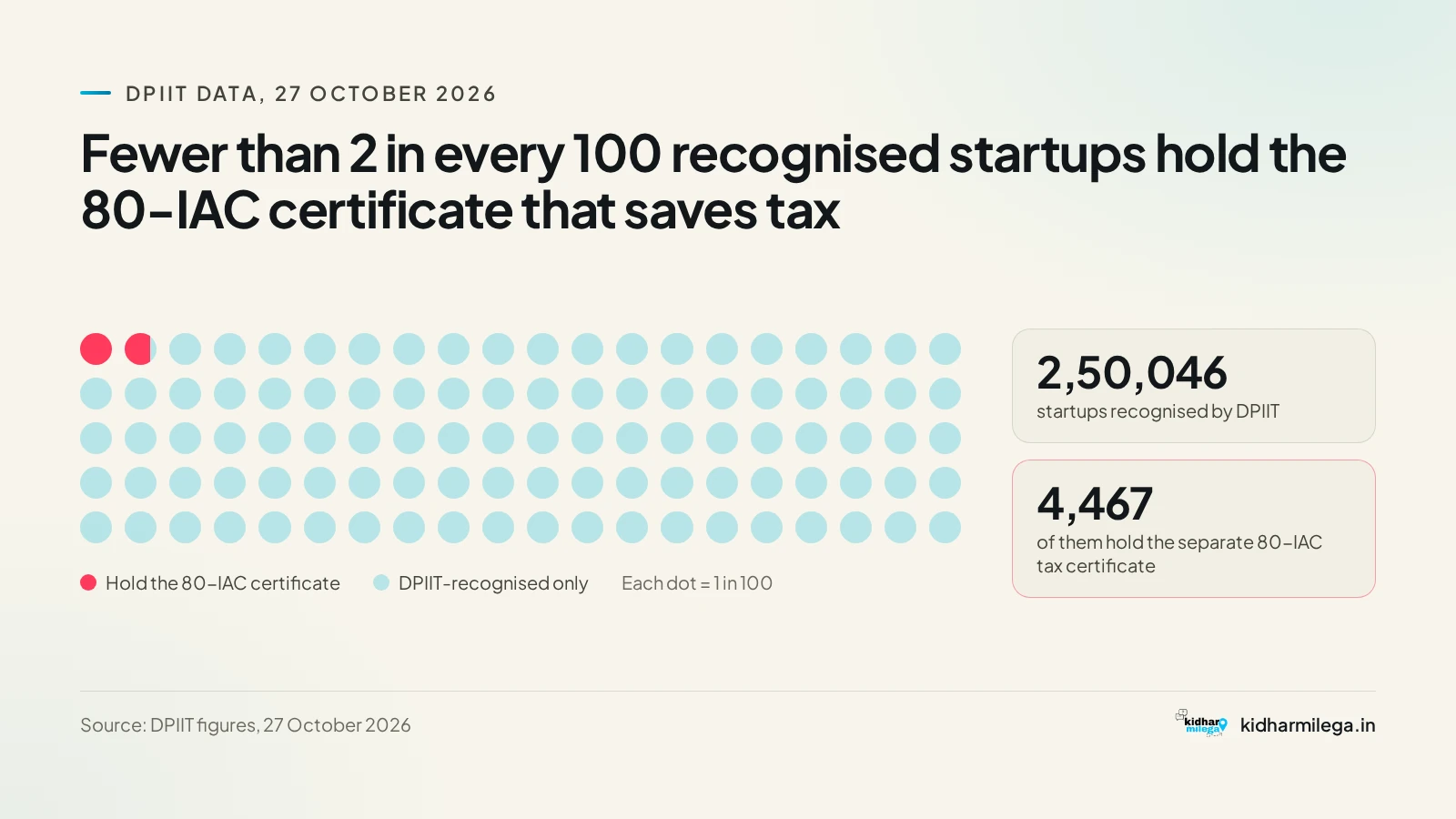
Most reels skip this number. On 27 October 2026, DPIIT counted 2,50,046 recognised startups. Only 4,467 of them held the separate 80-IAC certificate, which is the one that actually saves tax. That is fewer than 2 in every 100.
Certificate milna aasaan hai. Usse paisa nikalna alag kaam hai. This page covers both. You get the eligibility rules, the documents, the NSWS steps, how to download and verify the certificate, and a rupee test of whether a ₹2.5 to 20 lakh local manufacturer should bother, or should just get Udyam.
Startup India certificate in short
It is a free government recognition that marks your company as a "startup" so you can claim startup benefits. It is not a loan, not a grant and not a tax exemption on its own. If you are a proprietorship selling locally, Udyam registration probably matters more to you at this stage. If you are a private limited company or LLP with a new product or process, apply on NSWS as soon as your papers are ready, since it costs nothing.
Key facts
- Issued by: DPIIT (Department for Promotion of Industry and Internal Trade), Ministry of Commerce and Industry.
- Rules in force: Notification G.S.R. 108(E), dated 4 February 2026, which replaced the 2019 rules.
- Turnover cap: ₹200 crore in any financial year (up from ₹100 crore). ₹300 crore for Deep Tech.
- Age limit: 10 years from incorporation. 20 years for Deep Tech.
- Who can apply: private limited company, LLP, registered partnership firm and, new in 2026, cooperative societies.
- Fee: ₹0 for the Certificate of Recognition and ₹0 for the 80-IAC Certificate of Eligibility.
- Apply at: nsws.gov.in. The Startup India recognition page redirects you there.
- Processing time: usually 2 to 10 working days. Filing firms quote this range; DPIIT does not publish an official one.
- Helpline: 1800 115 565, 10:00 AM to 5:30 PM.
- Re-apply under 2026 rules? No. Existing recognitions continue while you stay within the age and turnover limits.
What the Startup India certificate is, and what it is not
Here's the confusion that costs founders months. People mix up three registrations: the DPIIT certificate, Udyam (MSME) registration, and the 80-IAC tax certificate. They have different owners, different tests and different uses.
| DPIIT Startup India certificate | Udyam (MSME) registration | 80-IAC certificate | |
|---|---|---|---|
| Who issues it | DPIIT | Ministry of MSME | Inter-Ministerial Board (IMB) |
| Who can get it | Pvt Ltd, LLP, registered partnership firm, cooperative society | Any business, including a sole proprietorship | Only Pvt Ltd and LLP incorporated after 1 April 2016, already DPIIT-recognised |
| Fee | ₹0 | ₹0 | ₹0 |
| Where | NSWS | udyamregistration.gov.in | Form 80-IAC on Startup India |
| Main test | Age, turnover, innovation | Investment and turnover, from your PAN and GST data | Board review of your innovation and business |
| What it gets you | IP filing support, tender relaxations, self-certified compliance, access to startup schemes | MSME credit routes, 45-day payment protection from buyers, MSE tender benefits | 100% deduction on profits for 3 consecutive years within your first 10 |
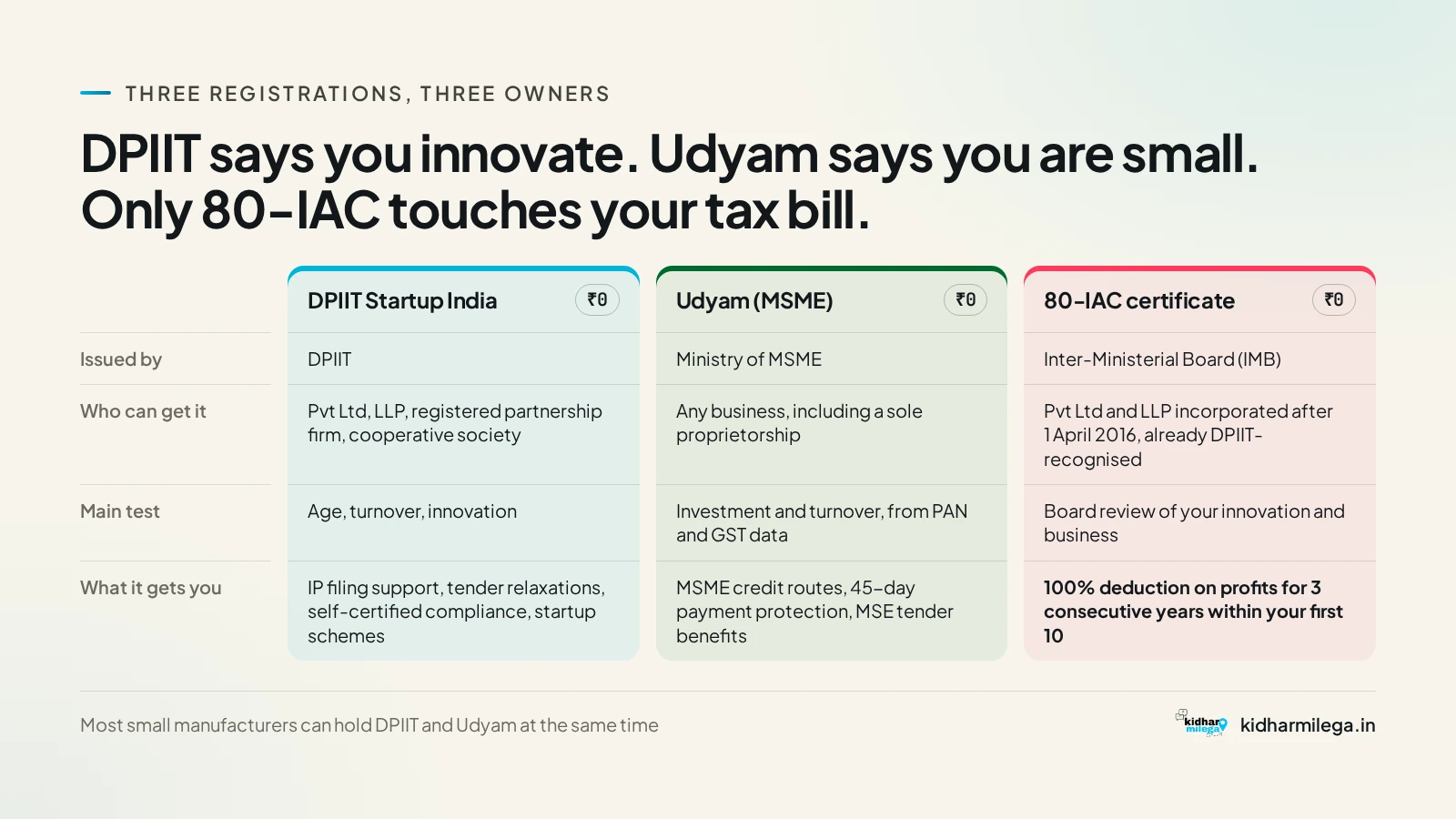
Simple rule. DPIIT tells the government you are innovating. Udyam tells the government you are small. The 80-IAC certificate is the only one that touches your tax bill. Most small manufacturers can, and should, hold both DPIIT and Udyam at the same time.
Startup India certificate eligibility in 2026: kaun apply kar sakta hai, honestly?
The 2026 framework, as set out on the official recognition page and in the G.S.R. 108(E) notification, has five tests. You must pass all five.
- Entity type. Private limited company, LLP, registered partnership firm or cooperative society. A sole proprietorship does not qualify. A One Person Company is a private company under the Companies Act and is generally accepted, but confirm it in the entity-type list on the NSWS form before you count on it.
- Age. Up to 10 years from the date of incorporation or registration. Deep Tech startups get 20 years.
- Turnover. Not above ₹200 crore in any financial year since incorporation. Deep Tech gets ₹300 crore. Some older pages still say ₹100 crore; that was the 2019 limit.
- Not a reconstruction. The entity must not be formed by splitting up or reconstructing a business that already exists.
- Innovation. You must be working on innovating, developing or improving a product, service or process, with potential to create jobs or wealth.
Deep Tech is a new category, and it is judged on what you do, not on your sector. The test looks at whether you create new science or engineering knowledge, spend heavily on R&D, hold or are building significant new IP, and face real technical uncertainty, as summarised by law firm Treelife. A chilli-drying unit with a better process is not Deep Tech. A company building a new sensor from scratch might be. Read the Gazette text before you claim it.
Test number 4 is the one that catches district founders. Papa ki dukaan ko company bana dena startup nahi hai. If your family has run a proprietorship for 15 years and you move that same business, its customers and its stock into a new private limited company, DPIIT can treat it as a reconstruction. A new company with a new product line, its own books and its own customers is a different story.
Use the eligibility checker on this page to run your own incorporation date and turnover against the age and turnover limits. It also gives a rough tax figure for the three-year 80-IAC window.
The math: one sample company through DPIIT and 80-IAC
Let's run a sample company, not a real one. Call it a Guntur spice processor. Guntur is the ODOP district for chillies. The company has built a low-moisture drying process that keeps colour longer and extends shelf life. It was incorporated as a private limited company on 12 June 2023.
Step 1: DPIIT recognition
| Test | Sample company | 2026 limit | Result |
|---|---|---|---|
| Entity type | Private limited | Pvt Ltd, LLP, partnership, cooperative | Pass |
| Age on 15 November 2026 | 3 years 5 months | Up to 10 years | Pass, about 6.5 years left |
| Turnover FY 2023-24 | ₹38 lakh | ₹200 crore | Pass |
| Turnover FY 2024-25 | ₹1.4 crore | ₹200 crore | Pass |
| Turnover FY 2025-26 | ₹2.6 crore | ₹200 crore | Pass, 1.3% of the cap |
| Reconstruction | Fresh company, new product line | Must not be a split or reconstruction | Pass |
| Innovation | Process improvement in drying and colour retention | Must improve a product, service or process | Depends on the write-up |
Recognition can last until 11 June 2033 at the latest, the company's tenth anniversary, provided turnover stays under ₹200 crore. Government fee paid: ₹0.
Step 2: the 80-IAC tax holiday, a separate application
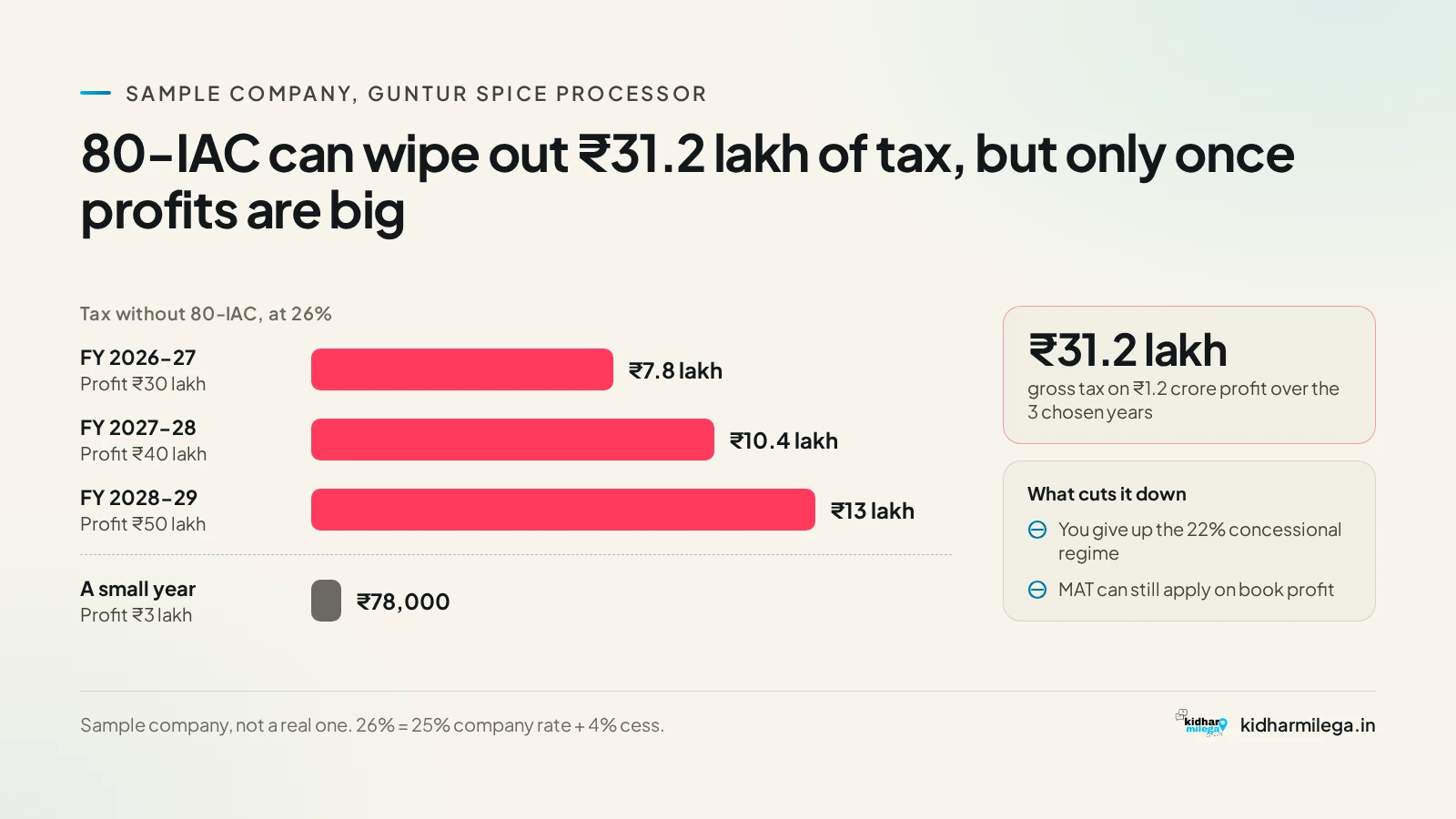
After recognition, the company applies on Form 80-IAC to the Inter-Ministerial Board. If approved, it can pick any 3 consecutive years out of its first 10 and deduct 100% of those years' profits. Smart founders pick the 3 years with the highest expected profit, not the first 3 lean years.
| Year chosen | Projected profit | Tax without 80-IAC at 26% |
|---|---|---|
| FY 2026-27 | ₹30 lakh | ₹7.8 lakh |
| FY 2027-28 | ₹40 lakh | ₹10.4 lakh |
| FY 2028-29 | ₹50 lakh | ₹13 lakh |
| Total | ₹1.2 crore | ₹31.2 lakh, gross |
The 26% here is the 25% company rate plus 4% cess, for a small company with income below ₹1 crore. That ₹31.2 lakh is the headline. It is not the cash you keep. Two things cut it down:
- You give up the 22% concessional regime. A company that opts for the lower 22% rate cannot claim 80-IAC. Your CA has to compare both routes.
- Minimum Alternate Tax (MAT) can still apply to a company on its book profit even when the profit is deducted. LLPs face a similar alternate tax. You get credit for it later, but the cash leaves your account now.
So the real saving is smaller, and it only matters once profit is meaningful. If your company makes ₹3 lakh profit a year, the gross saving is ₹78,000 a year at 26%, before any of the above. Bada certificate, chhota fayda, at that stage.
Documents required for DPIIT recognition
This checklist follows what the NSWS form asks for, as laid out in the official NSWS Startup Application Guide and the recognition user guide. Keep every name, number and date identical across all of them.
Checklist: must have
- Certificate of Incorporation (Pvt Ltd, with CIN), LLP Incorporation Certificate (LLPIN), partnership registration certificate, or cooperative society registration certificate.
- PAN of the entity.
- Registered office address and contact details.
- Details of every director or partner: name, contact, and DIN where applicable.
- Details of the authorised representative filing the application.
- A written description of your innovation: what problem you solve, how your product or process is new or better, how it scales, and how it creates jobs or wealth.
- Number of employees, and your industry, sector and category.
- Self-declarations on turnover, age and that the entity is not a reconstruction.
Checklist: supporting, if you have them
- Pitch deck, website link or a short product video.
- Patent or trademark application numbers.
- Proof of funding, if any.
- Awards, incubator letters or recognition from a government body.
Supporting documents are optional on paper. In practice, a two-minute video of your process on the factory floor makes your innovation far easier to judge than three paragraphs of adjectives.
How to apply for the Startup India certificate on NSWS, step by step
- Match your records first. Check that your company name, CIN or LLPIN, PAN and incorporation date are identical on your MCA record and PAN card. A mismatch here is the easiest way to get sent back.
- Write the innovation note offline. Draft 300 to 500 words in a document. Say what already exists in the market, what you do differently, and what number proves it (shelf life, cost per unit, yield, defect rate).
- Create an Investor account on nsws.gov.in with your email and mobile number.
- Go to Dashboard, then Add Approvals, then Central Approvals.
- Search and add "Registration as a Startup".
- Fill the form: entity details, address, authorised representative, directors or partners, sector, your innovation answers, IP, funding and awards, then the self-declarations.
- Upload the documents and submit. Save the application reference number.
- Track status on NSWS or on the Startup India application status page. If DPIIT asks for clarification, reply on time. If the application expires, use the edit expired application page.
- Download the certificate once it is approved (steps below).
- Only then, if you are a Pvt Ltd or LLP, apply separately for the 80-IAC certificate on Form 80-IAC.
Why applications get sent back, and how to fix them
Filing firms and founders commonly report the same few reasons. None of them needs an agent to fix.
- Vague innovation write-up. "We are a customer-centric, tech-enabled brand" says nothing. Fix: name the old way, your new way, and one number that proves the difference.
- Wrong entity type. A sole proprietorship applying. Fix: incorporate a Pvt Ltd or LLP first, or skip DPIIT and use Udyam.
- Looks like a reconstruction. The new company is clearly the old family firm under a new name. Fix: show what is new, such as the product, the customers and the books.
- Mismatched details. CIN, name spelling, PAN or incorporation date don't match MCA records. Fix: correct the form to match MCA exactly and resubmit.
- Pure trading or reselling. Buying and selling with nothing new added. Fix: if there is a real process or product improvement, describe it. If there isn't, this certificate isn't for you.
To correct details on a certificate you already hold, use the access or modify certificate page.
How to download and verify your Startup India certificate
Download
The certificate is a digitally signed PDF carrying a recognition number that starts with "DIPP". You can get it from three places:
- Startup India dashboard: log in and open the recognised startup dashboard.
- NSWS: log in at nsws.gov.in and open the approval under your dashboard.
- DigiLocker: the certificate is also available in DigiLocker.
About the "updated certificate": several CA firms report that existing startups were asked to log in and download an updated certificate under the 2026 rules. The official recognition page did not carry such a notice as of 15 November 2026, so treat it as reported, not confirmed. Logging in to your dashboard to check costs nothing, and you do not need to re-apply either way.
Verify
Before you trust a supplier's or partner's "DPIIT recognised" claim, or before you submit your own to a tender, check it on the official validate startup recognition page using the certificate number. If the number doesn't show up there, the PDF means nothing. Also remember that under the 2026 rules, recognition obtained with false information can be revoked.
What the certificate actually gets a small founder
The benefits are real. Each comes with a condition, and for a small local manufacturer some of them overlap with Udyam.
- 80-IAC tax holiday. Only through the separate IMB certificate, and only for Pvt Ltd and LLPs. The 4,467-out-of-2.5-lakh number tells you how few get there.
- IP support. Startups get lower patent fees, faster examination and facilitator support. But check what you already get: Udyam-registered small enterprises also pay the lower trademark fee of ₹4,500 per class on e-filing, against ₹9,000 for others.
- Government tenders. Recognised startups can get relaxations on prior experience and prior turnover rules in public procurement. According to DPIIT's 27 October 2026 figures, 43,260 startups are on GeM with ₹68,105 crore in orders.
- Self-certified compliance under several labour and environment laws, which cuts down inspection visits in your early years.
- Funding schemes. DPIIT reports ₹775.67 crore of Seed Fund approved for 4,194 startups, and ₹12,623 crore committed under the Fund of Funds to 166 AIFs. One blog says new Seed Fund applications closed on 31 May 2026. That isn't confirmed, so check the Startup India schemes page before you plan around it.
- Research facilities. On 6 November 2026 the Startup India portal was linked with I-STEM, so recognised startups can find lab and testing facilities. That is useful if you need food testing or material testing near your district.
Not sure which of these schemes you actually qualify for? The KidharMilega Scheme Finder checks your profile against central schemes in a few minutes, so you know before you file anything.
The catch: what the reel didn't tell you
- It is not money. No amount gets credited when the certificate arrives. Announcement hai, cheque nahi. Every rupee benefit sits behind another application.
- You may not need an agent. The government fee is ₹0. Filing sites advertise ₹2,000 to ₹5,000 to do it for you. DPIIT says it has appointed no agents or franchises. Anyone who "guarantees approval" for a fee is selling you something DPIIT doesn't sell.
- The entity rule costs a proprietor money. To qualify, a proprietor has to incorporate a Pvt Ltd or LLP. That means a yearly audit and annual filings. CAs in smaller towns commonly quote ₹20,000 to ₹50,000 a year for a small company's compliance; that is a market quote, not a government fee, so take three quotes. If DPIIT's benefits don't beat that cost for you, don't convert just for the certificate.
- Your own declarations bind you. You self-declare turnover, age and non-reconstruction. A false declaration can get recognition revoked under the 2026 rules.
- Startup tag ends. Day 1 after your tenth year, or the year you cross ₹200 crore, you stop being a startup in DPIIT's eyes. Use the benefits while the window is open.
Wrong way vs right way
Galat tareeka: pay an agent ₹5,000, get the certificate, frame it, then wait for benefits to arrive.
Sahi tareeka: list the two or three benefits you will actually use this year (a GeM tender, a patent filing, an incubator application, 80-IAC in a high-profit year). File the DPIIT application yourself in one evening. Then file the next application that turns the certificate into rupees.
Toh lena chahiye ya nahi? Bhaiya's take
Get the Startup India certificate if you already run a Pvt Ltd or LLP and at least two of these are true:
- You can explain your new product or process in 300 words, with one number that proves it.
- You plan to sell to government buyers on GeM.
- You plan to file a patent.
- You want incubator support, investors or a startup scheme.
- Your profit is heading towards ₹25 lakh or more a year, where the 80-IAC window starts to matter.
A machine-parts maker in Rajkot's engineering goods cluster with a redesigned component and government buyers in view fits this. So does the Guntur processor above.
Skip it for now if you are a proprietor making pickles or fruit products in East Godavari and selling through local shops and WhatsApp. Get Udyam, FSSAI and GST in order first. Udyam is free, takes minutes, and gives you MSME credit routes and protection against buyers who sit on your payment past 45 days. Come back to DPIIT when you have a company, a real innovation and a profit worth protecting.
DPIIT says 52% of recognised startups are outside metros, across more than 770 districts. The certificate is already reaching small towns. Bheed ka hissa nahi, kissa bano: apply only when your product gives you a story to tell on that form.
Your next step this week
- Run your incorporation date and highest yearly turnover through the eligibility checker on this page.
- If you pass, write your 300-word innovation note tonight, then file on NSWS. It costs ₹0 and an evening.
- If you're a proprietor, register on Udyam first and check your scheme options on the Scheme Finder.
- Still deciding what to build? Start from what your district already makes and pick a product where you can actually be different.
Stuck on the portal? Call the Startup India helpline at 1800 115 565 between 10:00 AM and 5:30 PM before you pay anyone.
Frequently asked questions
Is the Startup India certificate free?
Yes. DPIIT charges no fee for the Certificate of Recognition or for the separate 80-IAC Certificate of Eligibility. You apply on nsws.gov.in yourself. Filing sites charge roughly ₹2,000 to ₹5,000 to do it for you, but DPIIT says it has appointed no agents or franchises. Anyone who promises guaranteed approval for money is not acting for the government.
Can a sole proprietorship or One Person Company get DPIIT recognition?
A sole proprietorship cannot. Only private limited companies, LLPs, registered partnership firms and, since 2026, cooperative societies qualify. An OPC is a private company under the Companies Act and is generally accepted, but check the entity-type list in the NSWS form. Proprietors usually get more immediate value from free Udyam registration.
Do existing startups need to re-apply or download an updated certificate under the 2026 rules?
You do not need to re-apply. Existing recognitions continue while you stay within the age and turnover limits. Some CA firms report that the portal asked startups to download an updated certificate, but the official recognition page did not show that notice as of 15 November 2026. Log in to your Startup India dashboard and check. It costs nothing.
Is DPIIT recognition the same as Udyam or MSME registration?
No. DPIIT recognition says your entity is innovating and gives you startup benefits such as IP support and tender relaxations. Udyam says your business is micro, small or medium and gives MSME benefits such as credit routes and 45-day payment protection. Both are free, and an eligible company can hold both at the same time.
How long does it take to get the Startup India certificate?
Filing firms usually quote 2 to 10 working days after you submit a complete application on NSWS. DPIIT does not publish an official timeline. Delays usually happen because the innovation write-up is unclear or the company details don't match MCA records. Track progress on NSWS or on the Startup India application status page.
How do I check whether a DPIIT certificate is genuine?
Open the validate startup recognition page on startupindia.gov.in and enter the certificate number, which starts with DIPP. A genuine recognition shows up there. If it doesn't, treat the PDF as unverified, whether it belongs to you, a supplier or a partner. Recognition obtained with false information can be revoked under the 2026 rules.
Sources
- Startup Recognition · Startup India, DPIIT
- Validate Startup Recognition · Startup India, DPIIT
- Recognised Startup Dashboard · Startup India, DPIIT
- NSWS Startup Application Guide · Startup India, DPIIT
- Recognition User Guide · Startup India, DPIIT
- Startup India Schemes · Startup India, DPIIT
- DPIIT press release on recognised startups · Press Information Bureau
- India's revised startup recognition framework 2026 · Treelife