
A genuine Tanjore painting (Thanjavur painting) is a devotional painting from Thanjavur, Tamil Nadu. It is made on cloth pasted over a wooden board, with raised gesso work, gold foil and glass or gem inlays, and it has been GI-registered since 2007. The price depends on four things: size, gold grade, stones and the artist. One IndiaMART seller lists a 12x15 inch piece with 22K or 24K foil at about ₹12,000, and most listings run from under ₹6,000 to over ₹20,000.
Tanjore painting price-per-inch checker
Works out what your quote costs per square inch and how it compares with a reference real-foil listing.
Painting area (sq in) —
Your price per square inch (₹) —
Area-only estimate at the ₹67/sq in reference (₹) —
Your quote as a multiple of the reference rate —
Reference: one IndiaMART seller's asking price of about ₹12,000 for a 12x15 inch piece with 22K or 24K foil (about ₹67 per sq in). This is an asking price, not a sale record, and prices do not scale exactly with area.
Below you get the price math by size, one quote broken down line by line, a checklist for spotting fakes, the official GI record, and a ₹2 to 5 lakh plan if you want to sell them yourself.
Key facts
- Other name: palagai padam, which means "plank painting".
- Origin: Thanjavur, Tamil Nadu. Its roots go back to the Nayaka period (around 1600 AD). The style took its known form at the Maratha court of Thanjavur (1676 to 1855) and peaked under Serfoji II.
- GI tag: GI Registry application no. 47, "Thanjavur Paintings", Class 16 (Handicraft). Filed 4 January 2006, certificate no. 32 dated 16 May 2007.
- GI applicant: Thanjavur Oviya Padhukaapu Sangam, with Poompuhar (Tamil Nadu Handicrafts Development Corporation) and individual artisans as co-applicants.
- Traditional makers: the Raju (Jinigara or Chitragara) community of Thanjavur and Tiruchi, and the Naidu community of Madurai.
- Price signal: about ₹12,000 for a 12x15 inch piece with 22K or 24K foil (an IndiaMART asking price). Exotic India lists framed 24K pieces at about $437 to $3,191.
- The biggest one in the news: a 12x8 ft painting of Lord Ram weighing about 800 kg, which India Post carried from Bengaluru to Ayodhya around 23 December 2025. Union Minister Jyotiraditya Scindia valued it at ₹2.5 crore.
Tanjore painting price: why one Balaji costs ₹8,000 and another ₹40,000
One Tanjore painting went to Ayodhya valued at ₹2.5 crore. Meanwhile some buyers ask artists for a painting at ₹200, and artist Meena Muthiah has called that out in public. Both are "Tanjore paintings". The gap comes from materials and hours, not from the name.
Most shop pages show you a price and nothing else. So here is the price split into its parts. One caution first: every price online is an asking price, not a sale record. Use these numbers to question a quote, not as a rate card.
Price by size: the area napkin math
Start with the one solid reference: about ₹12,000 for a 12x15 inch piece with real foil. That works out to roughly ₹67 per square inch. Scale it by area and you get a starting point for bigger sizes.
| Size (inches) | Area (sq in) | Times a 12x15 | Area-only estimate at ₹67/sq in | Usually fits |
|---|---|---|---|---|
| 12x15 | 180 | 1x | about ₹12,000 | Pooja shelf, gift, small mandir |
| 18x24 | 432 | 2.4x | about ₹28,800 | Pooja room wall, entrance wall |
| 24x30 | 720 | 4x | about ₹48,000 | Living room feature wall |
| 36x48 | 1,728 | 9.6x | about ₹1,15,200 | Large hall, temple, office lobby |
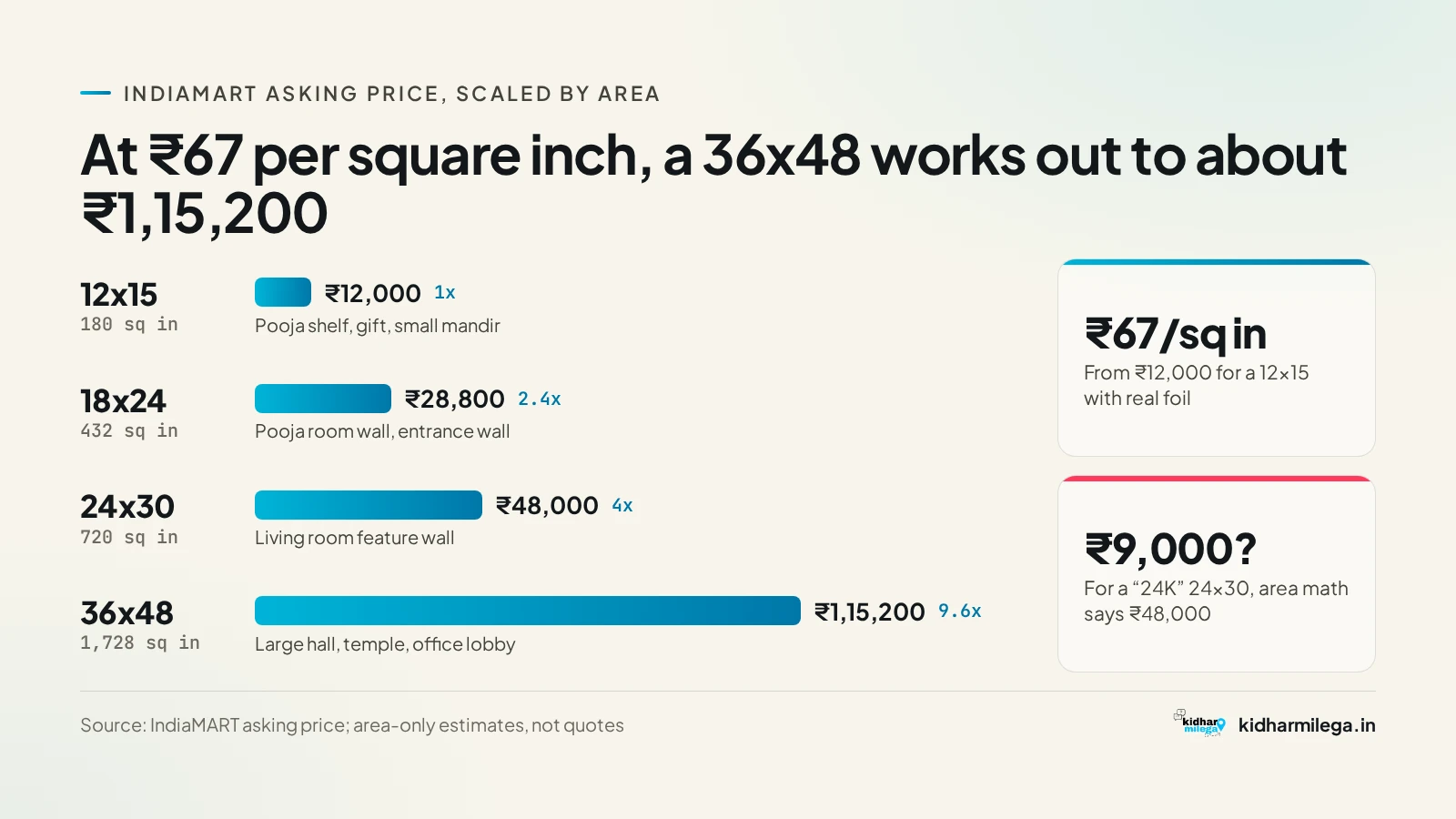
This is napkin math, not a quote. Real prices swing both ways. Detail work, the number of stones and the frame do not grow neatly with area. A big piece with one figure can cost less per inch than a small Ashta Lakshmi with eight figures. Still, if someone offers you a "24K" 24x30 for ₹9,000, the area math tells you to ask what the gold really is.
Want to check a quote in your hand? Use the price-per-inch checker on this page. Put in the quoted price and the size, and see how it compares with the ₹67 reference rate.
Gold grade: the biggest price lever
| What the seller says | What it usually is | Price effect |
|---|---|---|
| "Gold work" or "golden finish" | Gold-coloured paint or synthetic foil | Cheapest. Often sold as "Tanjore style". |
| "Second quality foil" | Lower-grade foil, tarnishes sooner | Mid-range |
| "22K" or "22 carat" | Gold foil, often gold-coated silver leaf in the traditional method | High. One seller puts real foil about ₹4,500 above second-quality foil on a 12x10 inch piece. |
| "24K" or "24 carat" | Purer gold foil | Highest |
The catch: sellers use "22K" and "24K" loosely. No reliable home test exists. The only sure way to check the gold is a lab test such as Raman spectroscopy. For a normal buyer that means one thing. Get the gold grade written on the bill or certificate, so the claim is on paper.
Stones: Jaipur stones vs semi-precious
Most paintings use Jaipur stones, which are coloured glass stones. They look good and cost little. Semi-precious stones cost far more and add a lot of weight to the price on jewellery-heavy themes like Lakshmi or Balaji. Plastic stones are the cheap end, and they are a red flag on anything sold as "traditional".
Worked example: two 18x24 Balaji paintings, line by line
Same size, same deity. One quote is ₹8,000, the other ₹40,000. The split below is an illustration of where the money goes, built on my assumptions. It is not market data. Ask your seller to break their quote into these same lines.
| Line item | Quote A: ₹8,000 | Quote B: ₹40,000 |
|---|---|---|
| Board and cloth | MDF board, ₹400 | Seasoned plywood or jackfruit wood with cloth, ₹1,500 |
| Gesso (chalk or limestone paste) and relief | Thin or no relief, ₹200 | Full raised relief on throne, pillars and jewellery, ₹1,000 |
| Gold | Imitation foil or gold paint, ₹500 | 22K foil, ₹9,000 |
| Stones | Plastic or basic glass, ₹300 | Jaipur stones plus some semi-precious, ₹4,000 |
| Colours | Basic chemical paint, ₹200 | Better pigments and fine detailing, ₹800 |
| Labour | 3 to 4 days, ₹3,000 | 3 to 4 weeks by an experienced artist, ₹15,000 |
| Frame and glass | Synthetic frame, ₹1,200 | Carved teak frame, ₹5,000 |
| Seller margin and overheads | ₹2,200 | ₹3,700 |
| Total | ₹8,000 | ₹40,000 |
Look at where the gap is: gold, labour and frame. Together they make up about ₹29,000 of Quote B. Quote A is not a "fake" if it is sold honestly as decor. It turns into a cheat when it is sold as 22K, GI-tagged Thanjavur work. Sasta hona galat nahi hai. Sasta cheez ko mehenga bata ke bechna galat hai.
Checklist: real vs fake Tanjore painting before you pay
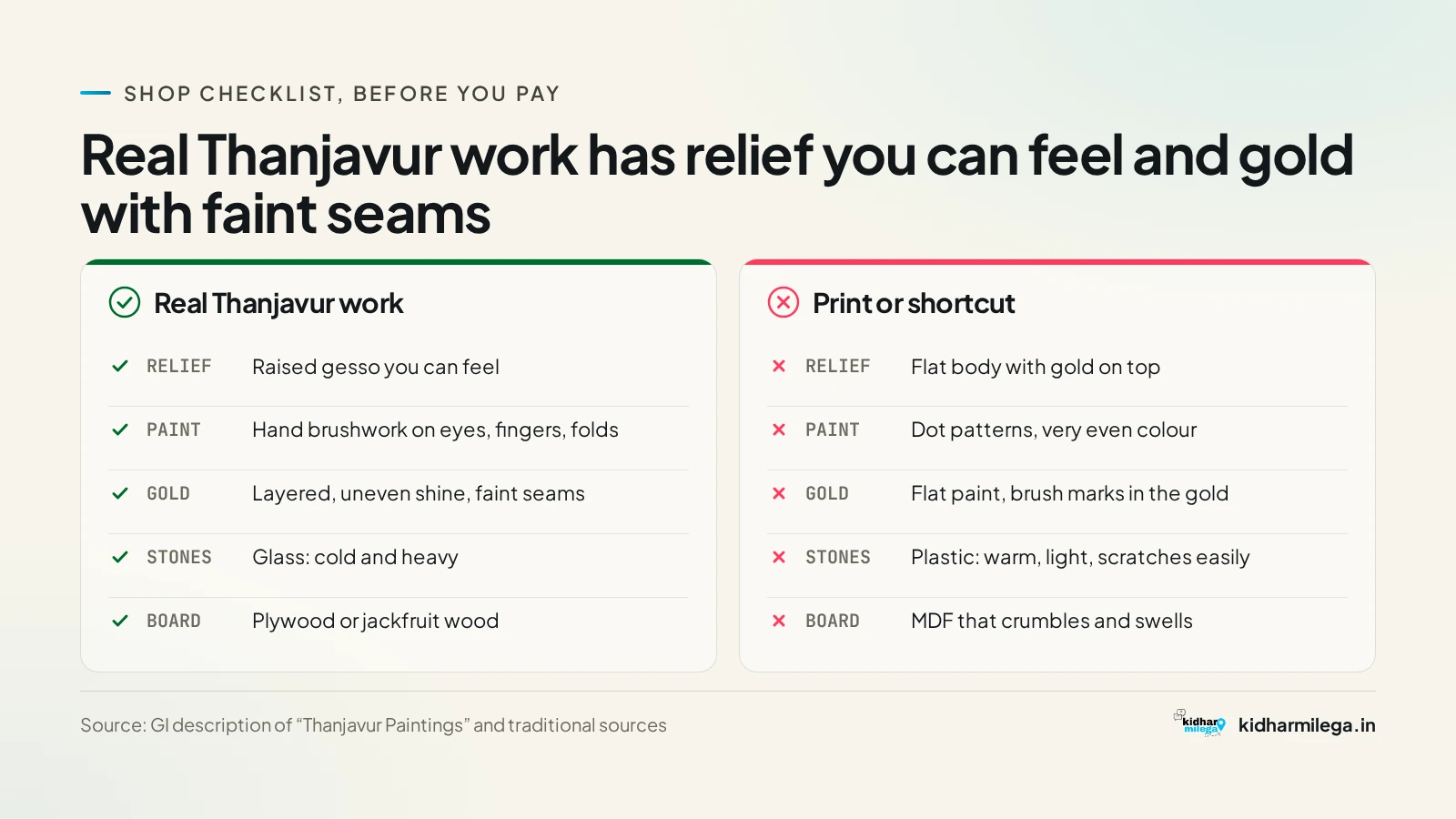
Print this, or keep it on your phone at the shop. Each point comes from how the GI description and traditional sources describe the craft: cloth on wood, raised gesso, gold foil, inlays, hand painting.
- Touch the relief. Run a finger over the throne, the arch and the jewellery. A real piece has raised gesso you can feel. A flat body with gold on top is a print or a shortcut.
- Look for a printed base. Check the faces and the background at an angle. Dot patterns or very even colour under the embossing point to a print with work added on top.
- Check the gold. Real foil has a layered, slightly uneven shine with faint seams where the sheets meet. Gold paint looks flat and even, with brush marks in the gold itself.
- Check the stones. Glass feels cold and heavy. Plastic feels warm and light, and it scratches easily.
- Flip it and look at the board. Plywood or jackfruit wood is what you want. MDF crumbles at the edges and swells in humidity.
- Look for visible brushwork. Fine lines on the eyes, fingers and fabric folds should show a human hand, not pixel-perfect sameness.
- Get it in writing. Ask for a bill or certificate that states the gold grade, the type of stone, the board material and the artist's name.
- Ask about the GI. Ask whether the maker is part of the registered GI producer group, and note any registration number they give you. Then check it against the official record (see below).
- Price sanity check. If the "24K" quote is far below the area math above, ask why before you pay.
The Thanjavur painting GI tag: what it proves and how to check it
A GI (Geographical Indication) tag protects a product name tied to a place and its traditional method. The official entry is on the GI Registry record for application no. 47, "Thanjavur Paintings". It was filed on 4 January 2006 and registered with certificate no. 32 dated 16 May 2007, under Class 16 (Handicraft). Other websites give 2006, 2007 or "2007 to 08". The registry dates above are the ones that count.
Two things the GI tag does not do:
- It is not a sticker on each painting. The tag protects the name and the method. A shop saying "GI-tagged" proves nothing until the maker shows a link to the registered producers.
- It does not certify gold purity. That is still on the bill.
One detail to watch: the registry page showed validity up to 3 January 2026. GI registrations run for 10 years and can be renewed, and this record shows renewal entries from 2016. Check the live status on the GI public search yourself before you print "GI certified" on anything you sell.
Where to buy: Thanjavur, Chennai, Bengaluru or online
In Thanjavur
Buying in Thanjavur means you can meet the artist, see work in progress and order to your size. Ask to see an unfinished board. A workshop that shows you its gesso stage is usually making the real thing.
Chennai and the Poompuhar network
Poompuhar, the Tamil Nadu Handicrafts Development Corporation, is a state body and a co-applicant on the GI. Its About page lists about 15 showrooms, 7 production units and around 70,000 artisan families. The head office is at 759 Anna Salai, Chennai 600002. It also has an online shop. A government showroom will not always have the lowest price. You buy it for the paper trail.
Bengaluru and other cities
Bengaluru has many sellers, and the Ram painting that went to Ayodhya started there. Andhra Pradesh's state handicrafts body also sells online through its Lepakshi Tanjore paintings section. For private galleries, use the checklist above.
Online marketplaces
Marketplaces are fine for decor pieces. For anything sold as 22K or 24K, ask for close-up photos of the relief, the back of the board and the gold seams. Ask for a written gold grade, and check the return policy for damage in transit.
Custom orders and lead times
The gesso relief and gold layers need drying time between stages. So a custom piece takes weeks, not days. Get the delivery date, the size, the gold grade and the advance amount in writing. If you need it for a wedding or a griha pravesh, order early.
Shipping an embossed painting
Raised gesso can crack and glass can shatter. Ask for corner guards, thick bubble wrap and a rigid outer box. For 24x30 inches and above, ask for a wooden crate. Record a video while you unbox, before you sign off any damage claim.
Which deity, which size, which wall
The common subjects are Bala Krishna, Rama Pattabhishekam, Ashta Lakshmi, Venkateshwara (Balaji), Ganesha and Murugan. Here is how buyers usually choose. Treat this as common practice, not a vastu ruling.
- Pooja room: Balaji, Lakshmi or Ganesha in 12x15 or 15x18. Measure the mandir first. A painting that covers the lamp space is a bad buy.
- Housewarming gift: Ganesha or Ashta Lakshmi. 12x15 is easy to carry and to gift.
- Wedding gift: Rama Pattabhishekam or Krishna themes, often in 18x24.
- Living room feature wall: 24x30 or larger, so it reads from across the room.
A simple size rule: the painting with its frame should cover about half to two-thirds of the width of the wall space or furniture under it. Keep it out of direct sunlight and away from the kitchen and bathroom walls, because steam and heat are bad for the gold and the wood.
Colour conventions help you read a piece too. Backgrounds are usually red, sometimes blue or green. Vishnu is painted blue, Nataraja chalk-white and Sivakami green.
Care: humidity, gold foil and termites
- Keep it behind glass. Glass protects the foil from dust and touch. Have it re-sealed if the frame gaps open.
- Humidity is the main enemy. In coastal cities and during the monsoon, moisture can lift the cloth and dull the gold. Hang it on an inside wall, not one with seepage, and leave a small gap between the frame and the wall for air.
- Clean dry. Use a soft dry cloth on the glass and frame only. No water, no glass spray directly on the painting, and never rub the gold.
- Termites. Teak resists termites but is not immune. Check the back of the frame once or twice a year for powder or small holes. If you see any, call a pest-control service that treats wood, and don't spray chemicals near the painting yourself.
- Tarnish. Dark spots on the gold mean either low-grade foil or moisture getting in. Restoration is a job for the artist, not a home fix.
Tanjore painting history in short
Artists moved to Thanjavur after the Vijayanagara empire fell at the Battle of Talikota in 1565. Under the Nayakas (around 1600 AD), and then at the Maratha court of Thanjavur (1676 to 1855), the style took its present form and peaked under Serfoji II. The traditional makers were the Raju community of Thanjavur and Tiruchi and the Naidu community of Madurai. Some sources date the beginning to the 16th or 17th century, so you will see different dates.
The traditional materials were cloth pasted on jackfruit or teak board with Arabic gum, and a gesso of limestone or chalk mixed with tamarind-seed paste. On top of that came gold leaf, glass beads or gems, and natural colours. Many contemporary artists use plywood, factory glue and chemical paints instead.
The making steps, in order:
- Coat the cloth-covered board with chalk or lime paste.
- Trace the sketch.
- Build the raised gesso on thrones, pillars and jewellery.
- Lay the gold foil and set the gems.
- Paint the figures and background.
Tanjore vs Mysore painting
| Feature | Tanjore (Thanjavur) | Mysore |
|---|---|---|
| Base | Cloth on wooden board | Paper |
| Relief | High gesso relief | Low relief |
| Gold | Lots of gold, often gold-coated silver leaf | Less gold, but purer |
| Inlays | Many glass or gem inlays | Few |
| Composition | Static, iconic central figure | More scenery and scene detail |
The craft is still going. A Hindu Post feature dated 8 November 2026 describes it as adapting, with artists such as Vijayalakshmi Prabhakaran and Marimuthu Uthrapathi mixing old methods with new materials. The same piece names two threats: cheap synthetic-gold copies and young people leaving the craft.
Want to sell Tanjore paintings? A ₹2 to 5 lakh plan
Mera ek dost bolta hai: "Thanjavur se sasta utha lo, Pune mein double mein becho." The logic is fair. Demand peaks in the Diwali and wedding season, which runs from November to February, and city buyers rarely know an artist directly. Now let's run it honestly.
Two models that fit ₹2 to 5 lakh
- Model A, curated resale: you build trade relationships with 3 to 5 Thanjavur artists. You hold a small stock of popular sizes, take custom orders, and sell at exhibitions, through housing-society pop-ups, to corporate Diwali gifting buyers and on Instagram.
- Model B, workshop: you partner with a trained artist to run weekend classes in your city and sell kits and finished pieces alongside. This suits you if you already have a space, such as a home studio, a cafe tie-up or a school.
Sample budget for Model A at ₹3 lakh
This is a sample split to plan with, not a quote. Your numbers will move once you have real trade rates.
| Item | Amount |
|---|---|
| Opening stock: 15 pieces, mostly 12x15 and 18x24, mixed gold grades | ₹1,80,000 |
| Two trips to Thanjavur to meet artists and check work | ₹20,000 |
| Stall rent for 2 to 3 exhibitions or society pop-ups | ₹40,000 |
| Packing material and crates | ₹15,000 |
| Product photos, display stands, printed certificates | ₹15,000 |
| Registration, accountant, bank charges | ₹5,000 |
| Buffer for damage and slow months | ₹25,000 |
| Total | ₹3,00,000 |
Napkin margin on one piece
Hypothetical numbers. Swap in your own.
- Trade price from the artist: ₹10,000
- Your selling price: ₹14,000
- Packing and shipping: minus ₹800
- Share of stall rent (₹20,000 stall ÷ 20 pieces sold): minus ₹1,000
- Payment or platform fee at about 2%: minus ₹280
- You keep: about ₹1,920, or roughly 14% of the selling price
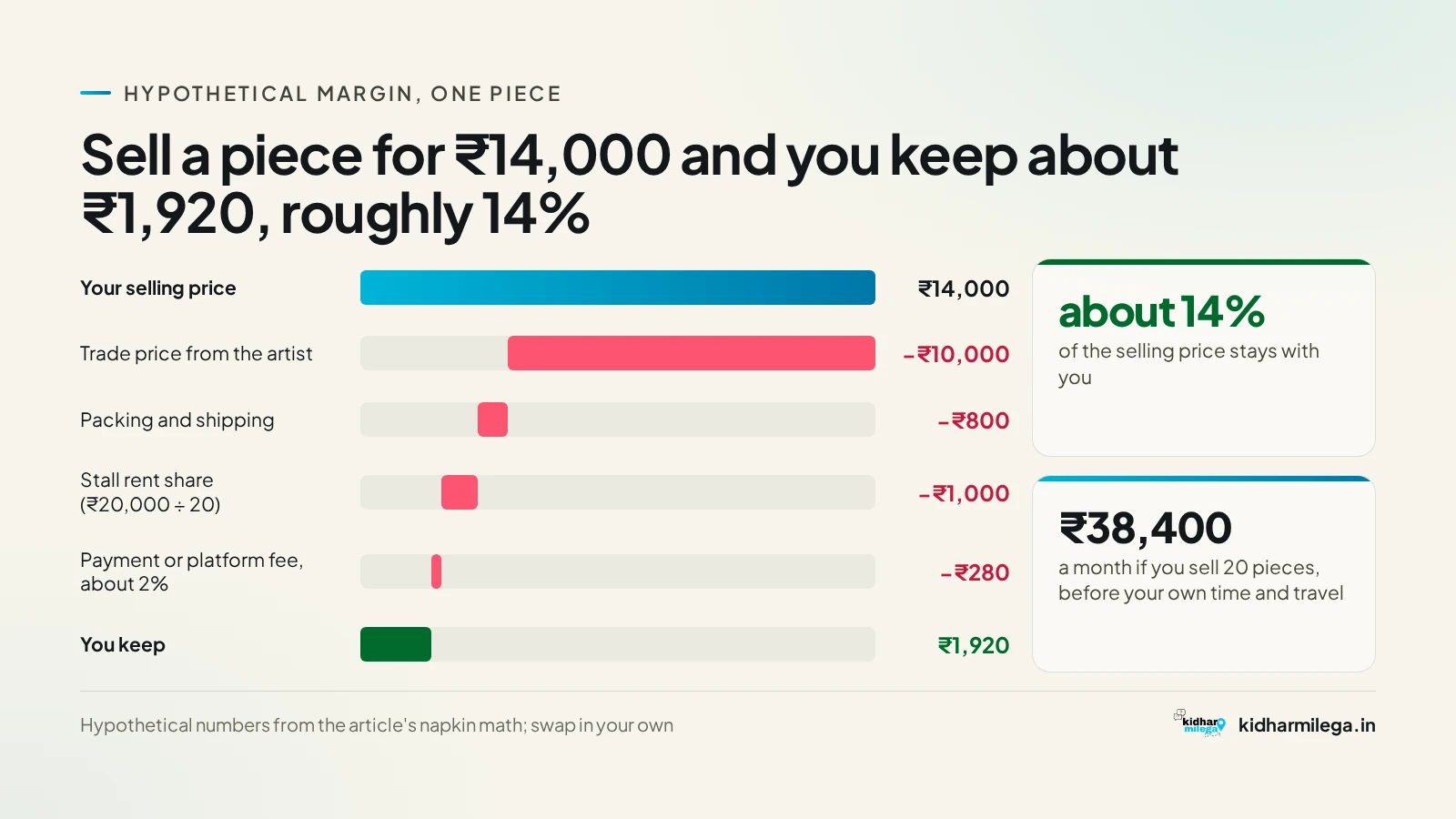
That is the real picture. "Double mein becho" works only on pieces you buy direct at a good trade rate and sell to buyers who value the story. On a ₹3 lakh stock it takes time to turn. If you sell 20 pieces a month at this margin, you make about ₹38,400 before your own time and travel.
Steps, in order
- Talk to 10 buyers before you buy 10 paintings. Ask friends, society groups and HR teams at nearby offices what they would pay for a 12x15 Ganesha or Lakshmi.
- Visit Thanjavur. Meet at least five artists, see their gesso stage, and get trade rates for the same size and gold grade from each.
- Start with 5 pieces, not 15. Sell them, see which sizes and deities move, then reorder.
- Register. Get a free Udyam registration. Check whether you need GST on the GST portal based on your turnover and whether you sell across states. Most online marketplaces ask for GST.
- Get the tax code right. Look up the code for hand-made paintings with the HSN code finder, then confirm the current rate on the CBIC GST rates page before you print a bill.
- Write your own certificate. State the gold grade, the stones, the board and the artist name on every piece. This is your edge over the cheap copies.
- Plan for the season. Build stock by September so it is ready for Diwali and the wedding months.
- Exports later. If overseas buyers ask, you will need an IEC from DGFT. Get domestic orders running smoothly first.
The catch
- Breakage. One cracked 24x30 can wipe out the margin on five small pieces. Price your shipping honestly.
- Gold claims you can't prove. If you write "24K" on the bill, you carry that claim. Write only what the artist will put in writing to you.
- Seasonal cash. Sales bunch up from October to February. Plan for a slow summer.
- Copy competition. Synthetic-gold pieces at a third of your price will sit next to you at every exhibition. Your answer is the checklist and the certificate, not a price war.
Wrong way vs right way
Wrong way: take a ₹3 lakh loan, buy 30 big 24K pieces in one trip, and book a mall kiosk. Right way: buy 5 pieces with your own money, sell them at one society Diwali mela, then reorder what sold. Pehle buyer, phir stock.
Toh karna chahiye ya nahi?
Do it if: you have roots in Tamil Nadu or a South Indian network in your city, you can travel to Thanjavur, and you are fine with a slow, trust-based sales cycle.
Skip it if: you want fast inventory turns, you can't hold stock for a few months, or you are planning to compete on price with printed copies.
And if you are from Thanjavur yourself, you are already sitting on the source. Most resellers have to travel to get what you can walk to.
Learning Tanjore painting as a hobby
Beginner kits usually include a pre-pasted board, a gesso or embossing paste, imitation gold foil, Jaipur stones, glue and a traced design. They use imitation foil to keep costs down, which is fine for learning. Before you pay for a course, ask three things: does it cover the gesso relief stage, does it use real foil at any point, and how many sessions does one finished piece take. Short one-day workshops usually skip the relief work, and that is the hardest part to learn.
Your next step
If you are buying, take the checklist above to the shop and get the gold grade in writing. If you want to sell, start with five pieces and one Diwali mela, not a loan.
Tanjore is one district's craft. Your own district may have one just as specific. Madhubani has its Madhubani paintings, Krishna district has Machilipatnam Kalamkari, and Tirupati has Srikalahasthi Kalamkari. See what your district already makes across all 787 mapped districts. If you are still deciding, start from the KidharMilega homepage. Bheed ka hissa nahi, kissa bano.
Frequently asked questions
What is the price of an original Tanjore painting?
It depends on size, gold grade, stones and the artist. One IndiaMART seller lists a 12x15 inch piece with 22K or 24K foil at about ₹12,000, and most listings run from under ₹6,000 to over ₹20,000. Exotic India lists framed 24K pieces at about $437 to $3,191. These are asking prices, so get the gold grade written on the bill.
How can I tell if a Tanjore painting is original?
Feel for raised gesso relief on the throne and jewellery. Look for a layered foil shine rather than flat gold paint, glass stones rather than plastic, and a plywood or wooden board rather than MDF. Check for visible brushwork. Ask for a written certificate stating the gold grade and stones. Only a lab test such as Raman spectroscopy can confirm gold purity.
Does Tanjore painting have a GI tag?
Yes. Thanjavur Paintings are registered under GI Registry application no. 47, Class 16 (Handicraft). The application was filed on 4 January 2006 and certificate no. 32 was issued on 16 May 2007. The applicant is Thanjavur Oviya Padhukaapu Sangam, with Poompuhar as a co-applicant. Check the live status on the GI public search portal.
What is the difference between Tanjore and Mysore painting?
Tanjore paintings use cloth on a wooden board, with high gesso relief, lots of gold (often gold-coated silver leaf) and many glass or gem inlays, and they show static, iconic figures. Mysore paintings are on paper, with low relief and less but purer gold, and they include more scenery and scene detail.
Which Tanjore painting is good for a pooja room?
Buyers usually pick Balaji (Venkateshwara), Lakshmi or Ganesha for the pooja room, in 12x15 or 15x18 inches. Measure your mandir first so the painting doesn't block the lamp space. For housewarming gifts, Ganesha or Ashta Lakshmi is a common choice. Keep it away from steam, direct sunlight and damp walls.
How do I clean and maintain a Tanjore painting?
Keep it framed behind glass and hang it on an inside wall with no seepage. Wipe only the glass and frame with a soft dry cloth, never use water on the painting, and never rub the gold. Check the back of teak frames for termite powder once or twice a year, and send tarnished gold back to an artist for restoration.
Sources
- Thanjavur Paintings, GI application no. 47 · Geographical Indications Registry, IP India
- Poompuhar, Tamil Nadu Handicrafts Development Corporation · Poompuhar (TNHDC)
- About Poompuhar · Poompuhar (TNHDC)
- Tanjore Paintings · Lepakshi Handicrafts, Government of Andhra Pradesh
- Thanjavur painting · Wikipedia
- Thanjavur painting: gold foil art adapts · Hindu Post
- From Bengaluru to Ayodhya: India Post transports priceless gold-based Ram masterpiece · Business Today
- Tanjore paintings · IndiaMART