
Can I sell on Amazon without GST? Yes, but only in two narrow cases. Case one: every product you sell is fully GST-exempt, like books, unbranded grains, fresh produce, earthen pots or bangles. Case two: you sell taxable goods only to buyers in your own state, stay under the turnover limit and use a GST enrolment ID. Anyone who wants buyers in other states, FBA warehouses outside their state or a taxable catalogue across India needs a GSTIN, whatever their turnover.
Amazon seller GST: register or skip? calculator
Works out whether getting a GSTIN costs or saves you money each year as an Amazon seller, if you keep your selling price the same.
GST you pay on Amazon fees (18%) —
GST you pay on packaging and inputs —
Input tax credit you can claim only with a GSTIN —
Output GST hidden in your sales with a GSTIN —
Yearly gain (+) or cost (-) of registering at the same price —
Output tax on a GST-inclusive B2C price = price × rate ÷ (100 + rate). Input tax credit under Section 16 of the CGST Act is available only to registered persons. This doesn't count the extra sales you can make in other states, which only a GSTIN allows for taxable goods. Check your product's rate on cbic-gst.gov.in.
Key facts
- Exempt goods: Amazon's seller pages say you can register with your PAN instead of a GSTIN if you sell only GST-exempt categories. The GST step can then be skipped.
- Enrolment ID route: Allowed by Notification 34/2023-Central Tax (dated 31 July 2023, in force from 1 October 2023). It covers goods only, sold within one state, below the turnover limit.
- Turnover limit for goods: ₹40 lakh a year in most states, ₹20 lakh in special-category states. ₹20 lakh is the limit for services, and blogs often mix the two up.
- Sales to other states: If you sell taxable goods to a buyer in another state, you need a GSTIN from the first rupee.
- Rule 14B (from 1 November 2026): This lets an already registered seller register in another state using the marketplace warehouse as the place of business. It does nothing for sellers who have no GST at all.
- TCS: Marketplaces collect 0.5% TCS (tax collected at source) from GST-registered sellers. It was cut from 1% in July 2024.
- Composition scheme: A middle option for turnover up to ₹1.5 crore. You pay a flat 1% on turnover, but you can sell only within your own state.
The myth: "PAN se hi Amazon chalu kar dete hain"
A friend of mine runs a small home business making block-printed cushion covers. His logic was simple. GST means a CA, monthly returns and the fear of a notice. So skip it, sign up on Amazon with your PAN and start selling.
His logic makes sense. Compliance does cost money, and for a ₹5 lakh a year seller every ₹1,000 counts. But cushion covers are not GST-exempt, and his buyers were in Delhi, Pune and Bengaluru, not only in his own state. That puts him in the one situation where the law gives no way out: taxable goods sent to another state need a GSTIN, at any turnover.
So the real question is not "can I avoid GST?" It is "which of the three routes fits my product, my state and my buyers?"
Which route applies to you: the 4-question check
Answer four things: what you sell, where your buyers are, your yearly turnover, and where your stock sits. Then find your row.
| Your situation | Route | GSTIN needed? |
|---|---|---|
| Only fully GST-exempt products (books, unbranded grains, fresh produce, earthen pots, bangles), buyers anywhere | PAN-only, exempt category | No |
| Taxable goods, buyers only in your own state, turnover under ₹40 lakh (₹20 lakh in special-category states) | GST enrolment ID, if the platform accepts it | No |
| Taxable goods, even one buyer in another state | Regular GSTIN | Yes, from the first sale |
| Turnover above the limit, in-state buyers only | Composition scheme (up to ₹1.5 crore) or regular GSTIN | Yes |
| Selling to shops, hotels or companies that want a GST invoice | Regular GSTIN | Yes, in practice |
| Stock in an Amazon FBA warehouse in another state | GSTIN at home, plus a registration in that state (Rule 14B makes this easier) | Yes |
| Exempt products mixed with even one taxable product | Check again: the exempt route no longer covers the full catalogue | Usually yes |
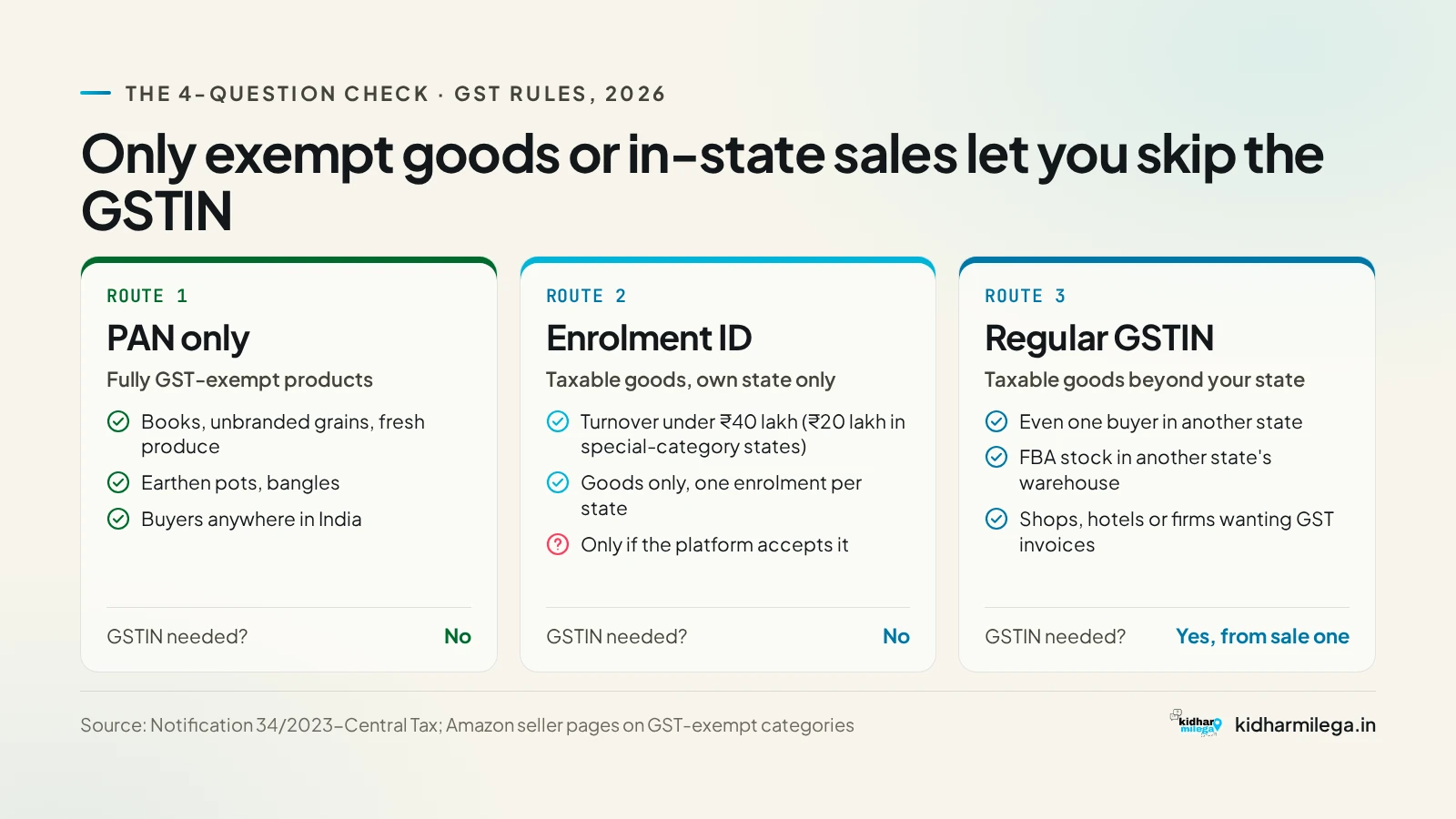
Most makers we talk to land in row three. Most buyers on Amazon are in other states. The usual mistake is not taking your time. The usual mistake is assuming your product is exempt when it isn't.
Route 1: Selling GST-exempt products with only a PAN
Amazon's own page on GST-exempted categories says sellers of these products can register with their PAN, and the GST section can be skipped. This works whether your buyers are in your state or across India, because no GST applies to the product at all.
Products usually listed as exempt include:
- Books, maps and newspapers
- Unbranded grains and fresh fruit and vegetables
- Bangles (non-precious) and earthen pots
- Pooja items and kites
- Some handloom fabric
- Organic manure and hearing aids
The catch: "exempt" is decided by the HSN code, not by how handmade it feels
Read "handloom fabric" narrowly. It means specific items under specific HSN codes, not every saree or stole that comes off a loom. Many finished handloom and handicraft products are taxable. A Machilipatnam Kalamkari dupatta, a Kondapalli toy set or a framed Madhubani painting from Darbhanga all have to be checked code by code. "Haath se bana hai, toh tax nahi lagega" is how sellers get notices.
Before you tick anything on Amazon, look up your exact code. Our HSN code finder gives you the 8-digit code in seconds. Then confirm the rate on the CBIC GST rates page. If you want to see what a wrong code costs you in tax and penalty, run it through the wrong HSN code GST cost calculator.
One more trap. If you start with books and later add one taxable product, say bookmarks or tote bags, the exempt route stops covering you. You have to check your registration status again that same day.
Route 2: How to sell on Amazon without GST using an enrolment ID
This route is for taxable goods. Since 1 October 2023, Notification 34/2023-CT has let unregistered sellers supply goods through e-commerce platforms if they meet all of these conditions:
- You sell goods only, not services.
- You sell only within one state or union territory.
- Your aggregate turnover stays below the registration limit (₹40 lakh for goods in most states, ₹20 lakh in special-category states).
- Your PAN and business address are validated on the GST portal.
- You hold one enrolment number per state.
Notification 37/2023-CT adds the marketplace's side of the deal: the platform may let such a seller list only if they have an enrolment number. The GSTN opened this facility on the portal through an advisory issued on 12 October 2023, as reported by Taxscan.
How to generate the enrolment ID on the GST portal
- Go to the GST portal.
- Click Services → User Services → Generate User ID for Unregistered Applicant.
- Tick "To apply as a supplier to e-commerce operators".
- Enter your PAN, state and business address, then verify with the OTP sent to your mobile and email.
- The portal generates your enrolment number. Save it, because the marketplace will ask for it.
Don't mix this up with Form ENR-03. That is a separate enrolment on the e-way bill portal, used by unregistered people who need to generate e-way bills. It is not the e-commerce enrolment, and some ranking pages confuse the two.
The catch: Amazon has not clearly confirmed this route
The law allows the enrolment ID route. Whether Amazon accepts it for taxable goods is a different question. Amazon's published no-GST route, in its seller registration guide and the exempt-categories page, only describes PAN-only sign-up for exempt products. We could not find an official Amazon page that confirms enrolment IDs for taxable goods. Some blogs say it works but cite no Amazon source.
Meesho is clearer. Its official announcement says it accepts enrolment IDs for sales within the seller's state, with the ₹40 lakh limit (₹20 lakh in north-eastern states).
So here's what to do. Start Amazon registration at sell.amazon.in and read the tax step on screen. If it gives you a field for an enrolment number for your category, use it. If it only offers GSTIN or "exempt goods only", the route is closed to you on Amazon until that screen changes. The law allows it, but Amazon may not. Announcement hai, cheque nahi.
Things to check before you enter the enrolment ID
- The PAN name matches. The name on your Amazon account, your bank account and your PAN should be the same.
- The state matches. The enrolment ID's state has to match your pickup or dispatch address. A Rajasthan enrolment with a Gujarat pickup address won't work.
- No GSTIN on the same PAN in that state. An enrolment number stops being valid once you get a GSTIN.
- You didn't use the wrong form. An e-way bill enrolment (ENR-03) is not an e-commerce enrolment.
The ₹ math: a ₹5 lakh home seller, with and without a GSTIN
Most pages say "get GST, claim input tax credit, save money." Let's actually run it. Input tax credit (ITC) means you subtract the GST you paid on business costs from the GST you collect on sales.
Assumptions (yours will be different, so use the calculator on this page):
- Sales: ₹5,00,000 a year, B2C, with prices that include GST, as Amazon shows them
- Amazon fees (referral, closing and shipping): ₹1,00,000, plus 18% GST of ₹18,000
- Packaging and other inputs: ₹40,000, plus 18% GST of ₹7,200
- Accountant for returns: ₹12,000 a year (our assumption)
- Selling price is the same in both cases
| Line item | No GSTIN (exempt or enrolment ID) | GSTIN, product at 5% | GSTIN, product at 18% |
|---|---|---|---|
| Sales received | ₹5,00,000 | ₹5,00,000 | ₹5,00,000 |
| GST included in your sales (output tax) | ₹0 | ₹23,810 | ₹76,271 |
| GST paid on fees and packaging | ₹25,200 (pure cost) | ₹25,200 (claimed as ITC) | ₹25,200 (claimed as ITC) |
| Net GST paid in cash | ₹0 | ₹0 (₹1,390 credit carried forward) | ₹51,071 |
| Compliance cost | ₹0 | ₹12,000 | ₹12,000 |
| Left in your pocket before product cost | ₹3,34,800 | ₹3,22,800 + ₹1,390 credit | ₹2,71,729 |
How the lines work: output tax at 5% is ₹5,00,000 × 5 ÷ 105 = ₹23,810. At 18% it is ₹5,00,000 × 18 ÷ 118 = ₹76,271. Without a GSTIN you pay ₹1,18,000 + ₹47,200 = ₹1,65,200 to Amazon and suppliers, and nothing to the government.
The honest result: for a small B2C seller at the same price, registering doesn't save money. At 5% you're about ₹10,600 a year worse off. At 18% you're about ₹63,000 worse off. ITC helps, but it only offsets the GST you now owe. It is not a bonus.
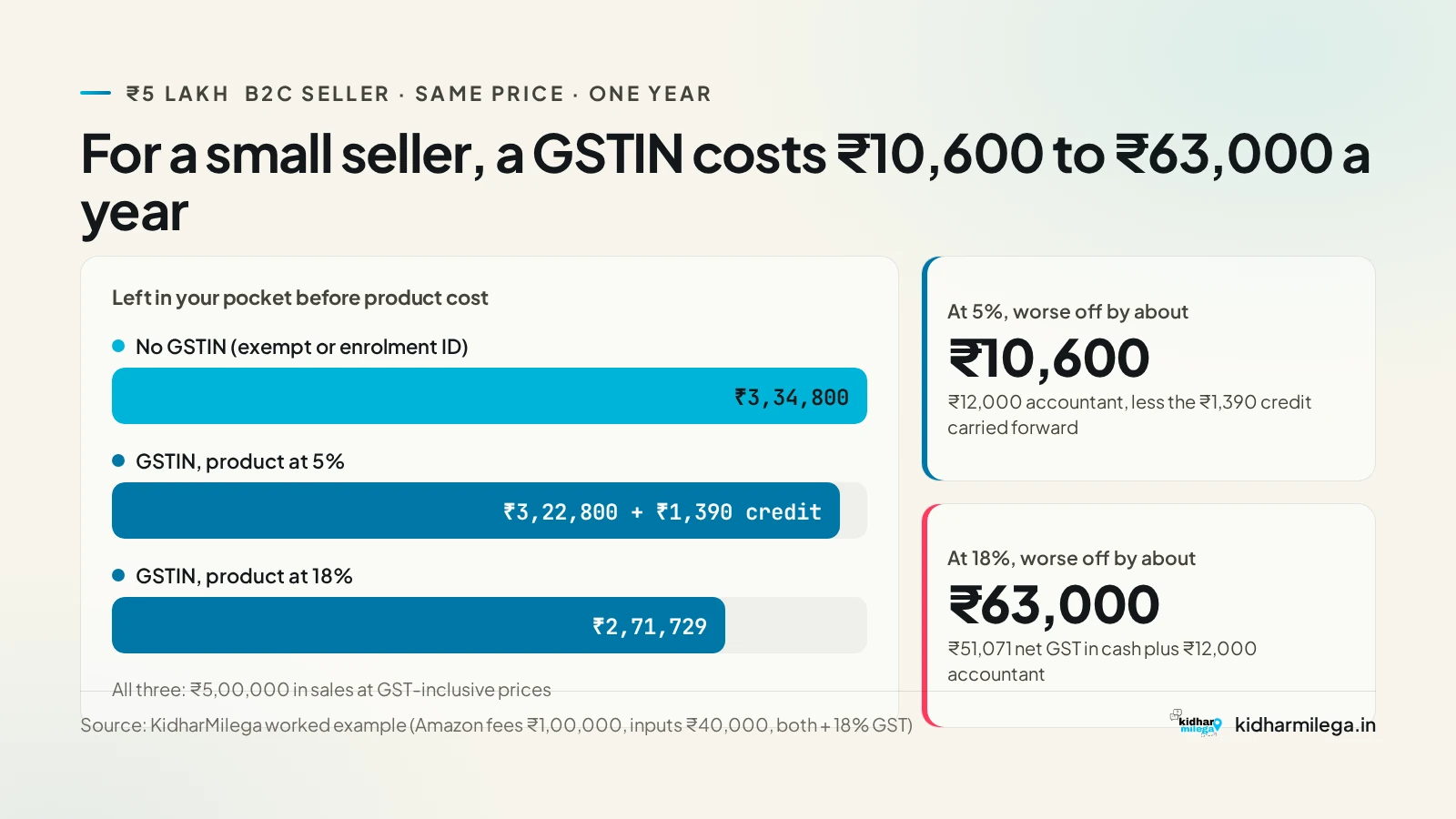
So why would anyone register? Because of reach. Without a GSTIN, your taxable goods can go to only one state. With one, every pincode in India is open. If out-of-state orders could add even ₹1 lakh of sales a year, that ₹10,600 is cheap. GST bachane ke chakkar mein baaki India mat chhodo.
TCS and TDS: the two small deductions people miss
- GST TCS (0.5%): Amazon collects this from registered sellers on net taxable sales. On ₹4,76,190 of taxable value, that's about ₹2,381. It shows on the GST portal in Form GSTR-2X. Once you accept it, it moves to your electronic cash ledger and you can use it to pay your GST. It is not a cost, but you have to claim it.
- Income-tax TDS on e-commerce sales (long known as Section 194-O): 0.1% of gross sales since October 2024, so ₹500 on ₹5 lakh. It applies whether or not you have a GSTIN, as long as you've given your PAN. It shows in your Form 26AS/AIS, and you claim it back when you file your income-tax return. Without a PAN on file, the rate is much higher.
Most small sellers lose these amounts because they never file the return. That's free money left with the government.
FBA, warehouses and the new Rule 14B
Amazon's FBA (Fulfilled by Amazon) means your stock sits in Amazon's warehouses. A warehouse in another state counts as a place of business in that state under GST, so you need a GST registration there too. Without any GSTIN, FBA in other states is not possible. If your plan depends on Prime badges and fast delivery from Amazon warehouses, you need a GSTIN.
Does Rule 14B mean I don't need GST? No.
The 57th GST Council meeting on 8 October 2026 recommended a simpler registration for marketplace sellers. Notification 05/2026-Central Tax then added Rule 14B from 1 November 2026. According to tax publishers including Corplawupdates, it works like this:
- A seller who is already registered in one state can register in another state, using the marketplace's warehouse as the principal place of business. No shop or office of your own is needed there.
- It covers marketplace sales only.
- Tax on sales to registered buyers can't exceed ₹2.5 lakh a month.
- The marketplace has to give consent within 7 working days. Without consent, the application doesn't go ahead.
- There is one registration per PAN per state, with Aadhaar authentication.
- Some related provisions start later: 1 December 2026, 1 January 2027 and 1 April 2027.
The headlines say "sell across states without a shop in every state". That's true, but only if you already have a GSTIN at home. For a seller with no GST at all, nothing has changed.
What happens when you cross the limit or get an out-of-state order
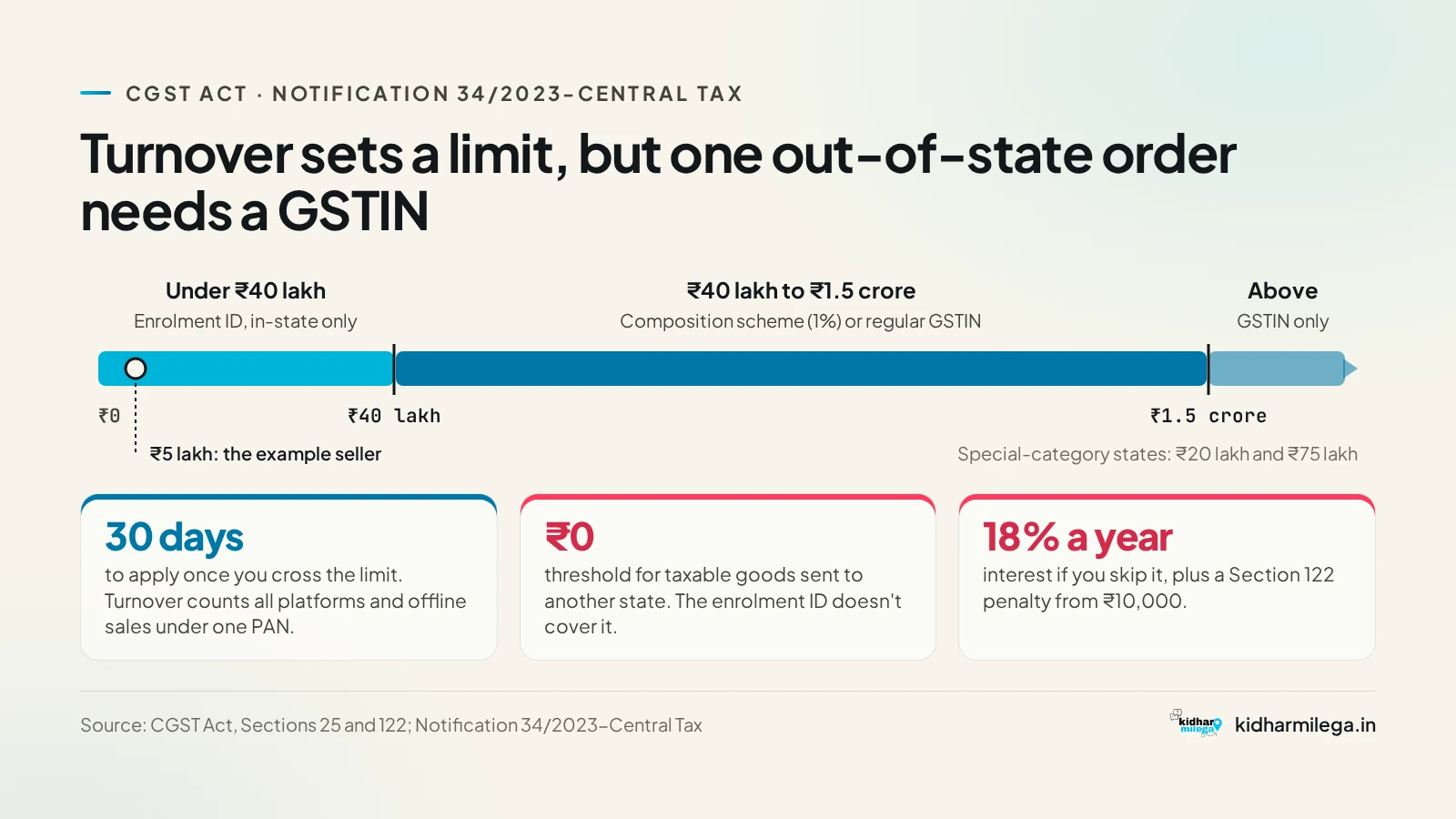
Two triggers move you from "no GST" to "GSTIN now":
- Your turnover crosses ₹40 lakh (or ₹20 lakh in a special-category state). Under Section 25 of the CGST Act you must apply for registration within 30 days of becoming liable. Turnover is counted across all your sales on all platforms, plus offline sales, under the same PAN.
- You want to sell taxable goods to another state. There's no threshold here. The enrolment route doesn't cover it, and the rules expect the platform to keep enrolment-ID sellers to in-state delivery. If you want those buyers, get the GSTIN first and then switch on wider delivery.
Once your GSTIN is issued, your enrolment number stops being valid. Update the GSTIN in Seller Central straight away so your listings don't get paused.
Skipping registration when you are liable costs far more than the compliance does. You pay the tax you should have collected, out of your own pocket. On top of that comes interest at 18% a year and a penalty under Section 122 that starts at ₹10,000. Ek notice ka kharcha, saal bhar ke CA se zyada.
The composition scheme: a middle option for in-state sellers
The composition scheme is a simpler GST registration for small businesses. You pay a flat rate on turnover, 1% for traders and manufacturers of goods, and file fewer returns. It is open up to ₹1.5 crore turnover (₹75 lakh in special-category states).
- What changed: Composition dealers used to be barred from selling through e-commerce platforms. Since 1 October 2023 they can supply goods through marketplaces, within their own state.
- What didn't change: Composition dealers still can't sell to other states. They can't collect GST from buyers or issue tax invoices, and they get no ITC.
- Who it suits: In-state sellers above the ₹40 lakh limit, or sellers whose platform demands a GSTIN even for local sales. On ₹50 lakh of sales, 1% is ₹50,000 a year, against output GST of ₹2.38 lakh at 5% under the regular scheme (before ITC).
For a ₹5 lakh seller under the limit, composition adds a 1% cost and solves nothing that the enrolment ID doesn't. It makes sense later, not on day one.
Wrong way vs right way
Wrong way: Register on Amazon with your PAN, tick "exempt", list your printed tote bags and ship them to Mumbai. A few months later a buyer's complaint or a payout hold shows the mismatch, and you are fixing tax for the past.
Right way: Look up your HSN code first. If it's exempt, use PAN. If it's taxable, look at where your first 20 enquiries came from. If they're all in your state, the enrolment ID is fine. If they're spread across India, get the GSTIN before you list. Pehle pincode dekho, phir registration.
Step-by-step: from Udyam to GST to your first Amazon listing
- Find your HSN code and GST rate. This decides your route. Use the HSN finder, then confirm on CBIC.
- Get Udyam registration. It's free on the Udyam portal with your Aadhaar and PAN. It doesn't replace GST, but it makes you a recognised MSME (micro, small or medium enterprise) for loans and schemes.
- Pick your route. Use the 4-question table above: exempt (PAN only), enrolment ID (in-state only) or GSTIN.
- Get the enrolment ID or GSTIN. Both are on the GST portal. For a GSTIN, file Form GST REG-01. If your tax on sales to registered buyers is up to ₹2.5 lakh a month, Rule 14A (added in October 2025) is meant to give you registration within 3 working days.
- Register on Amazon at sell.amazon.in. Enter your PAN, bank details and either the GSTIN, the enrolment number or the exempt-category option, whichever the screen offers for your category.
- List 5 to 10 products, not 100. Test which ones sell before you buy packaging in bulk.
- Every month, check your turnover against the limit and claim your TCS and TDS credits.
Documents required for a GSTIN (Form REG-01 on the GST portal)
- PAN of the business or proprietor
- Aadhaar (it is authenticated during the application)
- Passport-size photograph
- Proof of business address: an electricity bill or property tax receipt, plus a rent agreement or the owner's consent letter if you work from a rented or family home
- Bank account proof: a cancelled cheque or the first page of your passbook or statement
- Mobile number and email linked to the applicant, for OTPs
Selling from home is allowed. Your home address becomes your principal place of business, so keep the address proof in the name that's going on the form.
Toh GST lena chahiye ya nahi? Bhaiya's take
Skip the GSTIN for now if you sell only exempt products (books, earthen pots, fresh produce), or if you're testing a taxable product with buyers in your own state on a platform that clearly accepts enrolment IDs, like Meesho.
Get the GSTIN before your first listing if your product is taxable and your buyers are spread across India, if you want FBA, or if shops and hotels are going to buy from you. For a ₹5 lakh seller the compliance costs about ₹1,000 a month. Missing a sale in every other state costs far more.
Don't build your plan on a route Amazon hasn't confirmed. Build it on the one your product and your buyers actually need.
Your next step
Before you register anywhere, do one cheap thing. Look up your product's code in the HSN code finder and write down its GST rate. Then open your district's product page to see what's already made within 50 km of you and who buys it. Most sellers ask about GST first and only then work out what to sell. Do it the other way round. More practical guides for small makers are on the KidharMilega homepage.
Frequently asked questions
Can I sell on Amazon with just a PAN card?
Yes, but only if every product you sell is fully GST-exempt, such as books, unbranded grains, fresh produce, earthen pots or bangles. Amazon's seller pages say these sellers can register with their PAN and skip the GST step. Once you add even one taxable product, the PAN-only route no longer covers your catalogue, so check your HSN codes first.
Can I sell to other states on Amazon without GST?
Not for taxable goods. Any sale of taxable goods to another state needs a GSTIN, whatever your turnover. The enrolment ID route under Notification 34/2023-CT is limited to sales within your own state. Fully exempt products like books are the only goods you can ship across India without a GST registration.
Is the GST registration limit for online sellers ₹20 lakh or ₹40 lakh?
For goods it's ₹40 lakh a year in most states and ₹20 lakh in special-category states. ₹20 lakh is the usual limit for services. The limit only matters if you sell within your own state. Interstate sellers of taxable goods need a GSTIN from the first sale. Turnover is counted across all platforms and offline sales under one PAN.
Do I need GST for Amazon FBA?
Yes. Stock kept in an Amazon warehouse in another state counts as a place of business there, so you need a GST registration in that state. Rule 14B, in force from 1 November 2026, makes that second registration easier using the warehouse address, but only for sellers who already have a GSTIN in their home state.
Does the new Rule 14B mean small sellers don't need GST?
No. Rule 14B, notified through Notification 05/2026-Central Tax and effective 1 November 2026, lets an already registered seller register in other states using a marketplace warehouse as the place of business. It needs marketplace consent within 7 working days and caps tax on B2B sales at ₹2.5 lakh a month. It does not help sellers with no GST.
Is Meesho easier than Amazon for selling without GST?
For taxable goods, yes. Meesho officially accepts GST enrolment IDs for sales within the seller's own state, with a ₹40 lakh limit (₹20 lakh in north-eastern states). Amazon's published no-GST route only covers PAN-only registration for exempt categories. Check the tax step during Amazon sign-up to see what it offers for your category.
Sources
- Notification 34/2023-Central Tax · GST Council
- Notification 37/2023-Central Tax · GST Council
- 57th GST Council meeting press release · GST Council
- GST-exempted categories on Amazon · Amazon India
- Amazon seller registration guide · Amazon India
- Meesho makes platform non-GST inclusive · Meesho
- GSTN introduces enrolment facility for GST unregistered suppliers to supply goods through e-commerce operators · Taxscan
- CBIC Rule 14B GST registration for e-commerce sellers · Corplawupdates