
KidharMilega's free Export Market Finder shows you which countries buy your product from India, ranked, with each country's share, the region mix and whether demand sits in one country or is spread across many. You can also flip it: pick a country and see what India sells there. It costs nothing and you don't need to know trade data to use it.
Built for first-time exporters, district makers and buyers abroad who source from India. Yeh tool aapke liye hai agar aap abhi tak sirf "export karna hai" bol rahe ho, par country ka naam nahi pata.
Key facts
- Tool: Export Market Finder, live now on kidharmilega.in, free to use.
- Two ways to search: product to countries (who buys this from India) or country to products (what India sells to that country).
- What each result shows: ranked buyer countries, each country's share, the region mix, and how concentrated the demand is.
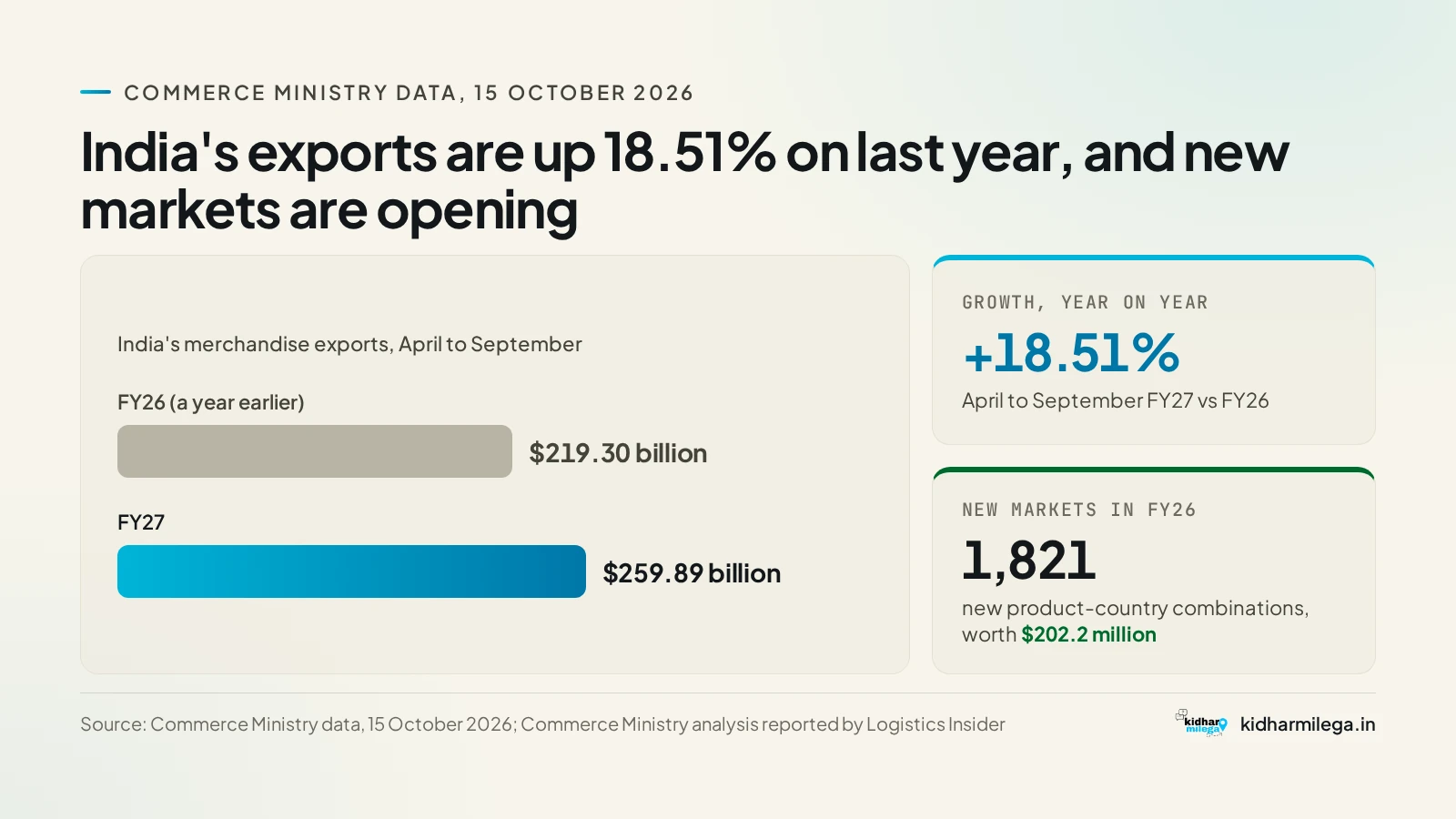
- Why it matters now: India's merchandise exports for April to September FY27 were $259.89 billion, up 18.51% from $219.30 billion a year earlier (Commerce Ministry data, 15 October 2026).
- New markets are opening: in FY26 India added 1,821 new product-country export combinations, worth $202.2 million in extra exports, according to a Commerce Ministry analysis reported by Logistics Insider.
- Official cross-check: the government's Trade Intelligence and Analytics (TIA) portal, launched on 18 November 2025, has replaced TRADESTAT.
What the free export market finder tool actually does
Most first-time exporters start with one question: who buys this? The usual answer is a guess. America, maybe Dubai, maybe "Europe". The Export Market Finder replaces that guess with a ranked list.
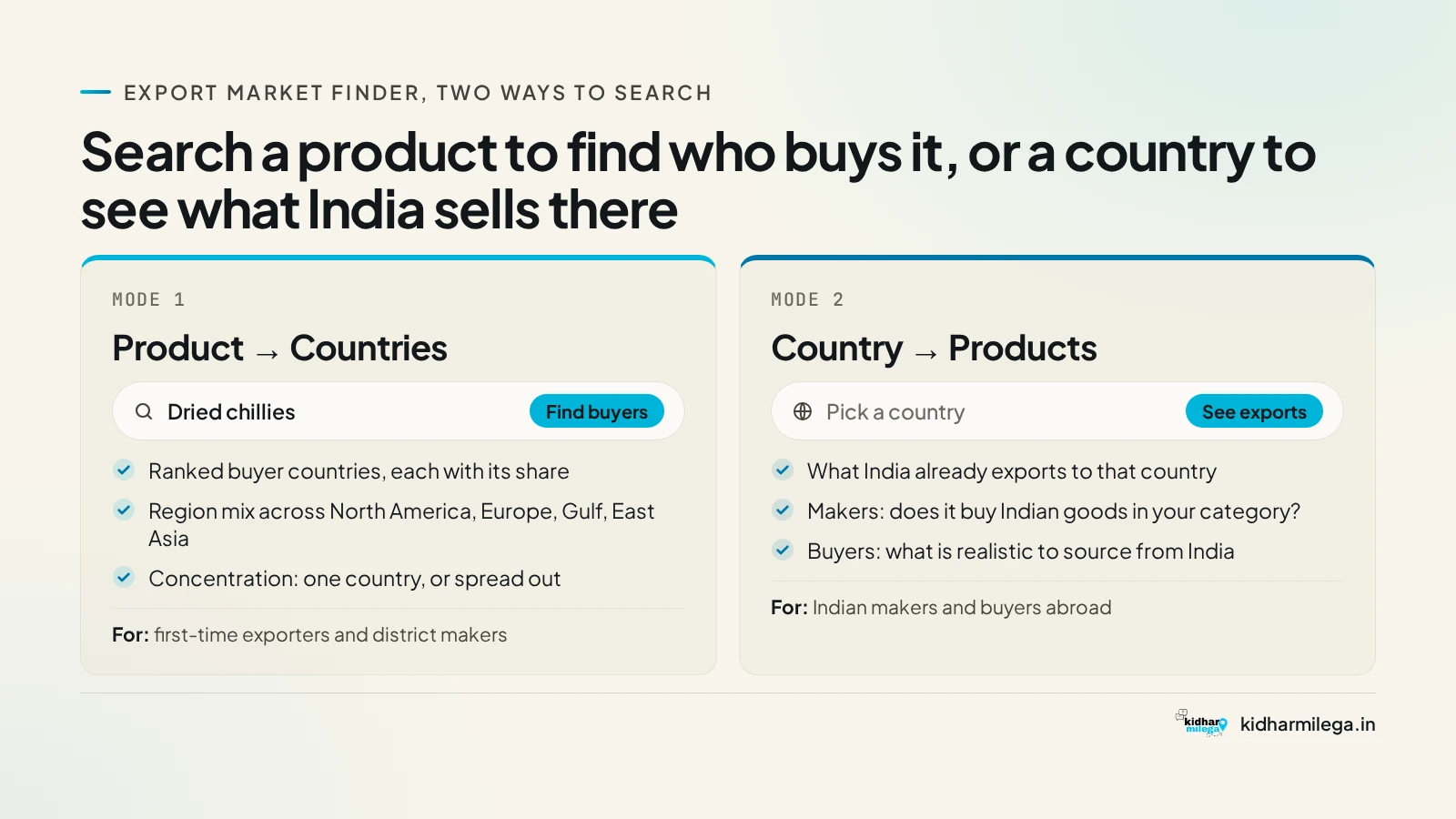
Mode 1: Pick a product, get the countries
Choose your product. The tool returns the countries that import it from India, ranked from biggest to smallest. For each one you see:
- Rank and share. What slice of India's exports of this product goes to that country.
- Region mix. How the demand splits across regions, such as North America, Europe, the Gulf or East Asia.
- Concentration. Whether one country takes most of it, or demand is spread across many buyers.
Mode 2: Pick a country, see what India sells there
Choose a country. The tool shows what India already exports to it. This helps two kinds of people. An Indian maker can check whether a country already buys Indian goods in their category. A buyer abroad can see what India sells to their own market, and so what is realistic to source from here.
Who should use it, honestly
- First-time exporters with a product and an IEC (Importer Exporter Code, issued by DGFT), or about to get one, who need to pick their first two or three markets.
- District makers and ODOP clusters. If your zila makes Guntur chillies, Machilipatnam kalamkari or Visakhapatnam seafood, the question isn't "can this be exported". It already is. The question is: to whom, and how much depends on one country.
- Existing exporters stuck on one market. If 70 to 80% of your orders go to one country, the concentration view is for you.
- Buyers abroad who want to see what India already ships to their country before they look for a supplier.
Skip it for now if you don't have a product yet. Market data won't tell you what to make. Start with what your district already makes on the KidharMilega homepage, then come back.
"Export matlab America": the myth, and the math
Mera ek dost bolta hai, export karna hai toh America hi jaana padega. Sabse bada market, dollar mein payment. His logic isn't wrong. The US is a huge buyer of Indian goods, and for years many exporters built their whole business on it.
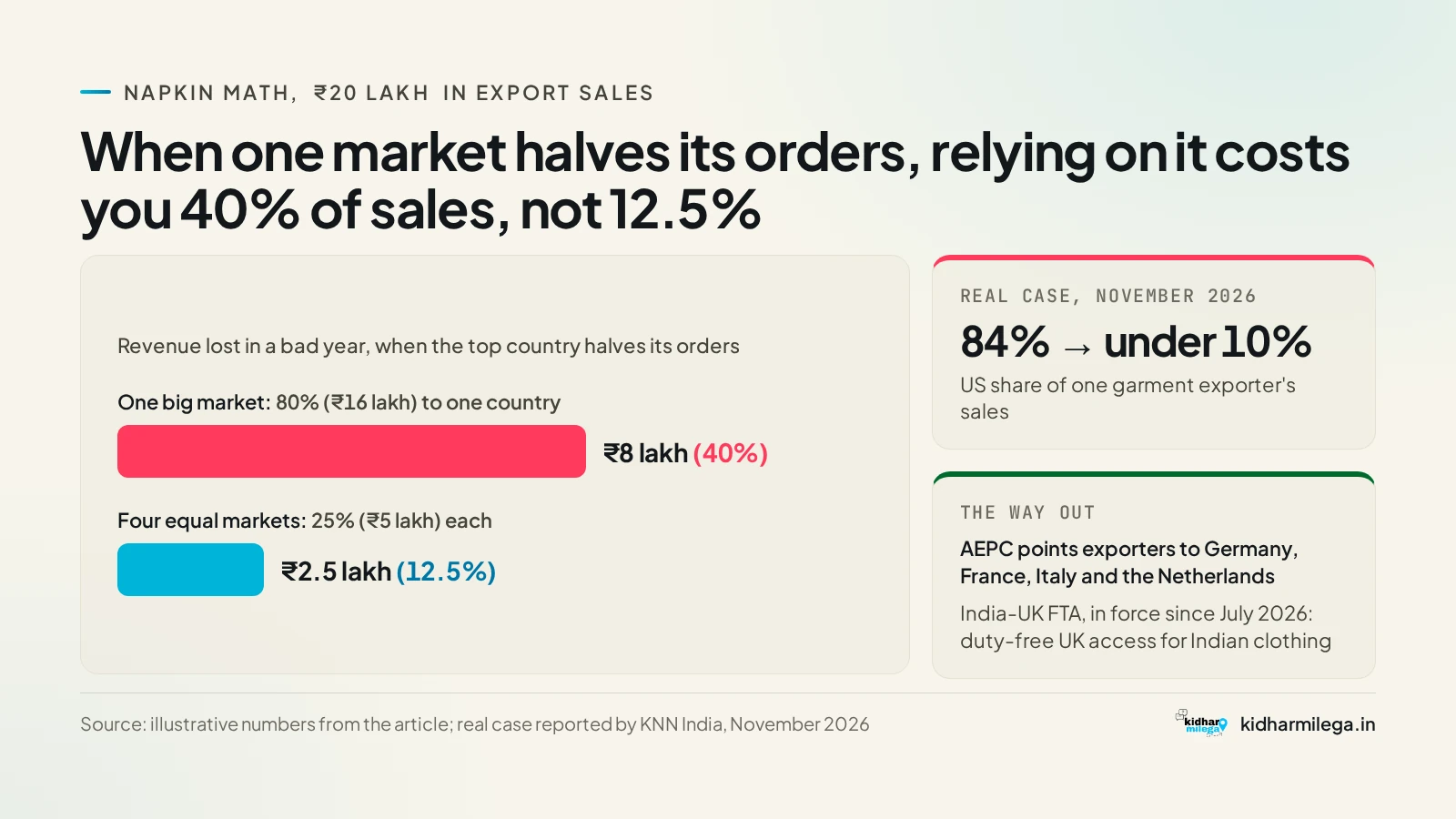
Here's what that looks like when things change. In November 2026, KNN India reported a garment exporter whose US share fell from 84% of sales to under 10%. The Apparel Export Promotion Council (AEPC) is now pointing exporters towards Germany, France, Italy and the Netherlands. And the India-UK FTA, in force since July 2026, gives Indian clothing duty-free access to the UK.
Run the napkin math on concentration. These are illustrative numbers, not data from any one business:
| Scenario | Annual export sales | Share to one country | If that country's orders halve | Revenue lost |
|---|---|---|---|---|
| One big market | ₹20 lakh | 80% (₹16 lakh) | ₹8 lakh gone | 40% of total |
| Four markets, equal | ₹20 lakh | 25% (₹5 lakh) | ₹2.5 lakh gone | 12.5% of total |
Same business, same product. One version loses 40% in a bad year. The other loses 12.5%. Ek market pe poora business, matlab ek phone call pe poora business.
The US situation itself is still unsettled. On 13 November 2026, Bloomberg and Business Today reported that the US has assured India of lower tariffs than rival exporters under a proposed trade deal, with a first tranche covering goods only. The deal is not signed, and reports disagree on which tariff rate applies right now. Check official US notices before you price an order.
How to use the Export Market Finder, step by step
Open the Export Market Finder tool and follow this order.
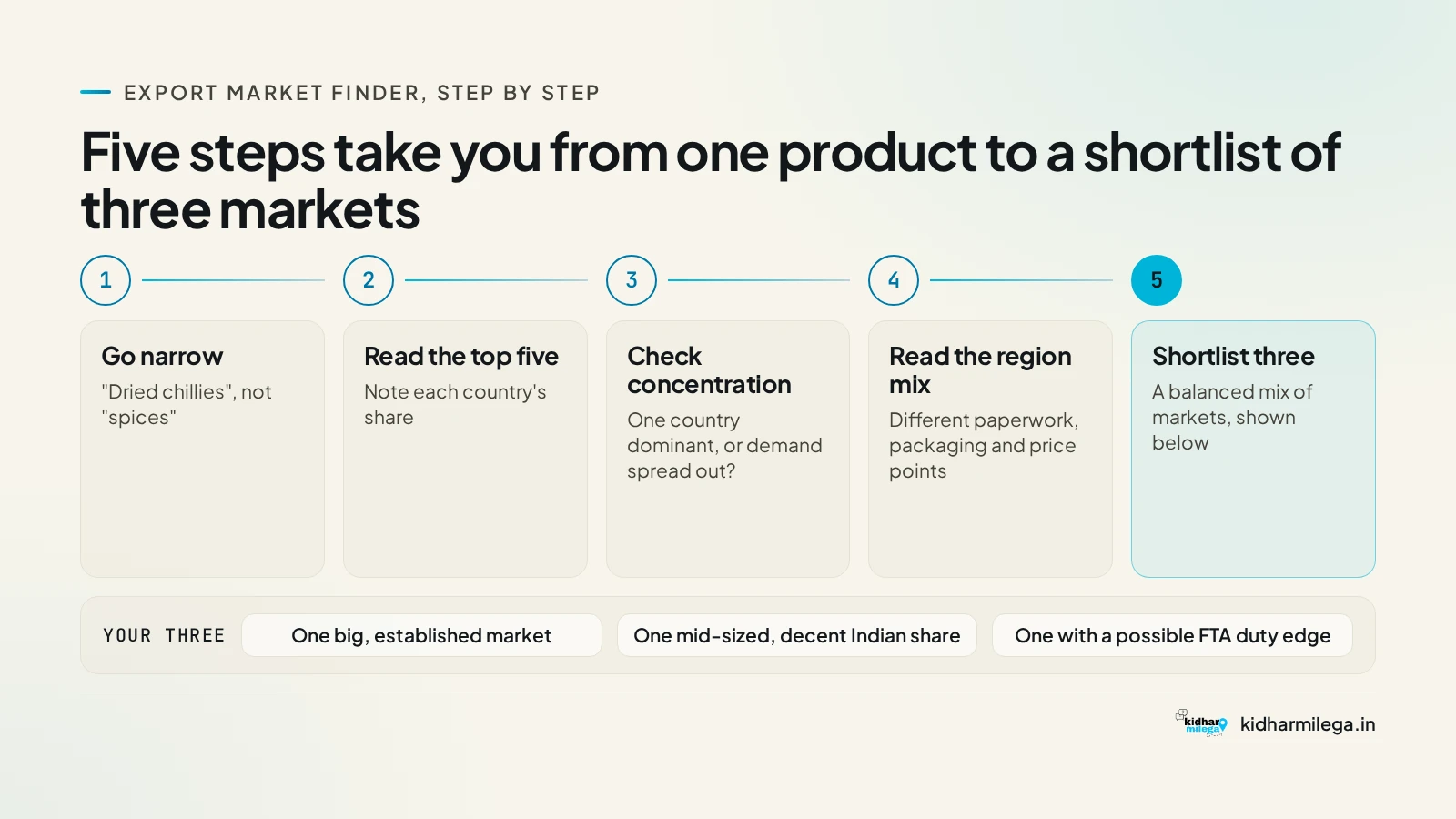
- Pick your product as narrowly as you can. "Spices" is too wide. "Dried chillies" is useful. Your real buyers buy a specific item, not a category.
- Read the top five countries first. Note each one's share. These are the markets where Indian sellers already have a footing.
- Check the concentration. If one country takes most of the share, the product depends on that market. If the top ten are close to each other, demand is spread out, and you have room to choose.
- Look at the region mix. This tells you whether you're dealing with one kind of buyer (say, Gulf wholesalers) or several (European retailers, US importers, East Asian processors). Different regions mean different paperwork, packaging and price points.
- Shortlist three markets. One big, established market. One mid-sized market where India has a decent share. One market where an FTA may give you a duty advantage.
- Flip to country mode for each shortlisted market. See what else India sells there. If India already ships related goods, there are importers who know how to buy from India. That's half the trust problem solved.
- Write it down. Product, three countries, their shares, the region. That one page is your export plan's first draft.
Worked example: reading the results
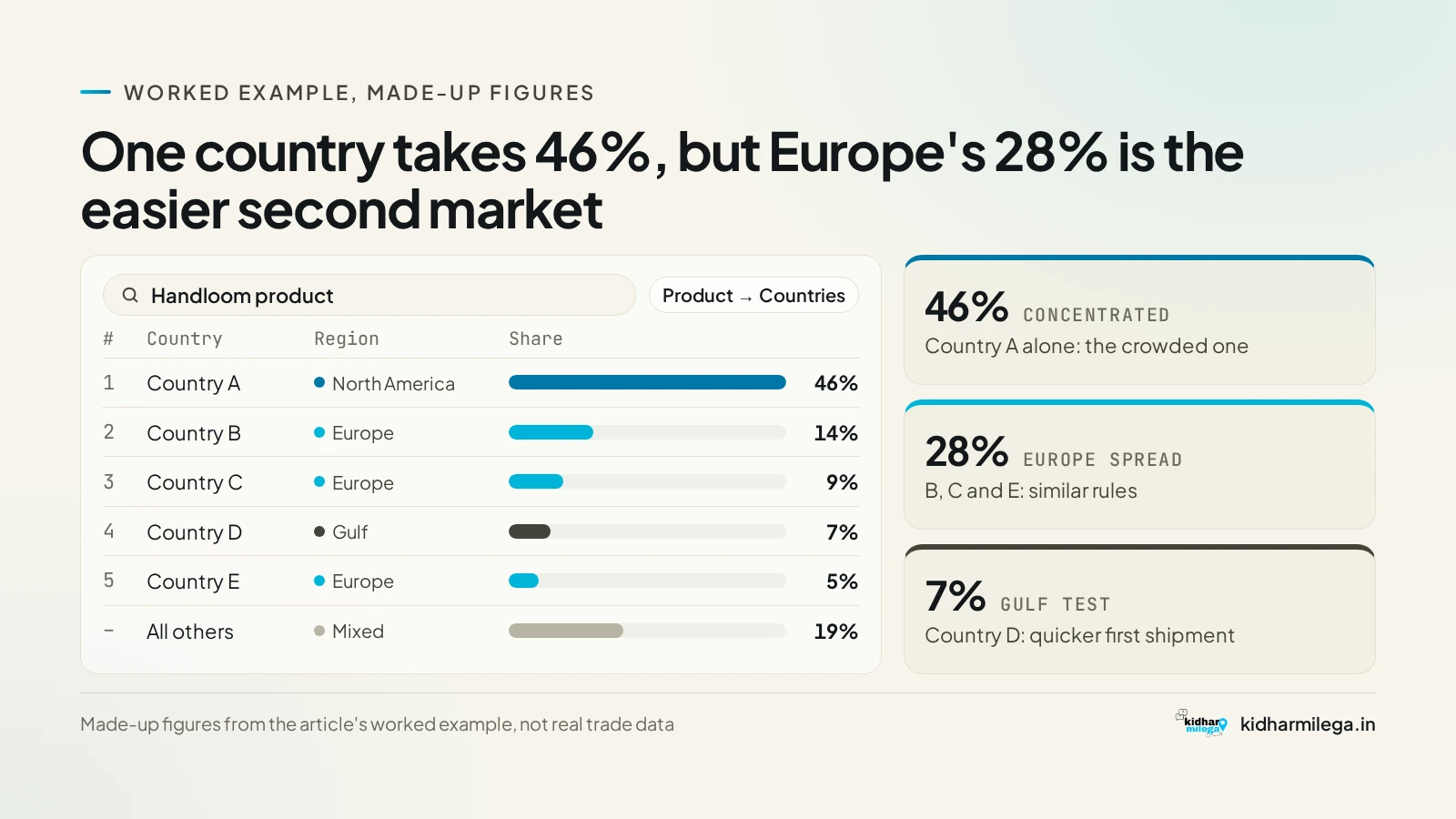
Say you search a handloom product and the results look like the table below. These figures are made up to show you how to read the screen. Run your own product to see the real ranking.
| Rank | Country | Share of India's exports | Region |
|---|---|---|---|
| 1 | Country A | 46% | North America |
| 2 | Country B | 14% | Europe |
| 3 | Country C | 9% | Europe |
| 4 | Country D | 7% | Gulf |
| 5 | Country E | 5% | Europe |
| All others | 19% | Mixed |
What this tells you:
- Demand is concentrated. Country A alone takes 46%. Every Indian seller of this product is fighting for the same buyers there.
- Europe is the real spread. B, C and E together take 28%. Three countries, one region, similar compliance rules. That's an easier second market than it looks.
- The Gulf is a test market. At 7%, Country D is small but often quicker to reach for a first shipment.
Your move: don't chase Country A first just because it's number one. Start with one European market and the Gulf market, where competition from other Indian sellers is thinner. Keep Country A as a later target once you have samples, certifications and references.
The catch: what a ranking won't tell you
Data shows you where the buyers are. It doesn't give you a buyer. Announcement hai, cheque nahi, and a ranking isn't an order either.
- Trade data lags. Shares come from past shipments. Markets move, especially in a year of tariff changes. Before you commit money, cross-check the latest numbers on the official TIA portal.
- Share is not price. A country can take a big share of India's exports and still pay the lowest price per kg. Ranking tells you volume, not margin.
- Duties change the picture. A smaller market with an FTA can beat a bigger one with a tariff. Look up the duty for your product in each shortlisted country before you quote.
- Rules differ by region. Food, cosmetics and textiles face labelling, testing and certification rules that vary country to country. Check them before you send samples.
- MOQ (minimum order quantity) can kill a deal. Big markets often mean big minimum orders. Make sure you can actually produce what the buyer needs.
Cross-check with the official free tools
Use the Export Market Finder to shortlist fast. Then verify with the government's own sources.
- TIA portal (Department of Commerce). Launched by Piyush Goyal on 18 November 2025, it has over 270 analytics and visualisations across more than 28 dashboards, combining UN Comtrade, DGCI&S data and macroeconomic indicators. It replaces the Department of Commerce Monitoring Dashboard, the Niryat portal and TRADESTAT, according to the press material. Many older "how to find buyers" guides still tell you to use TRADESTAT. From what the portal's FAQ says, the public page offers trend views, while advanced tools are for government users only. Check the access rules on the portal itself.
- Trade Connect e-Platform. Launched by the Commerce Ministry in 2024, it's described as offering a country guide, a tariff explorer, trade leads and contact with Indian missions and Export Promotion Councils. You register with your IEC.
- DGFT portal. For your IEC, trade notices and scheme updates.
A note on government support. The Export Promotion Mission has a total outlay of ₹25,060 crore from FY2025-26 to FY2030-31. Its INSIGHT intervention, for trade intelligence, analytics and AI advisory tools for MSMEs, was put into effect by DGFT Trade Notice 27/2025-26 on 20 February 2026 (PIB). It's a real scheme. But it's money for building intelligence and support, not a cheque in your account. Read the guidelines before you count on it.
Wrong way vs right way
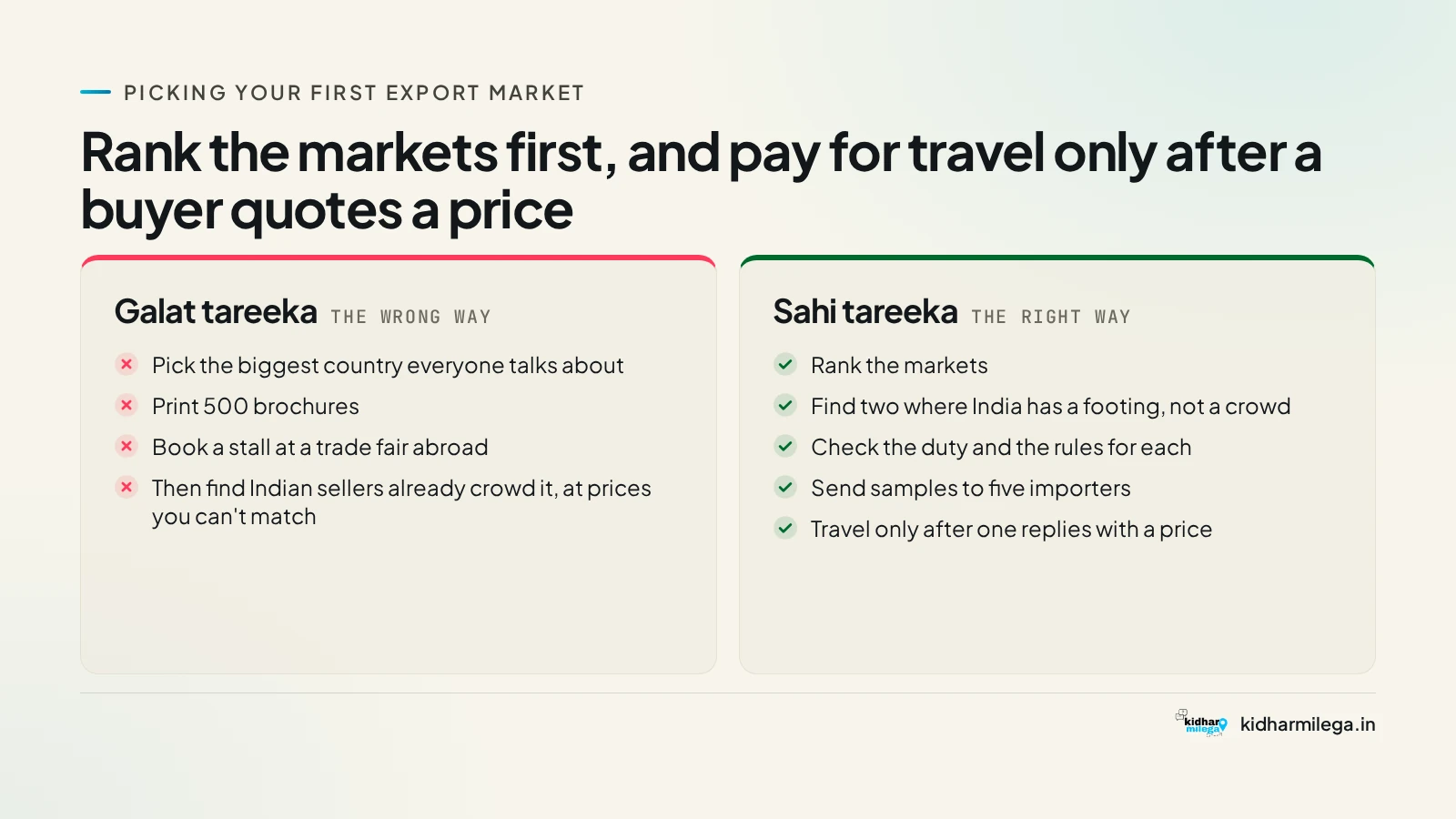
Galat tareeka: pick the biggest country because everyone talks about it, print 500 brochures, book a stall at a trade fair abroad, then find out Indian sellers already crowd that market at prices you can't match.
Sahi tareeka: rank the markets, find two where India has a footing but not a crowd, check the duty and the rules for each, send samples to five importers, and spend on travel only after one replies with a price.
Bhaiya's take: who should use this, and who should wait
Use it this week if you have a product, some production capacity and an IEC or a plan to get one. Fifteen minutes on the tool will give you a shortlist that many first-time exporters spend months guessing at.
Use it right now if most of your exports go to one country. Look at the concentration and the region mix. Find your second and third markets before you need them.
Wait if you're still choosing what business to start. Pick the product first, from what your district already makes. Market data helps you sell a product, not choose one.
Your next step
Open the tool, search your district's product, and shortlist three countries. Then find actual importers in those markets with the free Export Buyer Finder.
When those importers ask to see your range, send them one link, not 40 WhatsApp photos. A free KidharMilega Online profile gives you a product catalog and an enquiry form, listed on your district's ODOP page.
Bheed ka hissa nahi, kissa bano. Sab America ke peeche bhaag rahe hain; aap pehle data dekho.
Frequently asked questions
Is there a free export market finder tool for Indian exporters?
Yes. KidharMilega's Export Market Finder is free. Pick your product to see which countries buy it from India, ranked by share, with the region mix and how concentrated demand is. You can also pick a country to see what India sells there. For official cross-checks, the Commerce Department's TIA portal offers public trend views.
How do I find which countries import my product from India?
Search your product, as specifically as possible, in the Export Market Finder. It ranks the countries that import it from India and shows each one's share. Then confirm recent figures on the government's Trade Intelligence and Analytics portal, since trade data reflects past shipments and markets shift, especially when tariffs change.
What replaced TRADESTAT?
The Trade Intelligence and Analytics (TIA) portal, launched by the Department of Commerce on 18 November 2025, replaces TRADESTAT, the Niryat portal and the Commerce Monitoring Dashboard, according to the launch press material. It combines UN Comtrade, DGCI&S data and macroeconomic indicators across more than 28 dashboards.
Do I need an IEC to use export market tools?
You don't need one to research markets on KidharMilega's Export Market Finder. The government's Trade Connect platform requires registration with your IEC. You will need an IEC from DGFT before you actually ship goods abroad, so apply early if you're serious about exporting.
Which markets can Indian exporters target instead of the US?
It depends on your product, so check the ranking for it. For garments, AEPC is pointing exporters to Germany, France, Italy and the Netherlands, and the India-UK FTA, in force since July 2026, gives Indian clothing duty-free access to the UK. Look at the region mix to find markets where India already has buyers.
Can buyers abroad use the Export Market Finder?
Yes. Buyers outside India can use country mode: pick their own country and see what India already exports there. This shows which Indian product categories already have importers and supply routes into their market, which makes it easier to decide what to source and from which Indian district.
Sources
- Trade Intelligence & Analytics Portal · Department of Commerce, Government of India
- TIA Portal FAQs (Public Page) · Department of Commerce, Government of India
- Trade Connect e-Platform · Ministry of Commerce and Industry
- INSIGHT intervention under Export Promotion Mission · Press Information Bureau
- Union Minister Piyush Goyal launches Trade Intelligence and Analytics Portal in New Delhi · News On AIR
- Indian garment exporters diversify markets amid US tariff uncertainty · KNN India
- India accelerates export diversification in FY26, adds 1,821 new market-product combinations · Logistics Insider
- US assures India of lower tariffs than peers under proposed trade deal · Business Today