
On IndiaMART and TradeIndia, sawmill machinery in India is listed from about ₹9,000 for a chainsaw mill attachment up to ₹8 to 8.5 lakh for a plant-scale line. Those are sellers' asking prices, not market data. A small licensed job-work sawmill with a main bandsaw, a re-saw, a sharpening machine, power and a shed comes to about ₹16.6 lakh in our worked example below. It pays back in about 35 months, and only if it cuts around 200 CFT a day. Buying the machine is the easy part. The hard part is the state forest licence.
Sawmill payback calculator
Works out monthly profit, payback months and break-even output for a job-work sawmill from your own costs and rates.
Monthly revenue —
Monthly power bill (energy only) —
Monthly profit —
Payback (months) —
Break-even output (CFT per day) —
Job-work model: revenue = CFT cut × rate; profit = revenue − power − fixed costs; payback = setup cost ÷ monthly profit. Licence fees in the default setup cost use the Assam EoDB schedule. A payback in the hundreds of thousands means the mill is losing money at these inputs.
Key facts before you call a seller
- Asking prices: chainsaw mill about ₹9,000. Table, trolley or rip saw ₹55,000 to ₹70,000. Bandsaw ₹1.3 to 1.6 lakh (IndiaMART vertical bandsaws are listed from ₹53,900 to ₹2,10,000). One "DD saw" listing is ₹3.9 lakh. Plant-scale setups run ₹8 to 8.5 lakh.
- Licence: you need a forest department licence from your state. Running a sawmill without one is illegal, even on private land.
- The 1996 order: in T.N. Godavarman Thirumulpad vs Union of India, the Supreme Court's interim order of 12 December 1996 put tight controls on sawmills. In 2021 it allowed State Level Committees to decide licence applications, including ones for new machinery.
- Assam: the official pages don't agree on the fee. The EoDB page lists ₹5,000 for the DPR and ₹5,000 for the application. Sewa Setu shows ₹10,000 for a sawmill. The forest department's how-to page shows ₹500. Some portal pages also list a ₹1,00,000 sawmill licence fee plus a Green Fund fee based on HP. Confirm the fee on the WBI portal before you pay. The licence is due within 60 days if your papers are complete. In reports dated 6 and 7 November 2026, the state said it is preparing fresh sawmill licences.
- Kerala: new sawmill rules were issued on 17 February 2026 as SRO No. 195/2026.
- JAK Machinery is a CNC woodworking machine maker in Surat. Its CNC Mill Band Saw cuts boards up to 4 inches thick. It does not sell log breakdown sawmills.
Sawmill machinery types and price in India, side by side
Mera ek dost bolta hai, "bandsaw le lo, sab kat jaayega." He has half a point. The vertical bandsaw does most of the work in small Indian mills. But each machine does a different job, and buying the wrong one means a log you can't cut or a machine that sits idle.
| Machine | What it does | Logs or jobs it suits | Asking price band (₹) | Who should buy it |
|---|---|---|---|---|
| Chainsaw mill (attachment) | Rips a log on the spot using your chainsaw | The odd farm-felled tree, slabs for a table top | About 9,000 (chainsaw extra) | Hobbyists and farmers. Not a business. |
| Circular, table, trolley or rip saw | Cross-cuts and rips planks, cuts small logs to size | Eucalyptus poles, small girth logs, plank sizing, firewood | 55,000 to 70,000 | Furniture workshops, packing-case and pallet units, as a second machine in a mill |
| Vertical bandsaw (the usual Indian "band saw machine") | Main breakdown saw. The log goes through on a trolley or carriage. | Mango, rubber wood, eucalyptus, neem, most plantation logs | 1.3 lakh to 1.6 lakh typical; IndiaMART listings 53,900 to 2,10,000; one TradeIndia H-1000 listing at 1,06,000 | A small job-work mill. This is your first machine. |
| Re-saw (smaller bandsaw) | Cuts thick planks into thin boards and strips | Furniture stock, toy and cutlery blanks, packing strips | We budget it at 1 to 2 lakh, the same band as small bandsaws | Mills that sell to furniture and craft units |
| Heavier saw lines (one seller's "DD saw" listing) | A bigger frame for bigger logs and longer shifts | Large-girth hardwood | About 3.9 lakh | Only once a small mill is already running full |
| Plant-scale setup | Main saw, carriage, re-saw and handling sold as one line | Commercial volume | 8 lakh to 8.5 lakh | Buyers who already have log supply and buyers lined up |
| Portable horizontal sawmill | A band head on rails that you take to the log | Remote plantations, on-site milling | Mostly imported. Get a landed quote with duty and GST included. | A niche. Think it through before buying one. |
| CNC router or CNC lathe (JAK-type) | Carves, profiles and turns wood that has already been sawn | Furniture panels, carving, turned legs | On quote | Furniture makers. This is not a sawmill. |
All these figures are asking prices on seller listings. Read them as a starting point for bargaining. Many sellers quote the frame without the motor, blades or installation, so always ask what is in the price.
Band or circular: the kerf math
Kerf is the width of wood the blade turns into sawdust on every cut. TimberKing and WOODWEB put a band mill's kerf at about 3/32 inch, or 0.094 inch. A circular mill's kerf is about 1/4 inch, or 0.25 inch.
Say you cut 1-inch planks. On a band mill, each plank uses 1.094 inches of log. On a circular mill it uses 1.25 inches. So the same log gives you about 14% more planks on the band mill (1.25 ÷ 1.094 = 1.14). If timber sells by the CFT, that 14% is pure margin. Circular mills are sturdier and faster on rough work, and that's why they survive in pallet and packing units. For a mill that sells wood, buy the bandsaw. Sawdust ka bhi bhav hai, par plank ka zyada hai.
Wheel size and motor HP: match the machine to your logs
The wheel size of a bandsaw (30, 36 or 42 inches) decides how big a log it can take. It also affects blade life, because a bigger wheel bends the blade less on every turn. A bigger wheel needs a bigger motor. Many Indian sellers work to a rough rule like the one below. Use it to brief the seller, then confirm it with a demo cut on your own wood.
| Wheel size | Typical motor (rough rule) | Logs it suits | Common woods |
|---|---|---|---|
| 30 inch | 10 to 15 HP | Small girth plantation logs, re-sawing planks | Eucalyptus, rubber wood, poplar |
| 36 inch | 15 to 20 HP | Mixed job work, medium logs | Mango, rubber wood, neem, babool |
| 42 inch | 20 to 30 HP | Large girth logs and harder wood | Teak, sal, big mango and jamun logs |
Start by walking to your nearest timber depot or mandi. See what actually comes in. If 80% of the logs are eucalyptus poles, a 42-inch machine is money you've burnt. If farmers in your area bring big mango trunks, a 30-inch machine will turn them away at the gate.
Power math: 1 HP is 0.746 kW. A 20 HP main saw, a 10 HP re-saw and a 3 HP sharpener add up to about 33 HP, or roughly 25 kW of connected load. That is a 3-phase industrial connection, not a domestic one. Apply to your DISCOM before the machine arrives, not after.
Worked example: what a small sawmill really costs
This example is a job-work mill. Farmers, contractors and furniture units bring their own logs and pay you per CFT to cut them. That keeps working capital low, because you don't buy timber or carry stock. Assam's official pages don't agree on the licence fee, so the licence line budgets for the highest figures shown. Every other line is our assumption, so swap in quotes from your own district.
| Item | Amount (₹) |
|---|---|
| 36-inch vertical bandsaw with log trolley and rails | 2,50,000 |
| 20 HP motor and starter | 80,000 |
| 30-inch re-saw with 10 HP motor | 1,50,000 |
| Blade sharpening and setting machine | 60,000 |
| 8 to 10 spare blades and tooling | 40,000 |
| Chain pulley block and log handling | 50,000 |
| Machines subtotal | 6,30,000 |
| GST on machines (assumed 18%; check the HSN 8465 rate on CBIC) | 1,13,400 |
| Electricals: panel, cabling, earthing, 3-phase connection and deposit | 1,50,000 |
| Shed of about 2,000 sq ft and machine foundations | 4,00,000 |
| Licence and paperwork, Assam example at the highest fees shown: DPR fee 5,000 + application 5,000 + licence 1,00,000 + Green Fund (assumed 40,000) + DPR preparation (assumed 15,000) | 1,65,000 |
| Working capital (2 months of running cost) | 2,00,000 |
| Total | 16,58,400 |
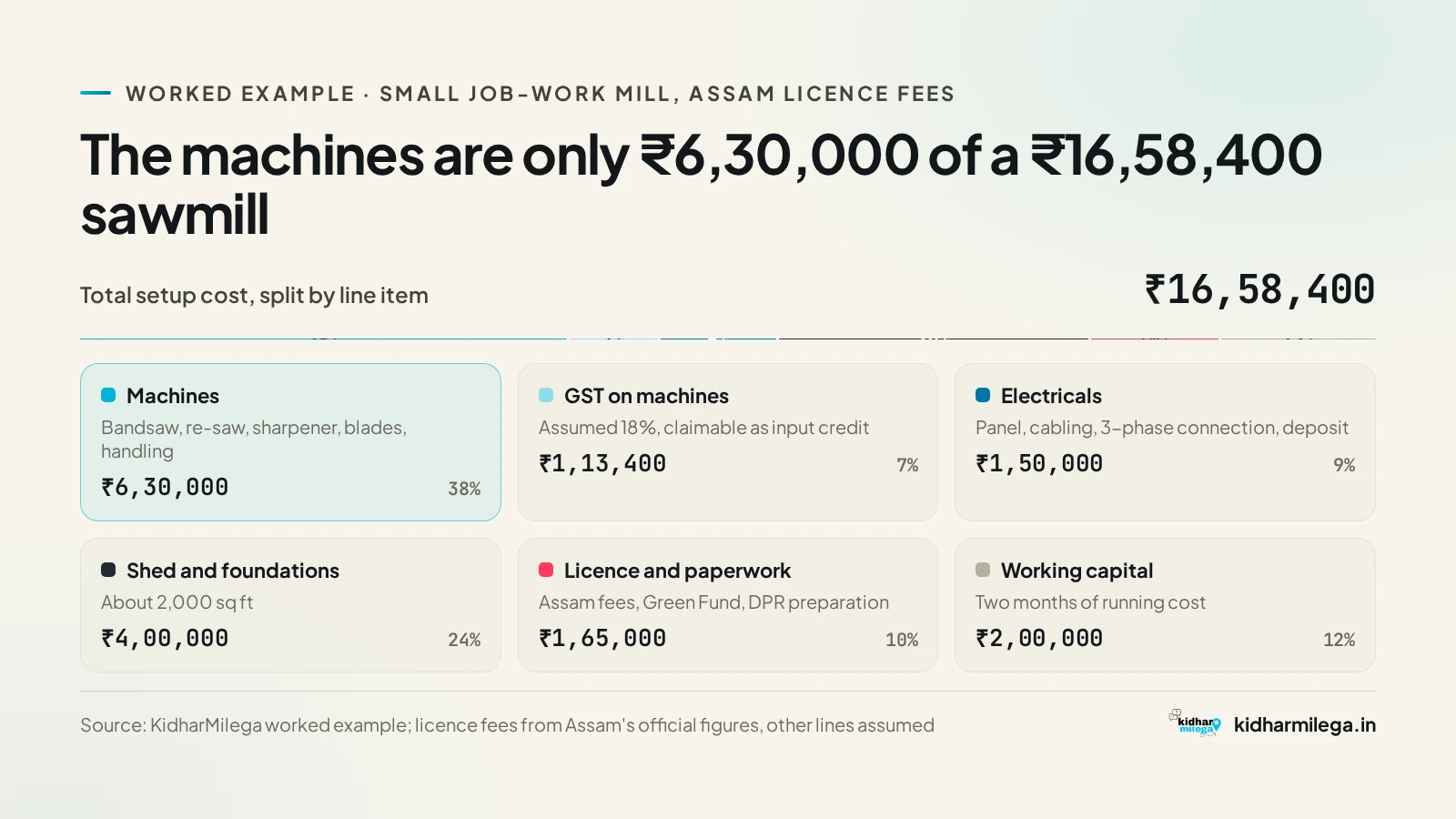
If the lower official fee applies to you, the licence line drops by up to about ₹1 lakh. Treat the difference as a cushion until the portal confirms it. If you register for GST, you can claim the ₹1,13,400 as input credit against the GST on your job-work bills. That brings the real cash cost down.
Monthly running cost and payback
The assumptions: 200 CFT of logs cut a day, 25 working days, a job-work rate of ₹30 per CFT, power at ₹9 a unit, and about 0.45 kWh per CFT. That power figure comes from 15 kW of average draw for 6 cutting hours a day. Before you trust the ₹30, ask three mills in your district what they charge.
- Revenue: 200 × 25 × ₹30 = ₹1,50,000
- Labour: one sawyer at ₹20,000 and three helpers at ₹13,000 each = ₹59,000
- Power: 2,250 units × ₹9 = ₹20,250, plus about ₹5,000 in fixed and demand charges = ₹25,250
- Blades and sharpening consumables: ₹8,000
- Maintenance (bearings, belts): ₹5,000
- Miscellaneous (accounts, phone, transport): ₹5,000
- Total cost: ₹1,02,250
- Monthly profit: ₹47,750
- Payback: ₹16,58,400 ÷ ₹47,750 = about 35 months
Output drives everything else. See what happens when the saw runs slower or faster:
| CFT cut per day | Monthly revenue (₹) | Monthly cost (₹) | Monthly profit (₹) | Payback |
|---|---|---|---|---|
| 150 | 1,12,500 | 97,187 | 15,313 | About 108 months |
| 200 | 1,50,000 | 1,02,250 | 47,750 | About 35 months |
| 300 | 2,25,000 | 1,16,375 | 1,08,625 | About 15 months |
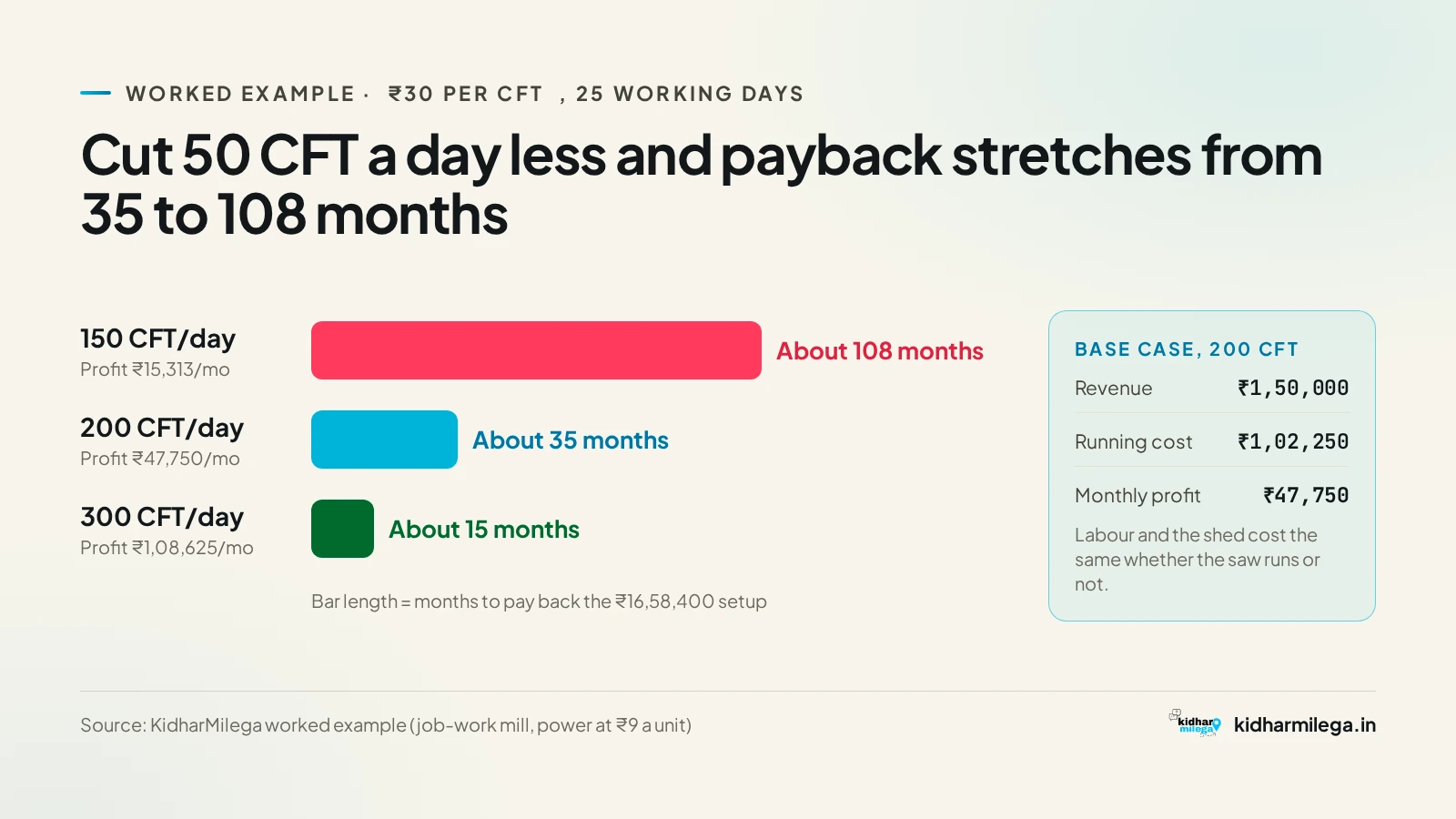
Labour and the shed cost the same whether the saw runs or not. Drop 50 CFT a day and nine years of payback is waiting for you. Machine nahi kamaati, utilisation kamaata hai. You can plug your own numbers into the payback calculator on this page. If you're borrowing for working capital, the MSME working capital loan cost calculator shows what the interest adds to your monthly cost.
Saw mill licence in India: the part sellers skip
The myth goes like this: "Machine lagao, licence baad mein ho jaayega, sab karte hain." It's tempting, because the seller can deliver in two weeks and the government office feels far away. Here's why it doesn't work.
In the Godavarman case, the Supreme Court's interim order of 12 December 1996 shut down sawmills, veneer units and plywood units in Assam that depended on forest timber within 100 km of the Assam to Arunachal border. Most Assam plywood factories had stopped by 24 December 1996. More than 1,000 units were hit and about 1 lakh workers lost their jobs. Production moved to Yamunanagar in Haryana, Perumbavoor in Kerala and the area around Kandla in Gujarat. In 2021 the Court let State Level Committees decide on licence applications, new machinery included. So in every state, a new saw mill now goes through the forest department and that committee. There is no way around it.
The enforcement is real. On 30 June 2026, Assam Forest Minister Jayanta Malla Baruah started a "mission mode" drive against illegal sawmills, as reported by ANI. By 7 July it had reached 212 operations in seven days, according to NKTV. Officials check for "unauthorised machinery", and even licensed mills are asked for transit passes, GST invoices and e-Way Bills for the timber. If you install a saw without a licence, you can lose both the machine and the money you paid for it.
Assam: fresh licences, and the fine print
The Sentinel Assam (6 November 2026) and BorderLens (7 November 2026) report that the state is preparing fresh sawmill licences "after a long gap." Neither report says how many licences will be issued, where, or from what date. Activists, including Apurba Ballav Goswami and Dilip Nath, have raised concerns about forest loss and the Supreme Court's directions. Announcement hai, cheque nahi. Wait for the licence before you buy machines.
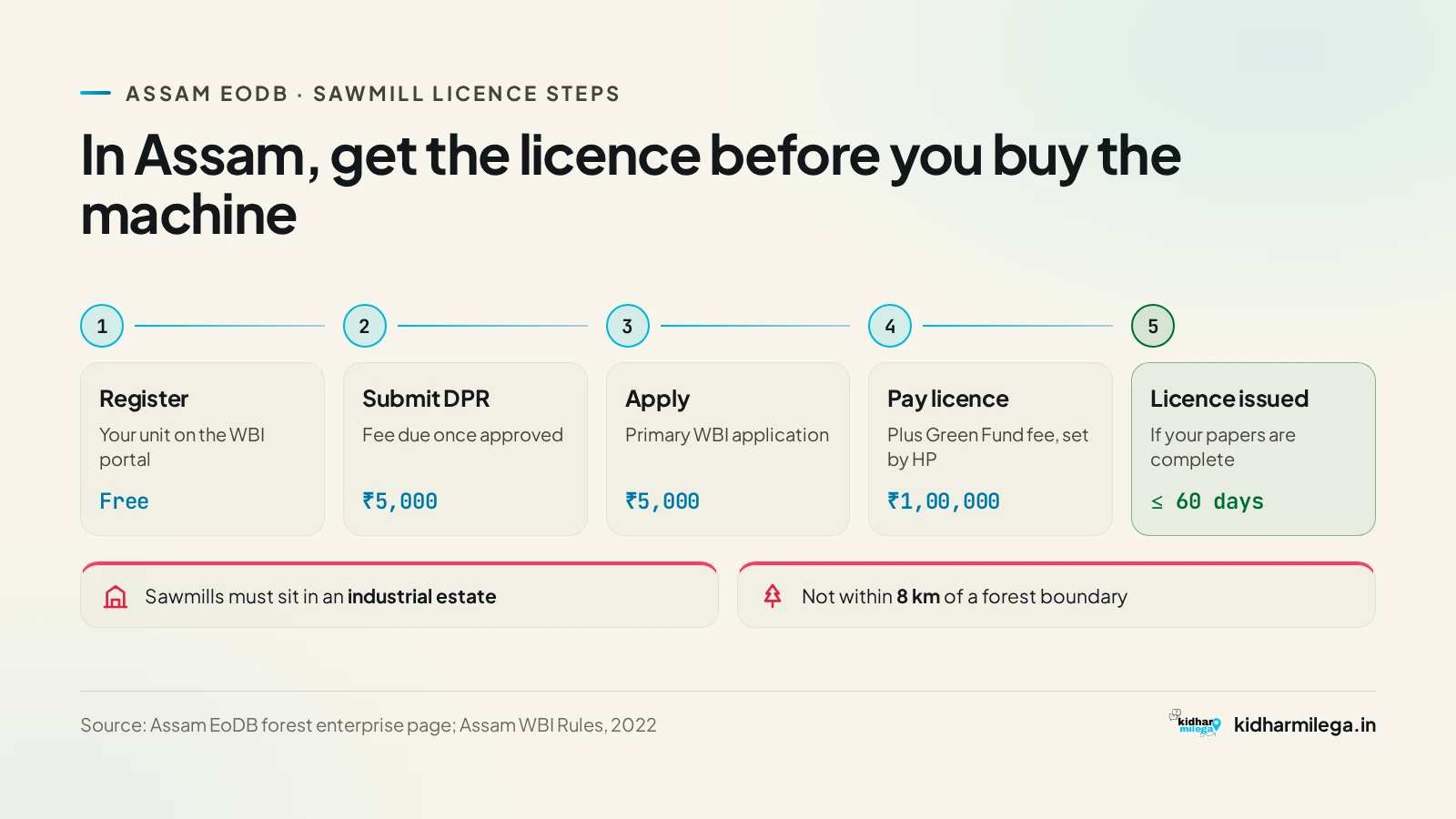
The legal frame is the Assam Wood Based Industries (Promotion and Development) Rules, 2022. The Cabinet approved them on 29 October 2022 and they were notified on 12 January 2023. Units are classed as primary, secondary or composite. A sawmill is a primary unit, and primary and composite units must sit in an industrial estate. No unit can operate within 8 km of a demarcated forest boundary. That rules out the land behind your house in most forest-edge villages.
These are the steps on the Assam EoDB forest enterprise page:
- Register on the Assam WBI portal and add your unit's details.
- Submit a Detailed Project Report (DPR). Once it's approved, pay the DPR fee, which the EoDB page lists as ₹5,000.
- Submit the Primary WBI application and pay the application fee, listed on the EoDB page as ₹5,000 for "sawmill and others".
- Pay the licence fee. The official pages differ here: Sewa Setu lists ₹10,000 for a sawmill, the forest department's how-to page lists ₹500, and some portal pages show ₹1,00,000 plus a Green Fund fee that depends on your HP. One version of the WBI FAQ shows a Green Fund fee of about ₹20,000 for under 20 HP and up to ₹80,000 for over 60 HP. We could not confirm any single figure, so check the portal and ask the forest office in writing before you pay.
- If your documents are complete, the licence should be issued within 60 days.
You can also apply through the Sewa Setu wood-based industry licence page. The office is PCCF & HoFF, Aranya Bhawan, Panjabari, Guwahati 781037. Phone 0361-2730337, email pccf.assam@gmail.com. To report an illegal mill, the forest helpline is 94352-04444.
Documents required (Assam EoDB)
- Sales tax or income tax clearance
- The Detailed Project Report (DPR)
- Self-attested copies of supporting documents, each up to 2 MB
Bigger units may also need forest or environmental clearance through PARIVESH.
Kerala: new rules from February 2026
The Kerala Forest (Regulation of Sawmills and Other Wood-based Industrial Units) Rules, 2026 were issued on 17 February 2026 as SRO No. 195/2026, according to TeamLease RegTech. One group has to act: units that held a local body, factory or SSI licence on or before 30 October 2002 but never got a forest licence. They must apply in Form IA, with notarised copies of those licences. We could not find the fees or the deadline in a public source. Check the gazette text with the Kerala Forest Department before you file. The earlier sawmill rules are still on the department's site for reference.
Every other state: the same five checks
- Visit your Divisional Forest Officer (DFO). Ask whether the State Level Committee is taking new sawmill applications and what location rules apply: industrial estate, distance from forest, and any cap on new units.
- Get your land checked against those rules before you sign a lease.
- Ask your State Pollution Control Board which category it puts saw mills in, and get consent to establish.
- Register on Udyam. It's free and you'll need it for loans.
- Get GST registration on the GST portal. Timber moves on GST invoices and e-Way Bills, and forest officials ask for them during checks.
PMEGP, Mudra and the catch
PMEGP gives a subsidy of 15% to 35% of project cost, and manufacturing projects can go up to ₹50 lakh. On our ₹16.6 lakh mill, a general-category applicant in a rural area (25%) could get about ₹4.15 lakh. Sounds like free money. It isn't, at least not upfront.
- The bank has to sanction your loan first. No bank will sanction a sawmill loan without the forest licence in hand.
- The subsidy sits in a fixed deposit for three years before it adjusts against your loan.
- You put in 10% yourself (5% for special categories). That's ₹1.66 lakh on this project.
- Ask your DIC or KVIC office whether a primary saw mill is eligible in your state before you build the DPR around PMEGP.
You apply on the KVIC PMEGP e-portal. Mudra loans are the other route. Mudra has no subsidy, but it's simpler, and Tarun Plus goes up to ₹20 lakh for borrowers who have repaid an earlier Tarun loan. The scheme finder checks which schemes you actually qualify for by category and district before you spend money on a DPR. Count every loan as an EMI. On a ₹12 lakh loan, that EMI comes out of the ₹47,750 monthly profit.
Checklist: how to judge a sawmill machinery seller
- Frame: ask for the plate or channel thickness in mm and the machine's total weight. A light frame vibrates, and vibration shows up as wavy planks.
- Wheel balancing: ask whether the wheels are dynamically balanced. Watch the machine run empty at full speed. It shouldn't walk or hum.
- Bearings: get the bearing brand in writing on the quote. Unbranded bearings are where sellers save money.
- Demo cut: take your own log, from your own district's most common wood, to the seller's workshop or a running customer's mill. Time a full cut and measure the plank thickness at both ends.
- What's in the price: motor, starter, trolley, rails, blades, foundation drawing, installation, transport, GST. Get each one listed as its own line on the quote.
- Installation and training: who comes, for how many days, and who pays their travel.
- Spare parts and service: where's the nearest spare stock, and how long does a replacement wheel or bearing take to reach you.
- Warranty: get it in writing. Note what it covers (frame, motor, wheels) and what it leaves out (blades, belts).
- References: ask for two buyers within 200 km and call them yourself.
- Legal paperwork: a proper GST invoice with the machine's serial number and HP. You'll need it for the licence and for forest inspections.
New vs used, Indian vs Chinese
Used machines save 30 to 50% on paper. A used bandsaw is fine if the wheels have no cracks, the bearings have no play and the frame is straight. The real risk is legal. A saw bought from a mill that was shut in a crackdown can count as "unauthorised machinery" on your premises. Buy used only with the original invoice, and only after your own licence names that HP.
Indian-made frames from established workshops are easier to service. Spares come by bus, not by container. Chinese imports can look cheaper and better finished. But you pay import duty and GST on top, wait weeks for spares, and often have nobody local to service them. For a first small mill, local service beats a shiny frame. JAK Machinery's own trade-show record (DelhiWood 2025, IndiaWood 2024, MumbaiWood 2024) shows how most Indian buyers find makers: at expos. IndiaWood is held every two years, and the last one ran in Bengaluru from 26 February to 2 March 2026.
Is JAK Machinery a sawmill maker?
Not in the log-breakdown sense. JAK Machinery is a CNC woodworking machine maker from Surat, founded in 2015. It says it has "300+ customers." It sells CNC routers, CNC wood lathes (2 to 5 axis), 5-axis machines and CNC tenon and mortise machines.
Its CNC Mill Band Saw (Autofeed) is a 15 kW, 3-phase, 1,500 kg machine that takes wood up to 48 × 20 inches and 4 inches thick. There is no listed price; you ask for a quote. JAK calls itself "India's one and only manufacturer" of this machine. That's the company's own claim, and we couldn't confirm it. With a 4-inch thickness limit, it works as a board resaw for already-sawn timber, not as the main saw for whole logs. Note its 15 kW draw when you plan your power connection.
Contact: Plot 35, Himson Mill Compound, Bldg A, Hiralal Colony, A K Road, Surat 395008. Phone and WhatsApp +91 6353531460, email info@jakmachinery.com.
A word of caution. jakmachinery.co.in is an IndiaMART-hosted page with a Sarthana address and a 2014 founding date, and another profile claims "5000+ clients." These figures don't match the official site. jakindia.com is a different website and may not be related. Confirm the GST number and address on your invoice before you pay any advance.
Where JAK-type machines fit: a CNC router or board resaw makes sense once you own sawn timber and want to sell finished furniture parts or carving. That's the step after a sawmill, not instead of one.
Wrong way vs right way
Wrong way: see a reel, pay an advance on a 42-inch bandsaw, rent a shed near the forest, then go to the DFO.
Right way: go to the DFO first. Check whether new licences are open and where you're allowed to set up. Count the logs coming into your nearest timber mandi for two weeks. Talk to 10 furniture units, contractors and farmers about what they pay local mills for cutting. Get the licence approved. Only then buy a machine sized to those logs.
Toh karna chahiye ya nahi?
Do it if: your district has steady plantation timber (rubber wood, eucalyptus, mango, poplar), your state is actually issuing new licences, you can get land in a permitted industrial area, and you have ₹15 to 17 lakh available, either as savings or as savings plus a loan. People with a furniture, packing-case or construction-contracting network nearby start with buyers already in hand.
Skip it if: your only plan is forest timber, your state isn't taking applications, or you can't get 200 CFT a day of work lined up. Skip it too if what you really want is furniture. In that case, buy sawn wood from an existing mill and put your money into finishing.
Wood-based ODOP districts are worth a look because their buyers already exist. Think of Sankheda furniture in Chhota Udaipur, Udayagiri wooden cutlery in Nellore, Etikoppaka lacquerware toys in Anakapalli and Kondapalli toys near Vijayawada. A re-saw that cuts clean blanks for these clusters is a niche nobody else is filling. Bheed ka hissa nahi, kissa bano.
Your first steps, close to home
- Call or visit your DFO and ask one question: is the State Level Committee taking new sawmill applications, and where are units allowed to set up?
- Spend two mornings at your nearest timber depot. Note the wood type, the girth and the number of logs.
- Call three mills in your district and write down their per-CFT job-work rate.
- Put those numbers into the payback calculator on this page.
If you already cut timber or make blanks for a craft cluster, a free KidharMilega Online profile lists your catalogue and enquiry form on your district's page, so furniture and craft buyers can find you. Still deciding whether a sawmill is right for you? The 3-minute quiz on the KidharMilega homepage matches ideas to your budget and district.
Frequently asked questions
What is the price of sawmill machinery in India?
On seller listings, a chainsaw mill is about ₹9,000, a table or rip saw ₹55,000 to ₹70,000, and a vertical bandsaw ₹1.3 to 1.6 lakh, with IndiaMART listings running from ₹53,900 to ₹2,10,000. Plant-scale setups are about ₹8 to 8.5 lakh. These are asking prices. Ask whether the motor, blades, trolley, installation and GST are included.
Do I need a licence to start a sawmill in India?
Yes. Every state requires a forest department licence for a sawmill, and since the Supreme Court's 1996 Godavarman order, new units are decided by a State Level Committee. States also set location rules. Assam, for example, requires primary units to be in an industrial estate and at least 8 km from a demarcated forest boundary.
How much electricity load does a small sawmill need?
A small mill with a 20 HP main bandsaw, a 10 HP re-saw and a 3 HP sharpener has about 33 HP of connected load. At 0.746 kW per HP, that's roughly 25 kW, so you need a 3-phase industrial connection. Apply to your DISCOM early, because the connection can take longer than the machine delivery.
How much space is needed for a sawmill?
Our worked example budgets about 2,000 sq ft of covered shed for the main bandsaw, re-saw and sharpening, plus open yard space for logs and sawn stock. The location matters more than the size. Many states only allow sawmills in permitted industrial areas, and away from forest boundaries.
What is the Assam sawmill licence fee?
Official pages don't agree. The Assam EoDB page lists ₹5,000 for the DPR and ₹5,000 for the application. Sewa Setu shows ₹10,000 for a sawmill, the forest department page ₹500, and some portal pages show ₹1,00,000 plus an HP-based Green Fund fee. The licence should be issued within 60 days if documents are complete. Confirm the fee on the WBI portal first.
Does JAK Machinery make sawmills?
Not log sawmills. JAK Machinery, based in Surat, makes CNC routers, CNC wood lathes, 5-axis and tenon machines. Its CNC Mill Band Saw is a 15 kW board resaw that takes wood up to 4 inches thick, sold on quote. Its official site is jakmachinery.com. Other profiles under similar names show different founding years and client numbers, so verify before you pay.
Sources
- Application for Grant of License for Wood Based Industry · Government of Assam, Sewa Setu
- Assam WBI portal FAQ · Government of Assam, Environment & Forest Department
- Grant of licence for wood based industry · Assam Environment & Forest Department
- Kerala sawmill rules (gazette) · Kerala Forest Department
- Assam launches statewide crackdown on illegal sawmills · ANI
- Assam government's plan to reopen sawmills sparks environmental concerns · The Sentinel Assam
- After 30-year Supreme Court ban, Assam's sawmills set to reopen, but will the trees survive? · Borderlens
- Kerala Forest (Regulation of Sawmills and Other Wood-based Industrial Units) Rules, 2026 · TeamLease RegTech