
Short answer: For 100 or more export-quality knit T-shirts with custom colours and your own label, go to a Tirupur T-shirt manufacturer. Listed MOQs start at about 100 pieces per style, and one Tirupur listing shows a 220 GSM plain cotton round-neck at ₹120 a piece. To test 10 to 50 printed pieces quickly, a T-shirt manufacturer or wholesaler in Delhi's Gandhi Nagar market is the cheaper first step. Listed MOQs there go as low as 10 pieces, and printed tees start at about ₹100.
T-shirt landed cost calculator
Enter your factory quote to see total cash out, landed cost per piece and how many pieces you must sell to get your money back.
Goods value before GST —
GST on goods —
Total cash out —
Landed cost per piece —
Landed cost per piece if you claim GST input credit —
Pieces to sell to recover total cash out —
GST is 5% on apparel priced up to ₹2,500 per piece; check the current rate on cbic-gst.gov.in. The payback count ignores marketplace fees, ads, returns and GST on your own sales.
Every price in this post is the seller's own directory figure, not a verified rate. Use it to check whether a quote is in the right range. Don't treat it as the price you'll pay.
Key facts before you call any factory
- Tirupur MOQ: usually about 100 pieces per style. With custom colours, the dye lot sets the minimum, not the sewing line.
- Delhi MOQ: Gandhi Nagar wholesalers in East Delhi list MOQs as low as 10 pieces.
- Listed prices: Tirupur 220 GSM plain cotton round-neck, ₹120 per piece (IndiaMART listing). Delhi printed tees from about ₹100, other styles ₹185 to ₹250 (directory listings).
- Price trend: On 2 November 2026, DT Next reported that Tirupur garment prices had risen 10 to 15%. Polyester yarn went from ₹190 to ₹280 per kg in a year.
- Cluster size: Tirupur makes about 60% of India's knitwear exports and about 90% of its cotton knitwear exports, from more than 20,000 units with over 6 lakh direct workers, according to a Rubix Data Sciences report reported on 23 November 2026.
- HSN code: 6109 covers knitted T-shirts and vests. 6109 10 is cotton. Polos come under 6105.
- GST: 5% on apparel priced up to ₹2,500 a piece, 18% above that, effective 22 September 2025 (Notification 9/2025-Central Tax (Rate)). Check the current rate on CBIC before you invoice.
- Getting there: Coimbatore airport is about 55 km from Tirupur. Tuticorin port is about 333 km and Chennai about 500 km.
Tirupur T shirt manufacturer vs T-shirt manufacturer in Delhi: side by side
Mera ek dost bolta hai, "Tirupur se lo, wahan sab sasta hai." He's half right. Tirupur's per-piece cost is lower at volume, but volume is the catch. If you're a first-time founder with ₹2.5 lakh, the bigger question is how much cash you want sitting in unsold stock.
| Factor | Tirupur (Tamil Nadu) | Delhi (Gandhi Nagar, East Delhi) |
|---|---|---|
| Typical listed MOQ | About 100 pcs per style. Export-focused units ask 1,000+ | As low as 10 pcs |
| Listed starting price | ₹120 for 220 GSM plain cotton round-neck (one listing) | About ₹100 printed; ₹185 to ₹250 for others |
| Strength | Knit fabric, dyeing, export-grade finishing, private label at scale | Small lots, fast wholesale, ready printed stock |
| Custom colour | Yes, but the dye lot sets the minimum | Mostly stock colours |
| Certifications on offer | GOTS, OEKO-TEX, WRAP, BSCI at many export units | Less common at the wholesale level |
| Best for | D2C brands past the test stage, corporate bulk, export buyers | First test batch, event merch, resellers |
This split is how the trade usually describes the two clusters. It isn't backed by an official survey, so check it against the quotes you actually get.
If you're nearer to North India, look at your own region first. KidharMilega maps readymade garments as Shahdara's ODOP (Gandhi Nagar is there) and textiles and apparel in Gurugram. A supplier four hours away by road is easier to visit than one 2,000 km away.
What decides the price of one T-shirt
A factory quote bundles five things into one number. If you don't split them out, you can't compare two quotes.
| Cost driver | What changes | What to ask for in the quote |
|---|---|---|
| GSM (fabric weight) | 160 GSM is light, for promos and events. 180 GSM is the everyday standard. 220 to 240 GSM is heavy, for oversized and streetwear. More GSM means more yarn per shirt. | GSM after washing, and an agreed tolerance |
| Yarn and fabric | Carded cotton is cheapest. Combed and compact cotton are smoother. Supima, Suvin, organic cotton, bamboo and modal are premium. | Yarn count, and whether it's 100% cotton or a blend, in writing |
| Dyeing | Stock colours are cheaper. A custom Pantone shade needs its own dye lot. | Minimum kg or pieces per colour |
| Print or embroidery | Screen print is cheapest at volume, but each colour needs a screen. DTF suits small runs with many colours. Embroidery is priced by stitch count. Puff print costs more than flat print. | Price per piece, plus any one-time screen or setup charge |
| Trims and packing | Neck labels, wash-care labels, hang tags, polybags, cartons | Priced as a separate line |
Rate list nahi, quote lo. A ₹120 headline price can turn into ₹160 once labels, screens and polybags are added. Get the quote broken into these five lines.
The napkin math: 300 pieces from Tirupur, landed in your city
Here's a full example. The blank price uses the ₹120 Tirupur listing, which is for 220 GSM, so it's on the high side for 180 GSM. The other figures are assumptions for illustration. Swap in your own quote line by line.
| Line | Working | Amount |
|---|---|---|
| Blank tee, 180 GSM combed cotton | 300 × ₹120 | ₹36,000 |
| 2-colour screen print, front (assumed) | 300 × ₹25 | ₹7,500 |
| Neck label, wash-care label, polybag (assumed) | 300 × ₹8 | ₹2,400 |
| Goods value | ₹45,900 | |
| GST at 5% | ₹45,900 × 5% | ₹2,295 |
| Paid sample (assumed) | One-time | ₹1,500 |
| Courier to Delhi or Mumbai (assumed) | Cartons, door to door | ₹3,000 |
| Total cash out | ₹52,695 | |
| Landed cost per piece | ₹52,695 ÷ 300 | about ₹176 |
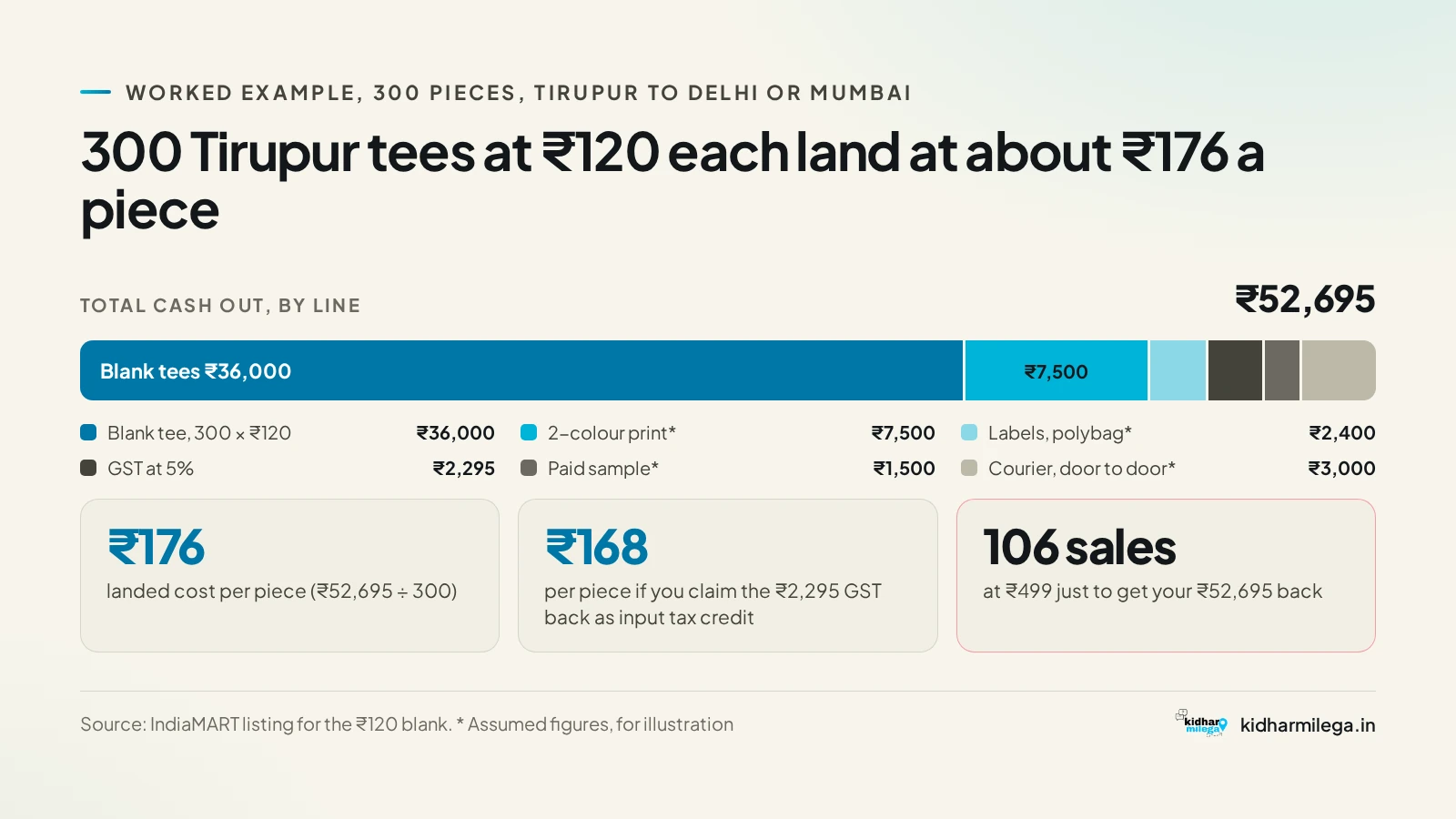
If you're GST-registered and selling under your own GSTIN, you can usually claim the ₹2,295 back as input tax credit. That brings your effective cost to ₹50,400, or ₹168 a piece.
Now the part reels skip. If you sell at ₹499, you need about 106 sales just to get your ₹52,695 back. That's before marketplace fees, ads, returns and GST on your own sales. The other 194 pieces are where any profit comes from, but only if they sell.
The same test from Delhi
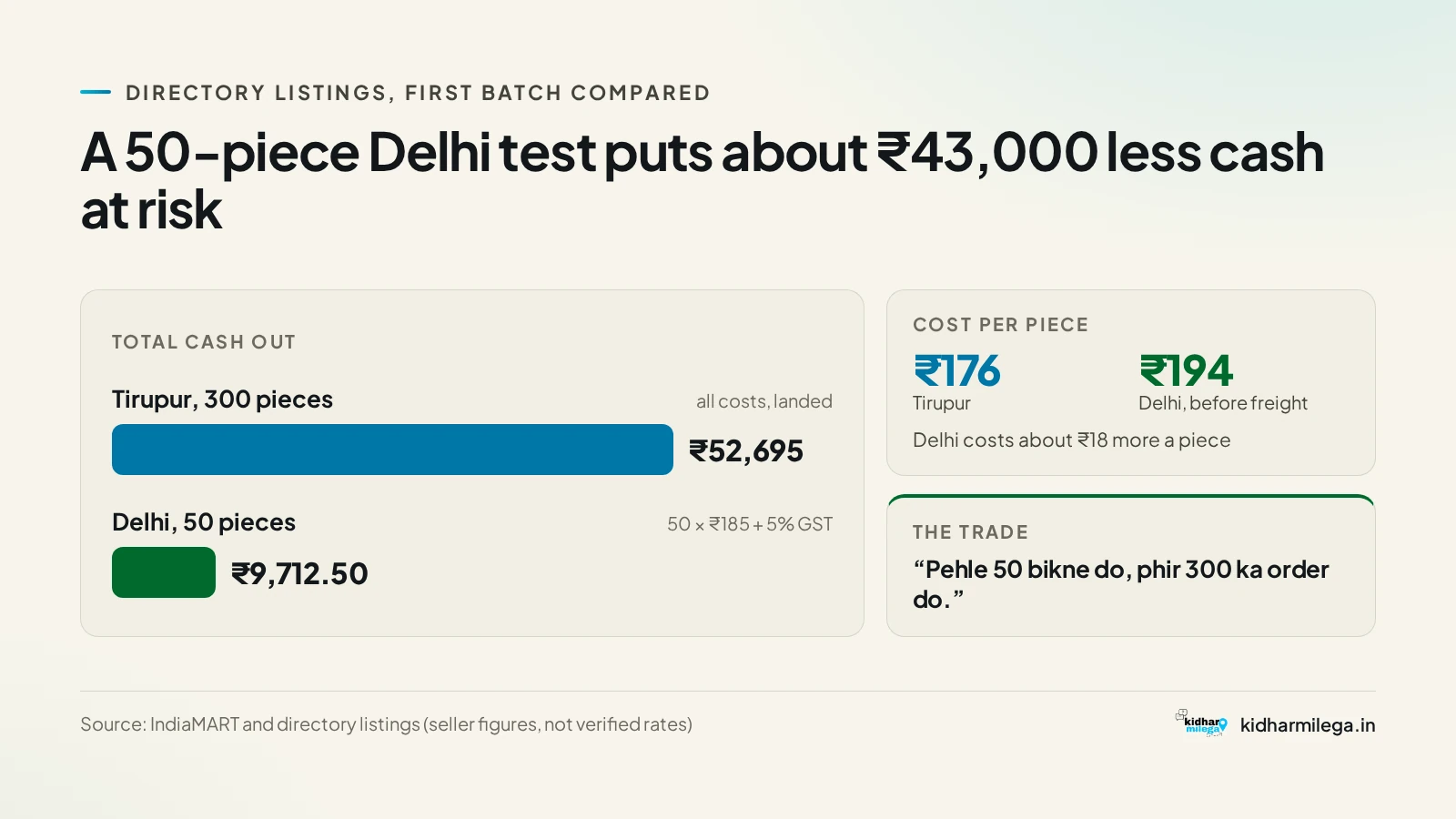
Now take 50 pieces from a Gandhi Nagar wholesaler at the low end of the listed ₹185 to ₹250 range:
- 50 × ₹185 = ₹9,250
- GST at 5% = ₹462.50
- Total: ₹9,712.50, about ₹194 a piece before freight
Each piece costs about ₹18 more than the Tirupur run, but you risk about ₹43,000 less cash. For a first batch that's a good trade. Pehle 50 bikne do, phir 300 ka order do.
What sellers claim about themselves: MOQ, price and lead time
Most pages ranking for "tirupur t shirt manufacturer" are written by a single seller about itself. Here are their public claims next to each other. KidharMilega has not verified or audited any of these sellers. Treat the table as a list of questions to ask, not a recommendation.
| Seller or listing | Claimed MOQ | Claimed price | Claimed lead time |
|---|---|---|---|
| Offnorth | 22 pcs | Quote on request | Not stated |
| Tirupur Hub | 1,000 pcs per style | Quote on request | 45 to 60 days |
| Ramsay | Not stated | US$4 to 8 per piece | Not stated |
| Tirupur IndiaMART listing (220 GSM round-neck) | Around 100 pcs, typical for the cluster | ₹120 per piece | Not stated |
| Gandhi Nagar, Delhi wholesalers | From 10 pcs | From about ₹100 printed | Often ready stock |
The MOQs run from 22 pieces to 1,000 pieces, which tells you they're different kinds of businesses. Low-MOQ sellers usually cut and print on fabric they already have. Export units dye fabric to your order. Neither is better. Each suits a different buyer.
To find makers by city and product, use the free supplier finder. Then run every name through the checklist below.
Which kind of maker fits you
Startup brand, 50 to 300 pieces
Look for a low-MOQ unit that prints in-house, or a Delhi wholesaler for the first batch. Ask for stock colours so you don't hit the dye-lot minimum. DTF printing suits multi-colour designs in small quantities.
Corporate, school or event order
You care about the deadline and consistent sizing more than fabric quality. A 160 to 180 GSM tee with one-colour screen printing is the usual spec. Put the delivery date in writing with a penalty for late delivery, because an event date can't move.
Private label, 1,000+ pieces
This is where Tirupur is strongest. You get custom dyeing, your own labels, GSM to your spec and certificates such as GOTS or OEKO-TEX if you need them. Lead times vary a lot. One export-focused seller quotes 45 to 60 days, while the November 2026 Rubix Data Sciences report puts typical cluster turnaround at 21 to 28 days. Ask which one applies to your order, and get it in writing.
Reseller who wants ready stock
Wholesale hosiery markets such as Khaderpet in Tirupur and Gandhi Nagar in Delhi sell ready stock, surplus and export rejects. Margins come from buying well, not from manufacturing. Check every carton, because sizes and shades get mixed in surplus lots.
How a private-label order actually runs
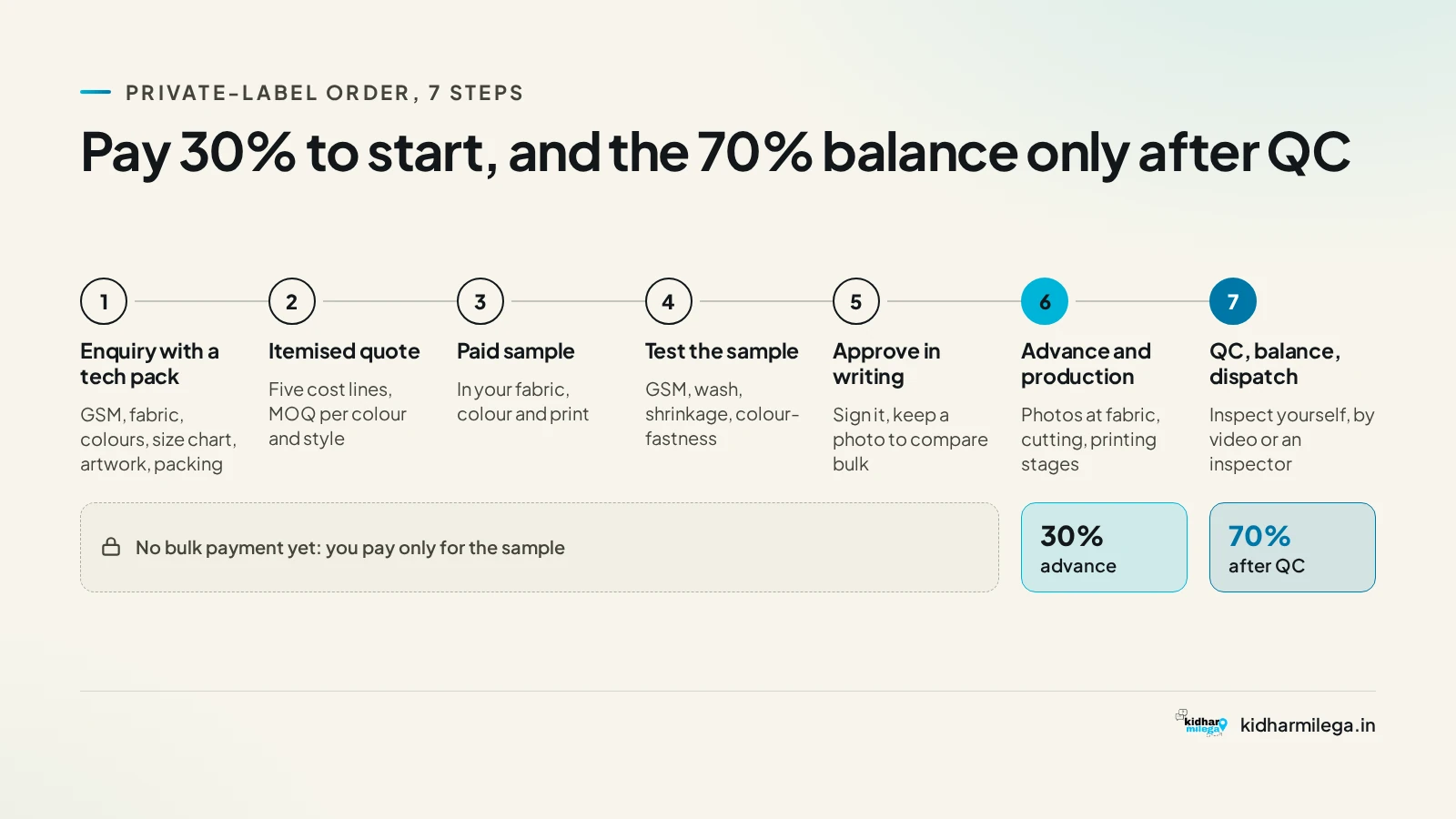
- Enquiry with a tech pack. Send GSM, fabric, colours, size chart, print artwork with sizes in cm, labels and packing. A vague enquiry gets a vague quote.
- Itemised quote. Ask for the five lines above, plus MOQ per colour and per style.
- Paid sample. Pay for one sample in your fabric, colour and print. A free sample from their stock proves nothing about your order.
- Test the sample. Check the GSM, wash it, measure shrinkage and check that the colour holds. See the checklist below.
- Approve in writing. Sign the sample and keep a photo. This approved sample is what you'll compare the bulk order against.
- Advance and production. Pay about 30% to start. Ask for photos at the fabric, cutting and printing stages.
- QC, balance, dispatch. Inspect the goods yourself, through a video call or through a local inspector. Pay the 70% balance only after that.
For small domestic runs, no seller page publishes a reliable timeline. Get three dates in writing: sample ready, bulk start and dispatch. If the factory won't commit to dates, it won't commit to quality either.
Checklist: vetting a Tirupur T-shirt manufacturer before you pay
- GSTIN check: Enter their GST number in "Search Taxpayer" on the GST portal. The legal name, address and status should match the invoice.
- Udyam check: If they say they're an MSME, check the Udyam number on the Udyam Registration portal.
- IEC for exporters: If they claim export experience, they need an Importer Exporter Code, which is issued by DGFT.
- Factory visit or live video call: Ask them to walk you through the cutting, stitching and printing floors on a live call. A photo album doesn't count.
- Paid sample before any bulk payment.
- GSM check: Cut a 10 cm × 10 cm swatch and weigh it. Grams × 100 = GSM. Agree a tolerance in writing, for example ±5%.
- Shrinkage test: Measure the sample, wash and dry it the way a customer would, then measure again. Agree the maximum shrinkage in the contract.
- Colour-fastness: Wash a dark sample with a white cloth. If the colour bleeds, it'll bleed on your customer too.
- Certificates: If they claim GOTS or OEKO-TEX, ask for the certificate number and check it with the certifier. GOTS has a public database at global-standard.org.
- Labour compliance: On 9 October 2026, 13 workers, four of them children, were rescued from a Tiruppur unit. Ask about WRAP or BSCI audits, especially if your buyers are abroad.
- Payment terms: 30% advance, 70% after QC. Don't pay 100% upfront on a first order.
- Penalty clause: Agree a fixed deduction per day or week of delay, in writing.
The catch: red flags and common scams
- GSM drops in bulk. The sample was 180 and the bulk is 160. You only find out if you weigh it.
- Poly blend sold as 100% cotton. Burn a thread from the seam allowance. Cotton burns like paper and leaves soft grey ash. Polyester melts into a hard bead.
- Size-chart drift. The M in bulk is 2 cm shorter than the M in the sample. Measure 5 pieces per size from each carton.
- MOQ goes up at the last minute. "Sir, your colour needs 500 pieces, not 100." Get the MOQ per colour written into the quote before you pay any advance.
- A price that's too low. With yarn up sharply in 2026, a quote far below the cluster's range usually means cheaper fabric or lower GSM.
- Hidden extras. Screen charges, packing and freight that show up after you've approved the sample.
Sample sasta hai, galti mehengi.
Wrong way vs right way
Wrong way: You fall for an oversized drop-shoulder reel, order 500 pieces in four custom colours from the first factory that replies, pay 100% upfront and start thinking about marketing after the cartons arrive.
Right way: Buy 50 pieces from Delhi or a low-MOQ Tirupur unit. Sell them to your own network, at a local stall or on one marketplace. Note which size and colour sold first. Then order 300 from Tirupur in those two colours, with a paid sample and a written contract.
What changed for Tirupur in 2026, and why it matters to you
Even if you only sell in India, export news changes what factories will offer you.
- US duty: In 2025, the 50% US tariff cut orders by 60 to 70%, according to reports from the cluster. A US Supreme Court ruling on 20 February 2026 reportedly ended those reciprocal tariffs. A temporary 10% surcharge followed, and on 23 July 2026 USTR finalised a 10% Section 301 duty on Indian goods for entries from 24 July 2026 (PIB release). No India–US trade deal has been signed, and apparel doesn't appear to be on the exempt list. One manufacturer's blog puts the total US duty on cotton T-shirts (HTS 6109.10.00) at about 26.5%. That's an unofficial figure, so check it on the USITC tariff schedule.
- UK deal: The India–UK trade agreement took effect on 15 July 2026, giving 99% of Indian exports duty-free access to the UK. That helps if you plan to sell to UK buyers.
- EU deal: Zero duty on textiles and apparel (currently up to 12%) is agreed under the India–EU FTA, but it is not in force yet. The European Commission sent it to the EU Council on 11 September 2026.
- A record export figure, with a caveat. A Rubix Data Sciences report, carried by ANI on 23 November 2026 and Apparel Resources on 24 November, puts Tiruppur's FY26 knitwear exports at a record ₹46,000 crore, up about 3% from ₹44,750 crore in FY25. The EU and US take about 70%. Not every figure agrees: the Tiruppur Exporters' Association president, quoted by Apparel Resources on 6 June 2026, put FY26 exports at ₹42,544.40 crore, down 4.91%. The cluster's target is ₹1 lakh crore by 2030.
- Costs and prices are up. The same Rubix report says production costs were up as much as 15% by end-September 2026, mainly from cotton yarn, and the cluster is short of about 20% of the labour it needs. DT Next (2 November 2026) reported garment prices up 10 to 15%, with polyester and sportswear up 15 to 20% in four months.
Here's my read, and it isn't a sourced fact: when export orders slow, some units become more open to domestic brand orders. That can mean better MOQs for you. Ask, and don't assume.
For official cluster information, contact the Tiruppur Exporters' Association: 62, Appachi Nagar Main Road, Kongu Nagar, Tirupur 641 607, phone +91-421-2220500.
HSN code and GST for T-shirts
Your invoice and your marketplace listing both need the right HSN code. Knitted cotton T-shirts are 6109 10. Other fibres are 6109 90. Knitted polos are under 6105. GST is 5% up to ₹2,500 per piece and 18% above it, per the GST Council's September 2025 decision. Some lookup sites still show a flat 5% or a flat 18%, and both are wrong. Confirm the full 8-digit code with the HSN code finder. If you plan to export, start from the HSN code pages, which show the codes, India's exports and buyers abroad.
A wrong code means the wrong GST rate, and that mistake adds up over every invoice. This wrong HSN code GST cost calculator shows what it can cost you.
Bhaiya's take: Tirupur ya Delhi, toh karna kya hai?
Go to Tirupur if you've already sold at least 50 to 100 pieces, you know your best size and colour, and you can put ₹50,000 or more into one style without needing it back next month.
Start in Delhi if this is your first batch, you're still testing designs, or you need event stock within days.
Skip both for now if you have no idea who your first 50 buyers are. A cheap T-shirt doesn't make a brand. Your first 50 buyers do.
Your next step, before you place any order
- Write a one-page tech pack: GSM, fabric, two colours, size chart and print size.
- Get itemised quotes from three makers, at least one in Tirupur and one in Delhi. Use the supplier finder to build your list.
- Put each quote into the landed cost table above and compare the per-piece price and the total cash out.
- Order one paid sample and run the checklist on it.
If you make or print T-shirts yourself, a free KidharMilega Online profile gives you a catalogue and an enquiry form, listed on your district's page, so buyers can find you directly. To see what else your district already makes, browse all 787 district products. If you're still not sure T-shirts are the right business for you, start from the KidharMilega homepage.
Frequently asked questions
What is the MOQ for a T-shirt manufacturer in Tirupur?
Most Tirupur units start at about 100 pieces per style. With custom colours, the dye lot sets the minimum, so a special shade can push it higher. Export-focused units such as Tirupur Hub ask for 1,000 pieces per style. A few low-MOQ sellers claim orders from about 22 pieces, usually in stock fabric and colours.
How much does one T-shirt cost from Tirupur?
One Tirupur listing shows a 220 GSM plain cotton round-neck at ₹120 a piece. Seller prices are self-reported and rose 10 to 15% in late 2026. Printing, labels, packing, 5% GST and freight come on top. In a 300-piece example, these extras took a ₹120 blank to about ₹176 landed per piece.
Is Delhi or Tirupur better for starting a T-shirt brand?
Start in Delhi if this is your first batch. Gandhi Nagar wholesalers list MOQs from 10 pieces, so a test costs around ₹10,000 instead of ₹50,000. Move to Tirupur once you know which sizes and colours sell. Tirupur is stronger for custom dyeing, private label, higher GSM and certificates like GOTS.
What is the HSN code and GST rate for cotton T-shirts?
Knitted cotton T-shirts fall under HSN 6109 10, other fibres under 6109 90, and knitted polos under 6105. GST is 5% on apparel priced up to ₹2,500 per piece and 18% above that, effective 22 September 2025. Confirm the full 8-digit code and current rate on the CBIC GST rates site before invoicing.
How do I check if a T-shirt manufacturer is genuine?
Verify their GSTIN on the GST portal and their Udyam number on the Udyam portal. Ask for a live video walkthrough of the factory. Pay for a sample in your own fabric and colour, then weigh it to check GSM and wash it to test shrinkage. Pay 30% upfront and the rest only after QC.
How do I check the GSM of a T-shirt myself?
Cut a 10 cm by 10 cm square from the fabric and weigh it on a kitchen scale that reads in grams. Multiply the weight by 100 to get GSM, so 1.8 grams means 180 GSM. Do this for both the approved sample and a few bulk pieces, and agree a tolerance in writing before production starts.
Sources
- GST rates on goods and services · CBIC
- GST Council press release, September 2025 · GST Council / PIB
- India's knitwear capital Tiruppur records highest-ever knitwear exports of Rs 46,000 cr in FY26 · The Tribune
- India's knitwear capital 'Tiruppur' records highest-ever knitwear exports of Rs 46,000 cr in FY26 · ANI
- Tirupur knitwear exports grow 3% to record Rs 46,000 crore in FY26 · Apparel Resources
- Global unrest: Tirupur's garment woes spill over · DT Next
- CBIC issues GST rate notification, new GST rates effective from 22 September 2025 · Taxscan
- T-shirts, Tirupur · IndiaMART