
Every AAC block has the same face, 600 × 200 mm (24 × 8 inch). Only the thickness changes, from 75 mm to 250 mm (3 to 10 inch). As of 25 November 2026, AAC blocks cost about ₹3,200 to ₹4,800 per cubic metre including GST in Delhi NCR. That works out to roughly ₹38 to ₹58 for a 4 inch block, ₹58 to ₹86 for a 6 inch block and ₹77 to ₹115 for an 8 inch block. For South India, the brand dealer rates we found were NCL at ₹76 per 6 inch block in Hyderabad and Maxlite at ₹98 per 6 inch block in Ernakulam.
Key facts
- Standard: IS 2185 (Part 3). Face size is 600 × 200 mm.
- Thicknesses: 75, 100, 125, 150, 200, 225 and 250 mm. NCL makes 100, 150, 200 and 225 mm.
- Density: 550 to 650 kg/m³. That is about one-third the weight of red brick, which is 1,600 to 1,800 kg/m³.
- Price range: ₹3,200 to ₹4,800 per m³ including GST in Delhi NCR (HeadsUp B2B, 23 October 2026). Ex-works rates start at ₹2,950 per m³ (Instablock, Panipat, on OfBusiness).
- Per-piece formula: price per m³ ÷ blocks per m³. A 6 inch block is 0.018 m³, so about 55.5 blocks make one m³.
- GST: 12% for AAC blocks with more than 50% fly ash (HSN 6815). Otherwise 18% (HSN 6810).
- Maxlite: based in Bengaluru, with plants in Karnataka and Tamil Nadu. Magicrete has owned a majority stake since March 2024.
- NCL: made by NCL Buildtek Ltd in Telangana, part of the NCL Industries cement group.
- Market mood: BigBloc, a listed AAC maker, reported its highest-ever monthly turnover and volume in October 2026. It also flagged higher lime and coal costs. Don't expect prices to drop during the 2026-27 building season.
AAC blocks sizes and prices: the full table by thickness
Dealers quote per cubic metre. Your mistri counts blocks. Saara confusion yahin se shuru hota hai.
The conversion is simple. One block's volume is 0.6 m × 0.2 m × the thickness. Divide 1 by that volume and you get the number of blocks per m³. Then divide the per-m³ rate by the blocks per m³ to get the price of one piece.
Example: a dealer quotes ₹3,800 per m³ for 6 inch blocks. 3,800 ÷ 55.5 = ₹68 per block.
| Inch | Size (mm) | Volume per block | Blocks per m³ | Approx. weight | ₹ per piece (at ₹3,200 to ₹4,800/m³) | ₹ per sq ft of wall, blocks only |
|---|---|---|---|---|---|---|
| 3" | 600×200×75 | 0.009 m³ | 111 | 5 to 6 kg | ₹29 to ₹43 | ₹22 to ₹33 |
| 4" | 600×200×100 | 0.012 m³ | 83 | 6.5 to 8 kg | ₹38 to ₹58 | ₹30 to ₹45 |
| 5" | 600×200×125 | 0.015 m³ | 67 | 8 to 10 kg* | ₹48 to ₹72 | ₹37 to ₹56 |
| 6" | 600×200×150 | 0.018 m³ | 55.5 | 8 to 12 kg | ₹58 to ₹86 | ₹45 to ₹67 |
| 8" | 600×200×200 | 0.024 m³ | 42 | 13 to 16 kg | ₹77 to ₹115 | ₹59 to ₹89 |
| 9" | 600×200×225 | 0.027 m³ | 37 | 15 to 20 kg | ₹86 to ₹130 | ₹67 to ₹100 |
| 10" | 600×200×250 | 0.030 m³ | 33 | 17 to 20 kg* | ₹96 to ₹144 | ₹74 to ₹111 |
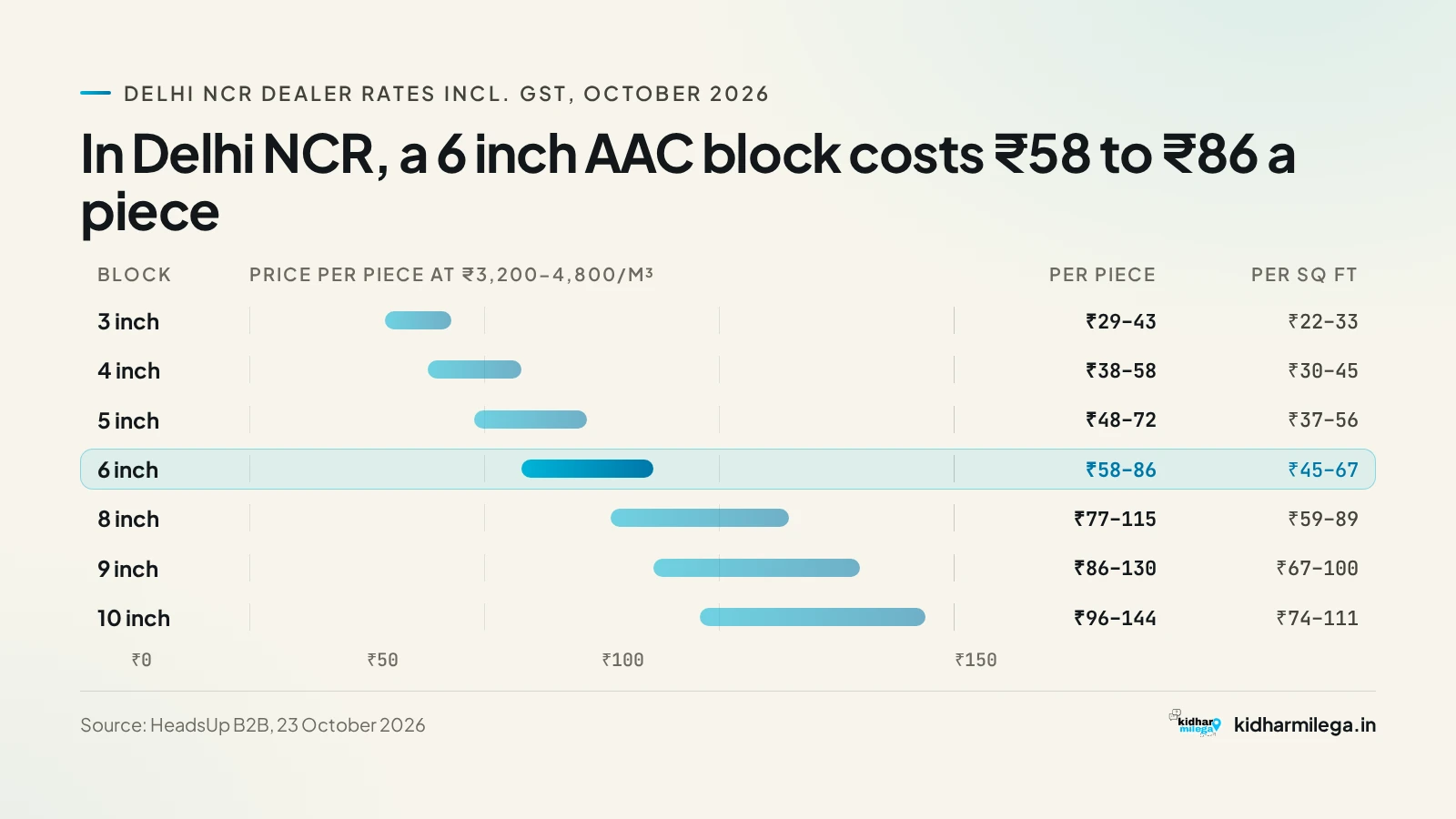
The per-piece range uses the Delhi NCR band of ₹3,200 to ₹4,800 per m³ including GST (HeadsUp B2B, October 2026). Weights marked * are worked out from dry density. Delivered blocks carry some moisture and weigh more. Some dealers sell the 9 inch block as 230 mm, which is about 36 blocks per m³.
How to read the "per sq ft of wall" column
Each block covers 0.12 m² of wall face, which is 1.29 sq ft. So a 100 sq ft wall needs about 78 blocks of any thickness, before wastage. Thickness only changes how much AAC goes into that wall. Price per sq ft of wall = rate per m³ × thickness in metres ÷ 10.764.
Searching "6 inch block ka rate"? At a mid-market ₹3,800 per m³ including GST, a 6 inch wall costs about ₹53 per sq ft in blocks alone. The 4 inch wall costs ₹35 and the 8 inch wall costs ₹71. Adhesive, plaster and labour come on top.
Which thickness for which wall
- 3 inch (75 mm): shafts, duct walls and light inner screens. Not for rooms.
- 4 inch (100 mm): internal partitions, bathroom and kitchen walls inside a flat.
- 6 inch (150 mm): partitions between rooms that need more sound cut, and some external infill.
- 8 to 9 inch (200 to 225 mm): external walls in an RCC frame. AAC can carry load only in low-rise buildings, up to G+1 or G+2, and only when a structural engineer signs off.
IS 2185 sets a minimum compressive strength of 3 N/mm². Most blocks on the market in 2026 test at 3.5 to 5. NCL's published spec is above 4 MPa. NCL also tells builders to add a lintel band every 5 to 6 courses, or every 6 m of wall length, to stop cracks. Most hairline cracks blamed on "bad AAC" come from skipping this band.
Maxlite AAC blocks vs NCL AAC blocks, and the other brands
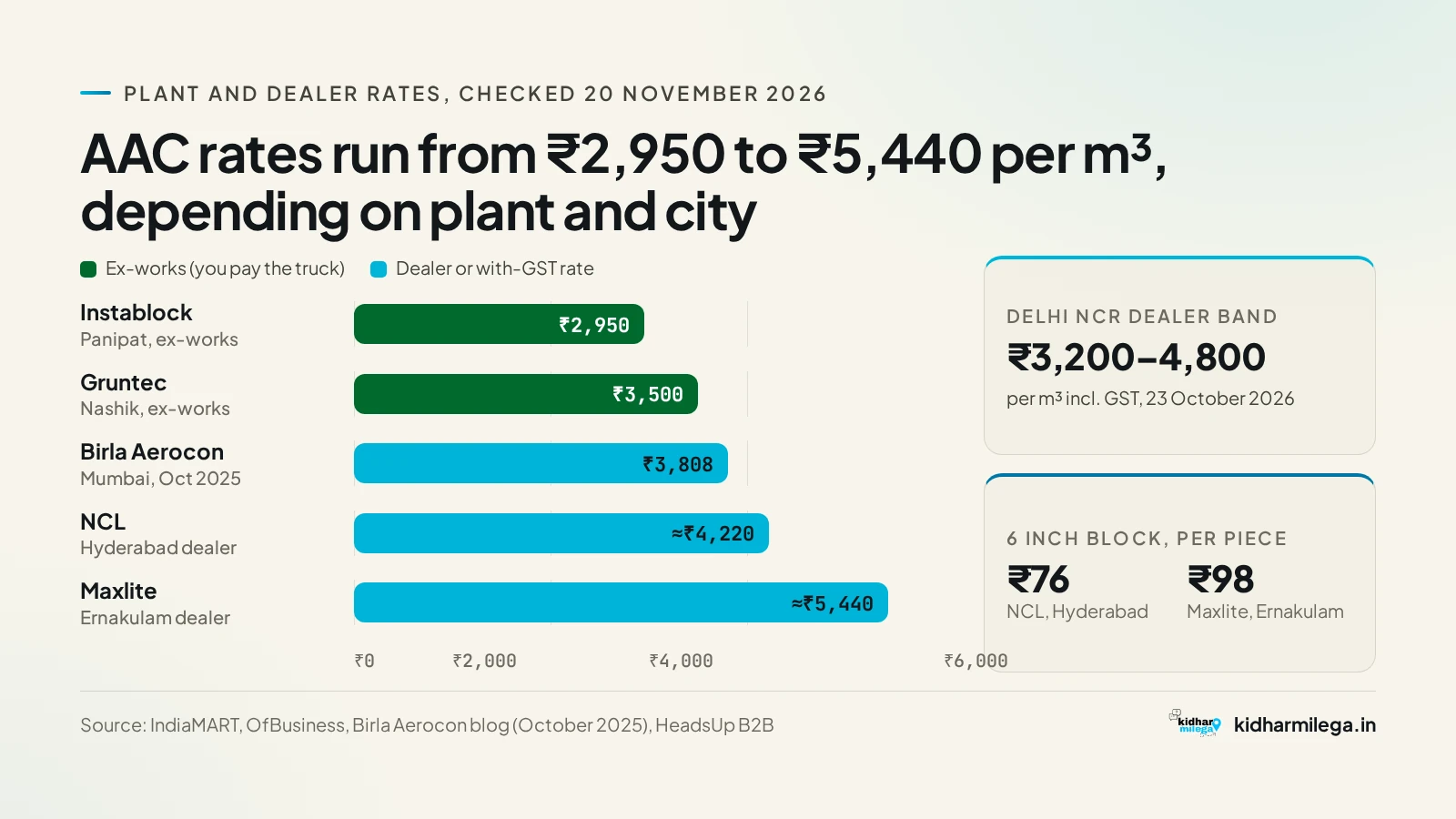
Neither Maxlite nor NCL publishes a price list. Both work through dealers, so every rate below comes from a dealer listing or a third-party price page. Treat these as starting points for bargaining, not as company prices.
| Brand | Maker and base | Rate found | Works out to | Where, and source |
|---|---|---|---|---|
| NCL | NCL Buildtek Ltd, Hyderabad. Plants in Telangana and AP | ₹76 per piece, 24×8×6 inch | ≈ ₹4,220/m³ | Hyderabad dealer, IndiaMART |
| Maxlite | Maxlite AAC Blocks (India) Pvt Ltd, Bengaluru. Magicrete-owned | ₹98 per piece, 6 inch, Grade 2, 4 N/mm², 650 kg/m³ | ≈ ₹5,440/m³ | Ernakulam dealer, IndiaMART |
| Magicrete | Magicrete Building Solutions (Maxlite's parent) | ₹3,500 to ₹4,000/m³ (company blog); about ₹4,500/m³ on IndiaMART | ₹63 to ₹81 per 6 inch block | Magicrete blog, September 2025 |
| Birla Aerocon | HIL Ltd | ₹3,400/m³ base, ₹3,808 with 12% GST | ≈ ₹69 per 6 inch block incl. GST | Mumbai, October 2025 blog rate |
| Instablock | Panipat plant | ₹2,950/m³ ex-works | ≈ ₹53 per 6 inch block | OfBusiness |
| Gruntec | Nashik plant | ₹3,500/m³ ex-works | ≈ ₹63 per 6 inch block | OfBusiness |
We found no dependable public rates for UltraTech Xtralite, JK Smartblox, BigBloc (NXTBLOC) or Infra.Market. Get written quotes for these brands. Infra.Market says it is India's largest AAC block maker by installed capacity. On 16 November 2026, Shalimar Paints' board approved a scheme to merge Hella Infra Market into Shalimar, and the AAC products will be sold as "Infra.Market AAC". The merger still needs its approvals, so for now this changes the brand name on the invoice, not the price per m³.
Maxlite AAC blocks: what you're actually buying
Maxlite AAC Blocks (India) Pvt Ltd was registered on 6 February 2019. Its office is in Byalahalli, Sarjapura Hobli, Anekal Taluk, Bengaluru. Magicrete bought a majority stake in March 2024. Maxlite's plants in Karnataka and Tamil Nadu have about 5 lakh m³ a year of capacity, which took the Magicrete group to 1.8 million m³ a year.
The ₹98 Ernakulam rate looks high next to NCL's ₹76, and it is. The most likely reason is freight. Ernakulam is a long truck ride from Maxlite's plants, and AAC is bulky. It is also a retail reseller listing and may not be current. In Bengaluru, close to the plant, you should expect a lower quote. One more warning: a website at maxlite.in exists, but its contact details point to a different company. Use the verified Maxlite page on IndiaMART or go through Magicrete directly.
NCL AAC blocks: specs worth checking
NCL's AAC blocks are made by NCL Buildtek, which belongs to a group that also runs about 4 MTPA of cement capacity. NCL publishes these specs: density 550 to 650 kg/m³, compressive strength above 4 MPa, thermal conductivity 0.16 W/m·K, 4 to 6 hours of fire resistance, ±1 mm dimensional accuracy, and BIS Grade 1 and Grade 2. For a quote, use the NCL Buildtek contact page (phone +91 6300 532 129). There is also an NCL-branded site at nclblocks.com, but as of November 2026 we had not been able to confirm it belongs to the company.
Maxlite or NCL? At the same grade and density, the brand matters less than how far the plant is from your site. In Telangana and AP, NCL usually lands cheaper. In Karnataka and Tamil Nadu, Maxlite usually does. Brand ka naam baad mein, plant ki doori pehle.
City rates we could verify (checked November 2026)
| City | Rate | Basis | Date of source |
|---|---|---|---|
| Delhi NCR | ₹3,200 to ₹4,800/m³ | Dealer, GST included | 23 October 2026 |
| Hyderabad | ₹76 per 6 inch block (NCL) | Dealer listing | Live listing, checked November 2026 |
| Ernakulam | ₹98 per 6 inch block (Maxlite) | Dealer listing | Live listing, checked November 2026 |
| Mumbai | ₹3,808/m³ (Birla Aerocon) | Base ₹3,400 + 12% GST | October 2025, so expect it to be higher now |
| Panipat | ₹2,950/m³ (Instablock) | Ex-works | Live price page, checked November 2026 |
| Nashik | ₹3,500/m³ (Gruntec) | Ex-works | Live price page, checked November 2026 |
For Bengaluru, Chennai and Pune, we found no dated public rate we would stand behind. If anyone gives you a "Bengaluru rate" without a date or a GST line, ignore it. Get three written quotes instead. Our free supplier finder lists verified manufacturers and dealers near you, so you can call plants and dealers within 100 km and compare.
Why two quotes for the same block differ by ₹1,000 per m³
Ask two dealers for "6 inch AAC" and you can get ₹3,300 from one and ₹4,300 from the other. Both can be honest. Most of the gap is in what the quote leaves out.
- Plant vs dealer price. An ex-works rate means you pay for loading and the truck. A dealer rate usually includes delivery and the dealer's margin.
- GST included or extra. At 12%, that alone is ₹408 per m³ on a ₹3,400 base.
- Freight. AAC is light but bulky, so a truck fills up long before it hits its weight limit. Freight per m³ rises steeply with distance.
- Order size. Plants and dealers price by the truckload. A full truck typically carries around 20 to 30 m³, depending on the vehicle. Ask what their truck holds. Part loads cost more per m³.
- Density grade and brand. Grade 1 and higher-strength blocks cost more.
- Unloading and breakage. Who pays the labour to unload, and who pays for broken blocks?
- Adhesive. Some quotes bundle block-jointing mortar. Others leave it out.
Here's the napkin math. On a 28 m³ order, every ₹100 per m³ is ₹2,800. A ₹1,000 gap is ₹28,000, which is roughly the cost of a door frame and a window.
Worked example: AAC blocks for a 1,000 sq ft 2BHK
Here is a single-floor 2BHK in an RCC frame, roughly 10 m × 10 m, costed line by line up to the delivered price. Change the numbers to match your own drawing.
Step 1: quantities
| Wall | Gross area | Less openings | Net area | Blocks (+3% wastage) | Volume |
|---|---|---|---|---|---|
| External, 8 inch (200 mm) | 40 m × 2.7 m = 108 m² | 15 m² | 93 m² | 775 + 3% = 798 | 19.15 m³ |
| Internal, 4 inch (100 mm) | 35 m × 2.7 m = 94.5 m² | 12 m² | 82.5 m² | 688 + 3% = 708 | 8.50 m³ |
| Total | 175.5 m² (≈ 1,889 sq ft) | 1,506 blocks | 27.65 m³, so order 28 m³ |
The 2.7 m height is the clear masonry height under the beam. AAC wastage usually runs under 2%, against 5 to 10% for red brick. We used 3% to stay on the safe side.
Step 2: the delivered cost
| Line | Working | Amount |
|---|---|---|
| AAC blocks | 28 m³ × ₹3,400 base | ₹95,200 |
| GST at 12% (fly-ash AAC) | ₹95,200 × 12% | ₹11,424 |
| Block jointing adhesive | Assumed 28 bags × ₹500. Check the coverage chart on the bag you buy | ₹14,000 |
| Freight, one truck | Assumed, local delivery within about 50 km | ₹6,000 |
| Unloading labour | Assumed | ₹2,000 |
| Delivered material cost | ₹1,28,624 |
That is about ₹68 per sq ft of finished wall area in material, across both thicknesses. Masonry labour and plaster are extra.
Now see what happens if the base rate is ₹4,000 instead of ₹3,400. The blocks plus GST rise to ₹1,25,440 and the total becomes ₹1,47,440. That is ₹18,816 more for the same house. This is why the quote checklist further down matters more than the brand name.
Want to run your own house? The calculator on this page takes your wall length, height, openings, thickness and quoted rate. It gives you the block count, the m³ to order and the delivered cost.
Is AAC cheaper than red brick? Per piece no, per wall often yes
Mera ek dost bolta hai, "Bhai, ₹68 ka ek block? Laal eent toh kuch rupaye ki hai." His logic is fair. Per piece, a brick is much cheaper. But one 6 inch AAC block covers the wall face of many bricks, so per-piece comparison is the wrong comparison. Compare per cubic metre of wall.
| Per m³ of wall | AAC block | Red clay brick |
|---|---|---|
| Units needed | 55.5 blocks (6 inch) | About 500 standard bricks |
| Jointing | Thin-bed adhesive, a few mm | About 0.25 to 0.30 m³ of cement-sand mortar |
| Weight | 550 to 650 kg | 1,600 to 1,800 kg |
| Wastage | Under 2% | 5 to 10% |
| Water absorption | 10% or less | 15 to 20% |
| Size accuracy | ±1 mm (NCL spec), so plaster can be thinner | Varies kiln to kiln, so thicker plaster is needed to level the wall |
Do this test with your own local numbers. Take your local brick rate, multiply it by 500, and add the cost of about 0.3 m³ of mortar. Compare that with about ₹3,808 plus one bag of adhesive for a cubic metre of AAC. Then remember the AAC wall weighs about a third as much, so your engineer can often trim the steel and concrete in the frame. The extra plaster on brick walls adds to brick's bill too. In most cities the total comes out in AAC's favour, even when the brick looks cheap on the invoice.
GST on AAC blocks: 12% or 18%?
It depends on how much fly ash is in the block.
- More than 50% fly ash: 12% (HSN 6815). The 55th GST Council meeting and CBIC Circular 247/04/2025-GST (14 February 2025) put fly-ash-based AAC under HSN 6815. From 22 September 2025, Notification 14/2025 (Rate) kept fly ash bricks, aggregates and blocks at 12%, split as 6% CGST and 6% SGST.
- Not meeting the fly ash threshold: 18% (HSN 6810), according to tax commentators.
Some secondary websites quote 5% or 18% for all bricks. Don't rely on them. Check the rate schedule on CBIC's GST rates page. Then ask your dealer to print the HSN code and the fly ash content on the invoice. The cement GST cut from 28% to 18% has not made AAC cheaper. Lime, fly ash, aluminium powder, autoclave energy and freight all cost more now.
If you're a dealer or a maker, getting the HSN wrong costs you real money: 6 percentage points on every invoice, plus interest if the department catches it later. Our wrong HSN code GST cost calculator shows you what that mistake would cost you.
Checklist: reading an AAC dealer's quote
These checks come from IS 2185 (Part 3) and the specs NCL publishes. Tick every line before you pay an advance.
- Density class written on the quote. It should fall between 551 and 650 kg/m³. If the quote just says "lightweight", that is not a spec.
- Compressive strength. At least 3 N/mm² under IS 2185. For external walls, ask for 3.5 to 4 or more.
- IS 2185 (Part 3) test certificate for the batch, not a brochure. The standard is published by BIS.
- Size tolerance. NCL claims ±1 mm. Measure five blocks when the truck arrives.
- AAC or CLC? CLC (cellular lightweight concrete) blocks are foamed and not autoclaved. They are cheaper and often sold as "AAC". Ask whether the block was autoclaved, and ask for the plant name.
- Manufacturing date. Fresh blocks still carry moisture. Ask when the batch was made.
- GST line and HSN code. 6815 at 12% or 6810 at 18%, plus the fly ash content.
- What the price covers. Ex-works or delivered? Loading and unloading? Breakage replacement?
- Truck size. How many m³ per truck, and the charge for a part load.
- Adhesive. Is it included? Which brand? How many bags per m³?
A quote that fails three or more of these lines isn't a cheaper quote. It is an incomplete one.
Thinking of starting an AAC block plant? Run this first
Construction season chal raha hai. October 2026 was BigBloc's best month ever. Every second WhatsApp group has a "AAC plant lagao, demand bahut hai" message. The demand is real. Now look at what one new plant cost.
On 29 October 2026, Lightbricks (KD Group) opened an AAC plant at Hapjan in Tinsukia, Assam, worth ₹55 crore, with about 2 lakh m³ a year of capacity (CemNet report, 9 November 2026). That is an autoclave, a cutting line, a boiler, lime and fly ash handling, and land.
The napkin math:
- PMEGP's maximum project cost for manufacturing is ₹50 lakh.
- ₹55 crore ÷ ₹50 lakh = 110. The Tinsukia plant is 110 PMEGP projects stacked together.
- Suppose a bank funds 75% of a ₹55 crore project. You still bring about ₹13.75 crore yourself.
- Against ₹2.5 to ₹20 lakh of savings, the gap is not small. It is a different business.
So a full AAC plant is a cement-company or group-company project. NCL makes AAC because it already runs a cement group. Maxlite was bought by Magicrete. Infra.Market's AAC business is now heading into a merger with a listed paints company. This is not a first-time founder's first project. Sapna galat nahi hai, bas pehla step galat hai.
What actually fits a ₹2.5 to ₹20 lakh budget
- AAC stockist or dealer in your district. One full truck of 28 m³ at ₹3,808 including GST is about ₹1,06,624 of stock. Add a small yard, a loader, and credit for contractors. Your profit is your margin per m³ × your volume. At 4 trucks a month (112 m³), every ₹100 per m³ of margin is ₹11,200 a month. Before you sign anything, talk to the brand's sales team to find out what margin they actually leave a dealer in your district.
- AAC laying and adhesive contracting. Builders want crews who know thin-bed jointing and lintel bands. You need very little capital, but you need skilled masons.
- Fly ash bricks and blocks, or a CLC unit. No autoclave is needed, so this is the version of the business that fits a PMEGP-size project. It also gets the same 12% GST treatment for fly ash products.
Some districts already have building-material clusters on their ODOP list, such as ceramic tiles and sanitary ware in Morbi, granite and marble blocks in Banaskantha and granite cutting and polishing in Bapatla. If you live in one of these districts, the builders and contractors who buy tiles and stone there are the same people an AAC dealer sells to. You don't have to find them from scratch.
How to finance it: PMEGP, CGTMSE, Mudra
- Udyam first. Register on the Udyam portal. It's free, and banks ask for it before almost any MSME scheme.
- PMEGP (apply on the KVIC e-portal). It fits a fly ash brick or CLC unit. Manufacturing projects up to ₹50 lakh get a 15 to 35% subsidy, and you put in 5 to 10% yourself. The catch: the bank must sanction your loan first, and the subsidy sits as a term deposit for three years before it is adjusted against the loan. Announcement hai, cheque nahi, until each of these steps clears.
- CGTMSE (cgtmse.in). It guarantees collateral-free loans for micro and small enterprises. The Union Budget 2025-26 announced a higher cover ceiling of ₹10 crore. Confirm the current limit and the guarantee fee with your bank, because the fee gets added to your cost.
- Mudra (mudra.org.in). Useful for dealer working capital. The Tarun Plus category goes up to ₹20 lakh for borrowers who have repaid an earlier Tarun loan.
Not sure which of these you qualify for? The KidharMilega scheme finder checks your profile against the central schemes in a few minutes. If you're taking a working capital line to fund dealer stock, run the interest on our MSME working capital loan cost calculator before you sign.
The catch nobody puts in the reel
- Builders pay late. A dealer who gives 60 days of credit is funding the builder's project with his own savings.
- Seasonality. October to March is busy. During the monsoon, trucks sit idle and stock sits in the yard.
- Input costs move against you. In November 2026, BigBloc flagged higher lime and coal costs. If you make blocks, your margin gets squeezed first.
- Breakage. AAC chips at the corners when handled roughly. Somebody pays for every broken block, and if your contract doesn't say who, it will be you.
- Freight decides your territory. If you are 200 km from the nearest plant, a dealer closer to the plant will beat you on price every time.
Wrong way vs right way
Galat tareeka: you pick a brand you saw on Instagram, pay an advance against a per-piece rate on WhatsApp, and find out about GST, freight and unloading when the truck arrives.
Sahi tareeka: you work out your m³ from the drawing, get three written quotes in ₹ per m³ that show GST, freight, unloading and adhesive as separate lines, check the IS 2185 certificate, and buy by the full truckload.
For a founder, it works the same way. Galat tareeka: buy a machine first, then look for buyers. Sahi tareeka: talk to 10 local builders and contractors first, ask how much AAC they buy each month and who supplies them now, and only then decide between a dealership and a unit.
Toh karna chahiye ya nahi?
If you're building a house: AAC makes sense for most RCC-frame homes. Use 4 inch inside and 8 or 9 inch outside, and buy from the plant closest to your site, whatever the brand. In Telangana and AP, start with NCL. In Karnataka and Tamil Nadu, start with Maxlite or Magicrete.
If you're a first-time founder: don't start with an autoclave plant. Start as a dealer or with a fly ash or CLC unit in your own district, where you know the builders by name. Do this only if you can handle 60-day credit cycles. If you can't, skip it and keep your savings.
Your next step, before you place an order
Measure your walls, put the numbers into the calculator on this page, and take the m³ figure to three suppliers. If you're asking about the business side, list the 10 biggest builders within 50 km of your home and call them. Ask what they pay per m³ of AAC and who delivers it. Those 10 calls will tell you more than any project report.
Still deciding what to build? Take the 3-minute quiz on the KidharMilega homepage and see ideas that fit your budget and your district. Bheed ka hissa nahi, kissa bano.
Frequently asked questions
What is the price of a 6 inch AAC block?
A 6 inch (600 × 200 × 150 mm) AAC block costs about ₹58 to ₹86 per piece including GST, based on Delhi NCR rates of ₹3,200 to ₹4,800 per cubic metre in October 2026. Dealer listings show NCL at ₹76 in Hyderabad and Maxlite at ₹98 in Ernakulam. To convert any quote, divide the rate per m³ by 55.5.
How many AAC blocks are there in 1 cubic metre?
Divide 1 by the volume of one block. A 4 inch block is 0.012 m³, so about 83 make one cubic metre. A 6 inch block is 0.018 m³, about 55.5 per m³. An 8 inch block is 0.024 m³, about 42 per m³. A 9 inch (225 mm) block gives about 37 per m³.
Which is better, Maxlite or NCL AAC blocks?
At the same density grade and compressive strength, the closer plant usually wins on price. NCL is made by NCL Buildtek in Telangana and usually lands cheaper in Telangana and Andhra Pradesh. Maxlite is Bengaluru-based and Magicrete-owned, with plants in Karnataka and Tamil Nadu. Whichever you pick, ask for the IS 2185 test certificate and the density class.
What is the GST rate on AAC blocks?
AAC blocks with more than 50% fly ash attract 12% GST under HSN 6815, as clarified by CBIC Circular 247/04/2025-GST and kept at that rate by Notification 14/2025 from 22 September 2025. AAC blocks that don't meet the fly ash threshold fall under HSN 6810 at 18%. Ask your dealer to show the HSN code on the invoice.
How many AAC blocks do I need for a 100 sq ft wall?
Each block's face is 600 × 200 mm, or about 1.29 sq ft. A 100 sq ft wall therefore needs about 78 blocks of any thickness, plus 2 to 3% for wastage, so order around 80. Thickness changes only the volume, and so the cost, not the number of blocks. Subtract door and window openings first.
Is AAC block cheaper than red brick?
Per piece, no. Per wall, often yes. One cubic metre of wall needs about 55 six-inch AAC blocks with thin adhesive, against about 500 bricks plus 0.25 to 0.30 m³ of mortar. AAC also wastes under 2% against 5 to 10% for brick, needs thinner plaster and weighs about a third as much, which can reduce structural steel.
Sources
- CBIC GST rate notifications · Central Board of Indirect Taxes and Customs
- AAC Block Price and Size Guide · HeadsUp B2B
- AAC Blocks Prices · OfBusiness
- Maxlite AAC Block · IndiaMART
- Lightbricks opens INR550m AAC block plant in India · CemNet
- Shalimar Paints to transform into Rs 19,839 crore building materials company through Infra.Market merger · DSIJ
- AAC Blocks Guide · Magicrete
- Autoclaved AAC blocks classified as cement concrete building products under GST · StudyCafe